
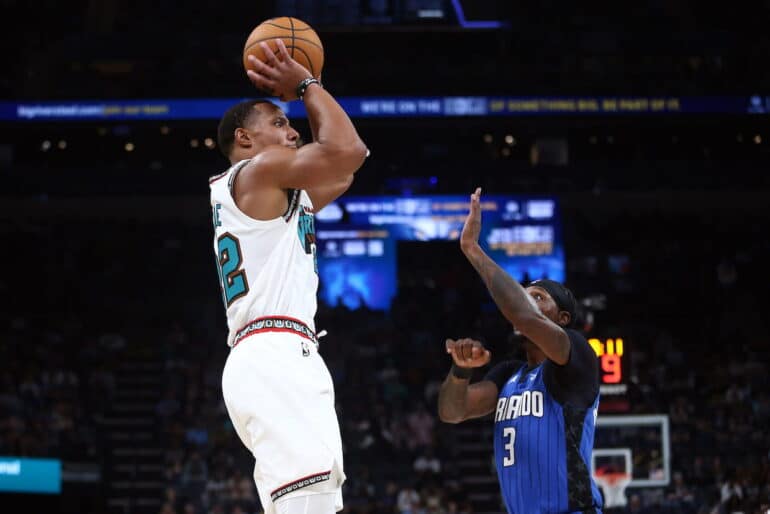
The basketball world was met with the shocking news Sunday when it was reported the Memphis Grizzlies were trading their homegrown star, Desmond Bane, to the Orlando Magic in exchange for Kentavious Caldwell-Pope, Cole Anthony, their 2025 first-round pick (16th overall), three unprotected first-round picks and one lightly protected pick swap.
Since the deal was announced, many folks have harped about whether the Magic overpaid for Bane. While four first-round picks may seem like a lot for a player who’s never made an All-Star Game, the Magic’s decision to sacrifice so much makes a lot more sense when you fully zoom out.
Bane Fits Perfectly With Orlando’s Core
Over the last two years, the Magic have been an elite defensive team — second in defensive rating each year — held down by their offense, which finished bottom 10 in offensive rating both times.
Their offense struggles so mightily in large part because of poor spacing. Last season, they were 30th in 3-point percentage. Bane represents the best 3-point shooter Paolo Banchero and Franz Wagner have ever played with, shooting 41 percent from downtown on 6.3 attempts per game for his career.
Spacing alone can’t cure the Magic’s offensive woes. Along with their shooting troubles, they were also sorely lacking in on-ball creation, finishing second-to-last in effective field goal percentage on pull-up jumpers last year (per NBA.com).
Bane started out his career as a pure spot-up specialist. But since then, he’s transformed himself into a credible on-ball scorer. And as as his frequency of unassisted field goals has grown, his true shooting efficiency has remained relatively the same — a sign he can handle more offensive responsibility without his impact diminishing.

Bane will likely be the weakest defender in Orlando’s starting lineup, but that doesn’t mean he’s a slouch. He won’t wow with steals or blocks, yet holds his own as a solid team defender. During his five years with Memphis, the Grizzlies posted a top-10 defense four times. So, Bane amplifies the Magic’s offense with his ability to play on or off the ball while also helping them maintain their defensive identity.
The Magic Paid For More Than Just Bane
Many talks about this deal are framing it as Orlando solely moving first-round picks to acquire Bane. But that’s not entirely correct.
Remember, one of the players the Magic traded away was Caldwell-Pope, who is fresh off the first year of a three-year, $66 million deal. Caldwell-Pope is still a starting-caliber player, but he is 32 and coming off the worst season of his career. There’s a chance the last two years of his contract could age poorly, so Memphis had to factor that into the price it charged Orlando.
Anthony is still a solid option off the bench, but even he is slightly overpaid. He’ll be making $13.1 million dollars each of the next two years, while my formula estimates his on-court value around $8.4 million. Not only is Orlando landing Bane, but they’re getting off two suboptimal contracts.
The Magic are also paying to avoid parting ways with players like like Jalen Suggs, Anthony Black, Tristan Da Silva, Jonathan Isaac and Jett Howard. As it stands, all five of these tantalizing rotational pieces will get to grow alongside the core trio of Bane, Banchero and Wagner.
The Market Determines Value
The value of trades are determined by the time and financial landscape of the league when the deal is being done.
Earlier, I mentioned Bane has never been an All-Star. Still, among his shooting, burgeoning on-ball creation and sound defensive effort, he’s the closest thing one can be to an All-Star without actually being one.
Desmond Bane 49 PTS on 19/31 FG pic.twitter.com/Lq6MT5oOVf
— Brett Usher (@UsherNBA) June 15, 2025
The last time a player of this perceived caliber was traded under the current Collective Bargaining Agreement (CBA) was last summer with Mikal Bridges joining the New York Knicks. In that deal, the Knicks parted ways with four unprotected firsts, a pick swap, a protected first, a second-round pick and salary filler in Bojan Bogdanovic.
Caldwell-Pope and Anthony are better players than Bogdanovic. So, the salary filler the Magic gave up here is more valuable. However, they didn’t have to include a first-round pick swap or a second-round pick to get Bane. At the very least, the Magic gave up just as much for Bane as the Knicks did for Bridges.
Sending out four first-round picks is a lot to swallow for any player, let alone someone not considered a conventional superstar. But Bane complements the Magic’s stars perfectly, allows them to keep their core intact and didn’t cost more than his fair market value. When you look at it from that perspective, Orlando did a great job negotiating this trade.