
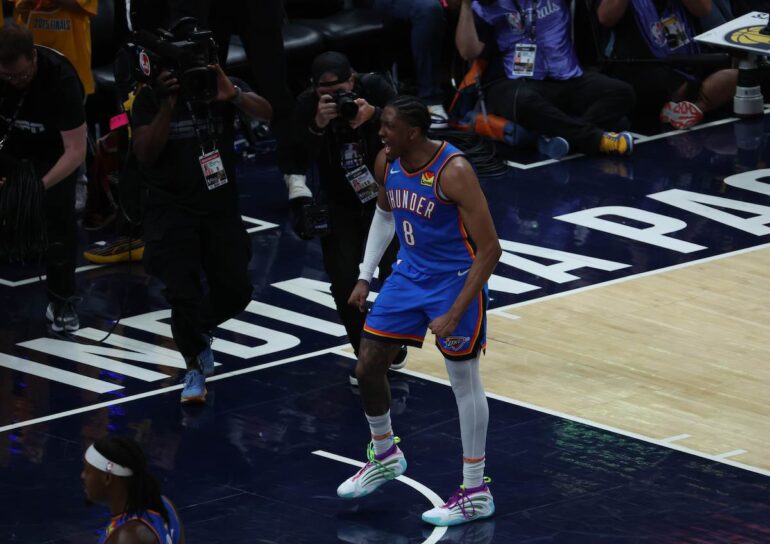
As the Oklahoma City Thunder rampaged through a 68-win season, brandishing a historic defense and point differential, one major theme defined questions about their championship prospects. Did they have enough offensive juice behind Shai Gilgeous-Alexander?
Although Gilgeous-Alexander is among the league’s preeminent scorers and offensive talents, capable of backpacking a titanic usage and metronomically spitting out efficient 30-point games, justifiable worries about the supporting cast persisted.
A year ago, he averaged 32.0 points on 60 percent true shooting in a six-game, second-round defeat to the Dallas Mavericks. Meanwhile, his co-star, Jalen Williams, averaged 17.0 points on 50.8 percent true shooting and struggled to consistently generate high-level scoring volume against Dallas’ sprawling defense. Oklahoma City’s offense faltered, scoring just 111.8 points per 100 possessions (118.3 during the regular season).
For as supreme as the Thunder and Williams were this regular season, those concerns didn’t dissipate. Williams still authored some clunkers facing playoff-caliber defenses (as well as a handful of excellent showings) and Oklahoma City’s offensive diversity lacked at times beyond Gilgeous-Alexander.
Even into the playoffs, questions remained and Williams didn’t fully quell them. Consternation peaked when he scored six points on 3-of-16 shooting in a Game 6 loss to the Denver Nuggets, pushing him and the Thunder to a do-or-die Game 7.
During the first six games of that series, he averaged 16.5 points on 45 percent true shooting — a prominent reason Denver hung around as long as it did. Since then, the Santa Clara product has been stellar, averaging 24.0 points (58.4 percent true shooting), 6.0 rebounds, 4.5 assists and 1.4 steals in the ensuing 11 games.
Starting with Game 3 of the NBA Finals, though, Indiana opted to truly test whether Williams could effectively scale up his usage if Gilgeous-Alexander was quieted. Andrew Nembhard began face-guarding Gilgeous-Alexander all 94 feet, denying him the ball, paying rent inside his jersey, greeting his touches with brash physicality and neutralizing off-ball screens designed to spring free the MVP. When Gilgeous-Alexnder tried to burn Nembhard’s overplays with back-cuts, he corralled those, too.
Space for Gilgeous-Alexander was at a premium, if it even existed anymore. Fewer and fewer possessions started as Oklahoma City was accustomed during his minutes, with a slew of other ball-handlers initiating plays.
Chief among those stepping in for Gilgeous-Alexander has been Williams, who is absolutely thriving and playing the best basketball of his young career in the biggest games of his young career. Compared to Games 1 and 2, his touches (69 vs. 63), time of possession (6.0 vs. 3.9) and average seconds per touch (5.19 vs. 3.73) have all spiked in Games 3-5, reflective of grander offensive duties.
Over those outings, he’s averaging 31.0 points on 61.2 percent true shooting, coalescing with Monday’s Game 5: a 40-point detonation (67 percent true shooting) to power Oklahoma City past Indiana, 120-109, toward a 3-2 series lead and within a game of the title.
Given the Thunder’s longstanding reliance on Gilgeous-Alexander offensively, it is, without context, hard to conceive them going 2-1 across a three-game stretch in the Finals where Williams outpaces his All-Star running mate in usage rate (32.1 vs. 30.7 percent) and touches per game (69 vs. 61).
Such an outcome would feel like a win for the Pacers and their scheme. But it’s precisely what’s transpired. Williams has been that good, while Gilgeous-Alexander (averages of 30 points, five assists, 57.5 percent true shooting) hasn’t relented against Indiana’s fleet of domineering defenders, led by Nembhard.
Throughout this series, Oklahoma City has produced minimal long-range volume, finishing in the 16th percentile or lower in 3-point volume four out of five times, including the second and zeroth percentiles during Games 3 and 4, per Cleaning the Glass. Numerous factors are responsible, featuring Gilgeous-Alexander’s midrange affinity, limited on-ball passers, hesitant shooters and the Pacers’ defensive ethos wired to suppress threes (fifth-lowest opponent 3-point rate in the regular season).
They’re selective in crashing on drives, helping from the strong-side and tagging pick-and-rolls. It bogs down opposing offenses and keeps themselves out of rotation. Yet that strategy is also benefitting Williams, whose leaky handle is less cumbersome on his downhill attacks without fear of navigating extra bodies or pesky hands poking at his dribble. He can instead focus on leveraging his size, strength and length, all boons of his slashing arsenal:

In both efficiency and totality, Williams has become a monstrous driver the past three games. Across his first 18 playoff games, he averaged 13.5 drives, shot 46.4 percent on them and scored 7.9 points from them. These last three contests, he’s logging 16.7 drives, shooting 58.6 percent on them and scoring 15.3 points from them, according to NBA.com.
Gilgeous-Alexander led the regular season in points per game via drives (15.5). Giannis Antetokounmpo leads the playoffs (15.2). Williams, who’s realized what Indiana’s defensive environment affords him and taken full advantage, is nestled between those bench-setting tallies during this brief stretch.
Since the start of Game 3, the third-year forward touts a 38 percent rim frequency and is making 74 percent of his shots there. He’s also sporting a gargantuan .557 free-throw rate. His 12 free-throw attempts in Game 5 set a new career-high, and the 11 attempts of Games 3 and 4 tied the previous top mark of his career. Similarly, his 13 field goals at the rim in Game 5 tied a career-high.
Regularly playing 4-on-4 with Nembhard (or whoever) face-guarding Gilgeous-Alexander, Williams is seeing ample space to operate, often free from the stress of decoding help awaiting him.
Imposing his 6-foot-6, 220-pound frame and 7-foot-2 wingspan, he’s flourishing against ill-suited defenders, unafraid to seek contact while periodically downshifting to find angles and compromising spots inside. He’s been a foul magnet Indiana is thus far unable to stymie downhill without conceding free throws or shots at the basket.
The Pacers are also yet to solve Oklahoma City’s high, early picks as a response to their backcourt pressure. Coverage is routinely botched, Isaiah Hartenstein is a premier screen-setter rescuing ball-handlers and Williams is coasting to the cup with runways like these (note the absence of help from Indiana):

Even in the half-court, though, Williams is succeeding as a lead creator. He’s showcasing the patience necessary to maneuver inside the arc while applying his foremost tools — strength and length — as a finisher. His poise operating on the interior, particularly when playing off of two feet, has not always been a superlative of his game — beset by an erratic cadence and wobbly balance.
In this series, poise has been integral to his approach. He’s setting up drives with discreet pacing, deceptive footwork and loping strides, more comfortable playing slowly and maintaining a live dribble south of the 3-point line. Composure inside the arc is a trait found in basically every star-level offensive player, and Williams is exuding it. Indiana’s defensive style surely simplifies these efforts, but Williams himself is adapting and growing.
Long-term, this evolution is his path to greater on-ball scoring volume and efficacy. Regardless of whether it translates moving forward, the most salient point right now is where it’s led Oklahoma City: to the brink of a championship.
Midway through this series, with Indiana landing on a wrinkle to at least bother the MVP for stretches, Oklahoma City required Williams to level up. There could be no more 3-of-16 nights stuck in the doldrums of single-digit scoring or calling the mid-teens home. The All-Star and All-NBA wing had to adjust and deliver. So, he did, with two wonderful performances followed by a career-defining, drop-the-mic Game 5.
There has never been a better time for Williams to be at his best. The 24-year-old’s NBA future presumably contains higher peaks than the past five days, but nearly everything before then did not. He is amending his game to meet the moment, and sits one win away from resolutely answering all those pertinent questions which have confronted him and the Thunder the past 13 months.