
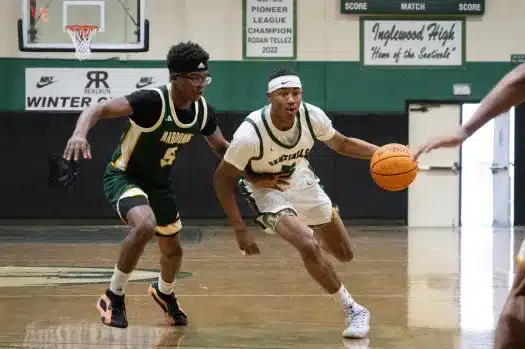
In a surprising change of circumstances, the Missouri Tigers are front-running for 2026 five-star guard Jason Crowe Jr., according to On3’s Joe Tipton. Multiple reliable sources corroborated Missouri’s pursuit of Crowe Jr., as 247 Sports predicts the Tigers to land the Lynwood, California product when he commits on July 18th.
Composite rankings from 247 Sports places Crowe Jr. sixth among all prospects in the 2026 high school class. Missouri hasn’t brought in a five-star recruit since Michael Porter Jr. and Jontay Porter in 2018, making Crowe Jr. the program’s possible biggest-name recruit in seven years.
The listed-6’3 (but probably a tad shorter) combo guard is one of the most talented scorers in the country and has dominated defenses since his freshman season. He’s currently playing on the EYBL circuit with Oakland Soldiers and averaged 23.2 points, 4.6 rebounds and 2.7 assists on 54.1% true shooting. Through his first 11 games, Crowe Jr. leads all 17u players in scoring on the EYBL circuit.
How does Crowe thrive on offense?
Off-dribble shooting is Crowe Jr.’s primary scoring weapon, as he turns to his pull-up jumper more often than most players at this level. Across 29 games over the last two years, Crowe Jr. converted a phenomenal 49.5% (46-93) of his off-dribble mid-range jumpers. He’s a buttery smooth shotmaker who flows from his dribble to a shot from multiple platforms at every spot on the floor.
jason crowe jr made an absurd 49.5% of his pull-up mid-range jumpers across his last few hs/aau seasons (29 games), he’s a nutty shotmaker
crowe has plenty of room to grow in a lot of areas, but he’s a truly ridiculous off-dribble shotmaker pic.twitter.com/ggm5yz36O9
— ben pfeifer (@bjpf_) July 10, 2025
Crowe Jr.’s raw 3-point numbers don’t paint him as a promising shooter — he made just 25.3% (21-83) of his triples so far in this EYBL season. He hasn’t extended his mid-range efficiency to beyond the arc, converting 29.2% (33-113) of his pull-up threes in that same 29 game sample. When Crowe Jr. sets up off the ball, his efficiency spikes (38.2% on 68 catch-and-shoot threes).
A challenging shot diet depressed Crowe Jr.’s raw efficiency, as he spends much of his time as an isolation or pick-and-roll creator without much off-ball movement. Most young guards aren’t efficient pull-up 3-point shooter, but his mid-range efficiency projects favorable shooting growth down the line. Crowe Jr.’s excellent touch helps him score at the basket (59.1% at the rim), but his lack of vertical explosiveness and size might beget translation issues.
Where can he improve?
Part of Crowe Jr.’s off-dribble efficiency stems from his decision making and shot selection, which are far more notable concerns than the numbers themselves. Life on the court increases in difficulty as a shorter guard without great passing vision and Crowe Jr. isn’t a prolific playmaker. He’s averaging a pedestrian 2.7 assists per game (0.7 assist-to-turnover ratio) in this EYBL season.
Digging deeper into his passing numbers causes a bit more concern for his projection. Crowe Jr.’s assist-to-turnover ratio drops in the half-court (0.5). Most of Crowe Jr.’s ball screens result in shots, as he hunts favorable matchups and space to rise up for off-dribble jumpers. At the high school level, his passing warts aren’t as impactful, but Crowe Jr.’s struggles as a passer will pop up more at the college level and especially in the SEC if he ends up as a Tiger.
passing will be a major swing skill for jason crowe jr at the college and pro levels — he’s wired to score, leading to fairly low passing volume
he has some flashes against pressure/big window interior passes, but he’s at 1.4 hc assists per game (0.5 a:to) so far in EYBL pic.twitter.com/rsScIWjOTH
— ben pfeifer (@bjpf_) July 10, 2025
High school and AAU defenses will often blitz and trap Crowe Jr., forcing him to evacuate the ball and make his teammates score and create. While he’s comfortable kicking back out to the perimeter and firing simple passes against pressure, he doesn’t often punish aggressive defenses with splits and high-value layup passes.
It’s reasonable to argue that Crowe Jr.’s passing levels out on a more talented team with better play finishers, creators and shotmakers around him. A decreased offensive load could help boost his defense, which mostly leans on his solid foot quickness and hip mobility to guard the ball. Though Crowe Jr. isn’t an active off-ball defender at this stage, a college ecosystem should help him improve marginally on defense.
We won’t know exactly what Missouri’s roster will look like in 2026. If head coach Dennis Gates does land Crowe Jr., he’ll have plenty of time to mold his roster around him. A strong season could see him spending just one year in Columbia, but his arrival would mark the highest-profile commitment for the Tigers in nearly a decade. That’s worth plenty of excitement, even with his areas of improvement.