
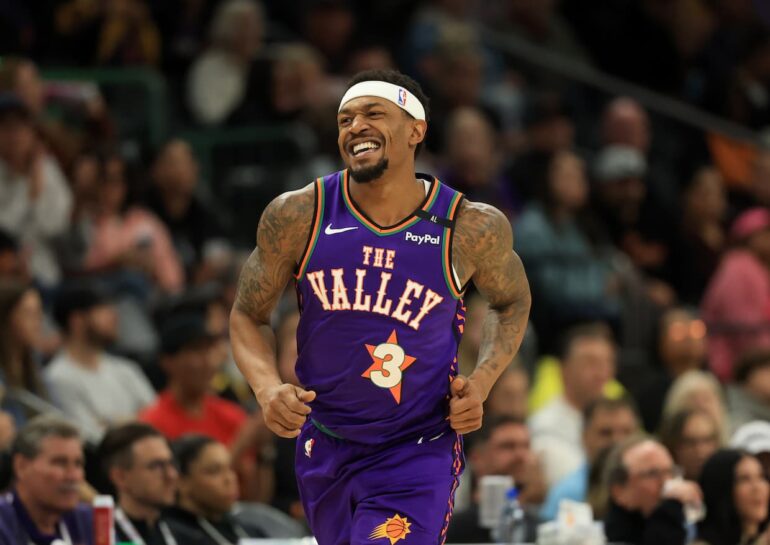
With a buyout between Bradley Beal and the Phoenix Suns looming, many people are wondering where the former three-time All-Star will end up next. However, the real question we should be asking is just how much the 32-year-old swingman has left in the tank.
Just waiting on that Suns Beal buyout news to drop.. pic.twitter.com/MvggOZ53tj
— Gabe Guerrero (@GabeGuerrero03) July 8, 2025
Why Things Went Wrong In Phoenix
It’s no secret he’s not lived up to the five-year, $251 million deal he signed during the 2022 offseason. Last year, based on a formula I’ve constructed, Beal’s contract ranked as the worst in the Association.
Of course, that chart misses some key context. The 2024-25 Suns may have been the worst possible context for Beal’s specific set of skills. As I’ve discussed in the past, you want teams which are talented, but you also need them to be balanced.
The Suns were flush with talent, but below the poverty line when it came to lineup cohesion. Phoenix had not one, but two, other players (Devin Booker and Kevin Durant) with nearly identical skill-sets to Beal’s. And no offense to Beal, but Booker and Durant were better versions of the archetype, making his strengths less valuable to the team.
Since so much of their cap space and available minutes were tied to those three, it was difficult to field versatile complementary players who could mask Beal’s weaknesses. However, this isn’t to say Beal was completely innocent in what went wrong with Phoenix. His nagging injuries and inability to transition to more of a three-and-D role greatly hurt the Suns.
What Beal Can Offer To A Contender
Just because Beal couldn’t flourish as a max player in the worst possible ecosystem for his skills doesn’t mean he’s without anything to offer a winning team.
For instance, he can still get a bucket from any part of the floor. In 2024-25, Beal shot 66 percent at the rim, 48 percent from midrange and 38 percent from three — making him one of seven players to hit those efficient benchmarks (per StatsPass).
Beal has also done a good job accommodating his star teammates and ensuring not all his buckets come from self-generated looks. Last year, 62.3 percent of his field goals were assisted, his highest mark since 2014-15, when he was still sharing a backcourt with John Wall.
Another reason the Suns never lived up to the hype is they never had a strong setup artist to help create opportunities for their on-ball/off-ball hybrid scorers. But just because Beal could never fill this void doesn’t mean he’s not a serviceable secondary creator alongside a strong floor general. Advanced measures of passing and playmaking paint him as above average in those categories, as he ranks in the 66th percentile in Passer Rating and the 83rd percentile in Creation (an estimate of a player’s ability to create open shots for teammates).
Beal’s defense has never been a calling card of his and it seems to keep getting worse with each coming season. Fortunately, a good chunk of defense is about effort, which tends to improve while playing on a competitive roster (in theory, Beal should be selecting a good team as his next employer, right?). Plus, Beal is a solid defensive playmaker, sitting in the 79th percentile in Regularized Adjusted Defensive Turnovers.
According to CraftedNBA’s Similarity Score metric, Beal’s statistical profile was comparable to guys like Jordan Poole, CJ McCollum, Ty Jerome and Collin Sexton. All are combo guards not asked to anchor their respective offenses (with the exception of Poole on the downtrodden Washington Wizards) but can provide a meaningful jolt when really dialed in. In a different situation, with a more compatible roster, Beal can be effective in this role.
Production Is Tied To Perception
Often, our perception of a player is largely tied to how much money they make. Beal was not a bad player last season, but because he was one of the highest-paid players in the league, everyone thought he was awful.
What he did last year was not befitting of a max player. We can all agree on that. But if he played the exact same way he did in 2025-26, Beal would look more like an $8.7 million player (per my formula for estimating production value), which is a little more than his next team is likely to pay him (his veteran’s minimum deal is $3.6 million dollars for 2025-26).
That would mean Beal, arguably on the NBA’s worst contract in 2024-25, still has the ability to bring positive value for the right price.