
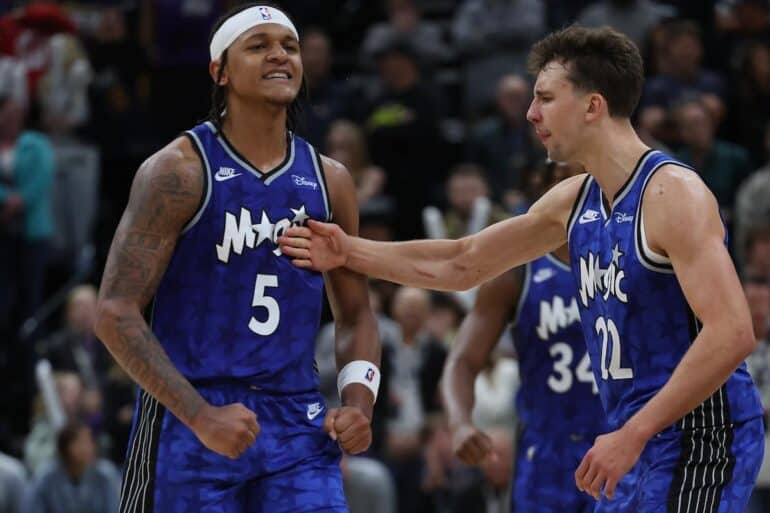
Trading star players for four-to-six first-round picks and a collection of prospects has been a feature of the last few NBA offseasons. The Orlando Magic tossed their hat in to the trend by trading for the Memphis Grizzlies’ star Desmond Bane, sending out Cole Anthony, Kentavious Caldwell-Pope and a generous pile of future draft picks.
After promising yet injury-riddled seasons from Paolo Banchero and Franz Wagner, the Magic suffered a second straight first-round loss this past spring. Injuries to multiple top Eastern Conference stars widen the playoff field for 2025-26. The Magic, which added Bane to a top-two defense last season, are poised to compete with any team in the East next year.
Even after trading for Bane, Orlando likely lacks the talent to scrap with Western Conference titans like the Oklahoma City Thunder, Denver Nuggets or Houston Rockets. Bane provides a critical third offensive star. Its range of recent draftees, notably Anthony Black, Tristan Da Silva, Jase Richardson and Noah Penda, bolstered an already deep roster beyond the stars.
Ascending to title contention would require Banchero or Wagner to develop as a strong primary offensive engine. Before his oblique injury in December, Wagner was playing like an All-NBA star, boasting the efficient off-dribble scoring, passing and defense of an elite wing player.
His 3-point shot still creates obstacles to his lead offensive viability. Wagner made below 30 percent of his threes across the last two seasons and fewer than 30 percent of his off-dribble threes over the past three years. Despite incredible slashing and passing prowess, his shooting limitations have led the mainstream consensus toward Banchero as Orlando’s long-term primary creator.
The Next Steps For Paolo Banchero
On the surface, Banchero profiles like an ascending superstar; the 6-foot-10, 22-year-old averaged 25.8 points, 7.5 rebounds and 4.8 assists per game last regular season. During five playoff games against the Boston Celtics, those averages ballooned to 29.4 points, 8.4 rebounds and 4.2 assists. Yet Orlando’s offense ranked 26th in the league, with long stretches near the bottom.
Poor health and outside shooting were the main detriments. Orlando ranked 21st in 3-point frequency (36.6 percent) and 30th (32.2 percent) in accuracy. Trading for one of the league’s best shooters should automatically boost his new team’s 3-point threat. Bane won’t guarantee the Magic and Banchero’s major decision-making and half-court creation issues improve, though.
To this point, Banchero hasn’t captained efficient offenses as a lead creator. Across his three NBA seasons, lineups with Banchero and Wagner on the floor posted an offensive rating 2.9 points below league average. When Wagner rides the pine, those Banchero-led lineups mustered an offensive rating 4.2 points below league average.
Inserting Bane’s off-ball spacing, gravity and secondary playmaking next to Banchero should help boost the Wagner-less groups. A great complementary player like Bane should amplify Banchero’s ball-dominant style. Though Banchero has undeniable passing talent, his decision-making and offensive process must mature significantly.
Banchero’s efficiency has improved each year of his career, but he’s still scored on efficiency 2.4 points below league average last season (55.2 percent true shooting). His 33.1 percent usage rate ranked fifth in the NBA last season. He spent 31.1 percent of his minutes with the basketball, ranking in the 91st percentile league-wide.
Despite immense offensive talent, his penchant for tough midrange jumpers caps his team’s offensive ceiling. He struggles to add value without the basketball, limiting his value alongside other great players. Banchero doesn’t maximize his herculean frame to create efficient offense; he attempted 31 percent of his shots at the rim last season, placing him in the 24th percentile among players classified as “bigs” by Cleaning the Glass.
paolo banchero must improve his on and off ball process to become a contending-caliber initiator and boost his creation efficiency. he leaves far too many rim attempts and high-value passes on the table
hopefully bane can help him become that guy, orlando's ceiling depends on it pic.twitter.com/djchsQqA9r
— ben pfeifer (@bjpf_) July 21, 2025
How Desmond Bane Can Help Offensively
The Magic brought in Bane to relieve some pressure from their fledgling star initiator. He’s one of the NBA’s more underrated players. Though he hasn’t made an All-Star Team, he’s placed in the 89th percentile or higher in Estimated Plus-Minus each of his last four seasons.
Through no fault of his own, Bane moved away from his bread and butter off-ball scoring over the last two seasons — the result of injuries in 2024 and a radically different offensive system in 2025. A spacing-needy Magic offense could revert him back to a role closer to 2023, when Bane spent less time on the ball. Regardless, he’s been remarkably consistent the past three seasons, (bouncing back from a slower start last year), averaging 21.1 points, 5.0 assists and 5.3 rebounds on 59.9 percent true shooting while making 39.4 percent of his threes.
It shouldn’t take much tinkering to feature Bane in advantageous play types Orlando hasn’t recently accessed. The Magic ranked 24th in handoffs per game (4.4) last season and ran even fewer in their playoff series against Boston (1.8). Bane’s presence should help remedy an often stagnant Magic offense beset by insufficient horizontal movement.
When Orlando added quick pin-down screens and pitches, like on the play below, it manufactured some much-needed space. Even as a shaky off-ball player, Banchero capitalized on the space Wendell Carter Jr. generated to draw free throws. Bane’s ability to shoot effectively off the catch and pass on the move makes this action much tougher to guard:
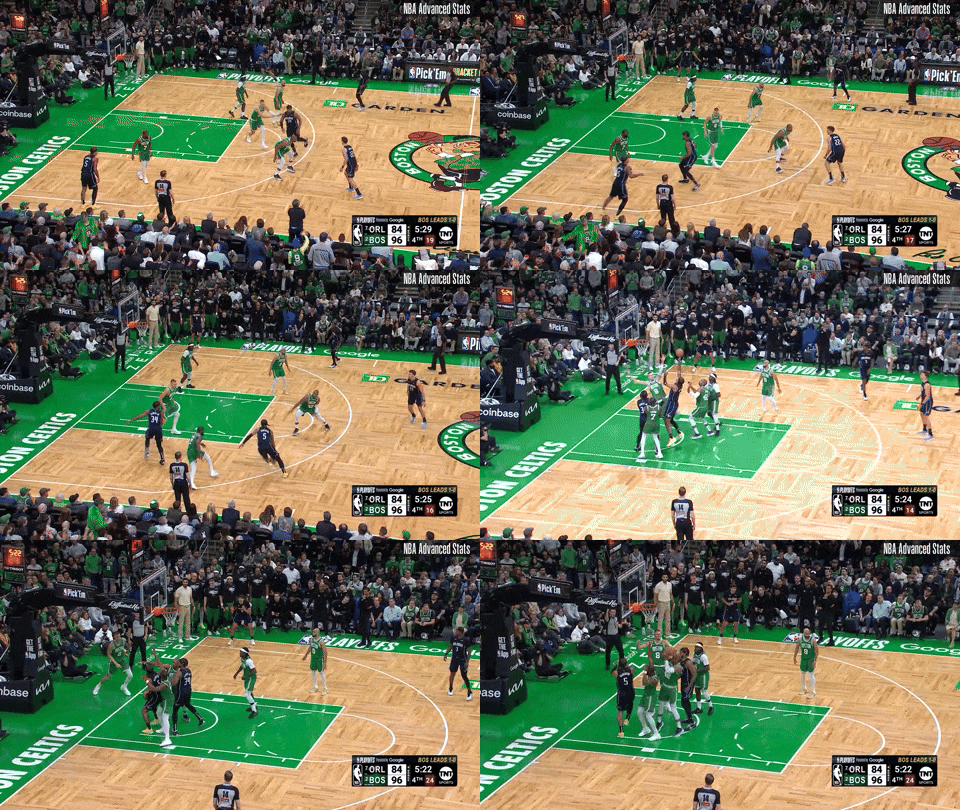
On a possession like the one above, Bane could also replace Wagner, which might dissuade Al Horford from pinching in to cover the drive. Bane could even screen for Banchero and pop to the corner, removing Kristaps Porzingis’s help at the rim. The theoretical optionality Bane brings to a random possession extends across Orlando’s entire offense.
Orlando’s offense didn’t entirely lack fruitful ideas; rather, it lacked pace, urgency and execution. Below, Banchero sets a rip screen for Caldwell-Pope in early offense, which opens space for Banchero, but Cory Joseph doesn’t look that way. Boston doesn’t bite on Joseph flaring off of Carter’s screen, leading to an inefficient Banchero pull-up three:
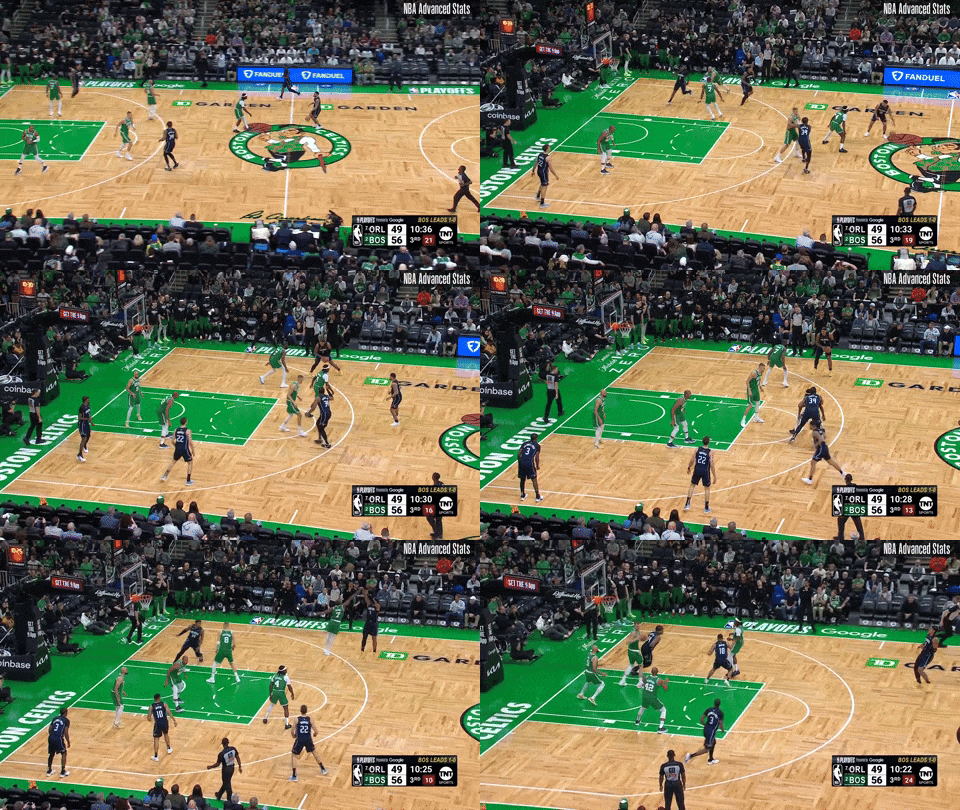
The Magic consistently failed to capitalize on openings in early offense, with countless examples like the clip above littered throughout their film. Orlando ranked 30th in average time per possession (15.4 seconds) last season, rarely pushing the ball even after missed shots or turnovers.
Memphis ran the third-fastest offense (13.3 seconds) in the NBA in 2024-25, partly fueled by Bane’s transition gunning and early driving. Raw pace and offensive success aren’t strongly correlated; slow but potent offenses like Boston or the New York Knicks (both 15.2 seconds) rely on elite creators and shooters setting up in the half-court.
Offensively challenged teams like Orlando, which lacks reliable half-court creation, should lean on early offense as a supplement, as Memphis did last season. Even with Bane on the roster, the Magic will likely still struggle at times to score against set defenses. A stout Orlando defense, which forces tons of turnovers and stops, shouldn’t rank in the bottom half of transition frequency as it did last season.
Orlando’s Supporting Cast Matters, Too
More fortunate injury luck should naturally help Orlando’s offense heading into 2025-26. All of its best offensive players missed significant time, including Wagner (22 games), Banchero (36) and Suggs (47), who flashed glimpses of notable offensive growth before his injury.
Moe Wagner, who Orlando re-signed this offseason, missed 52 games after tearing his ACL in December. Wagner quietly engineered one of the league’s most productive per-minute scoring seasons, averaging an absurd 24.9 points per 75 possessions on a sparkling 65.3 percent true shooting (only Nikola Jokic reached those marks last season).
retaining moe wagner was quietly a big move for the magic, assuming he can smoothly return from his ACL tear. his secondary creation and play finishing were key for orlando's offense
he averaged a comical 24.9 pts/75 on 65.3% TS, numbers that only nikola jokic matched last yr pic.twitter.com/wrMYtxTIpa
— ben pfeifer (@bjpf_) July 21, 2025
Even with the Bane acquisition, the Magic are still missing a true lead decision-maker. They signed Tyus Jones to a modest contract and he’ll likely man bench units, but he doesn’t offer the scoring threat requisite of a starting-quality initiator. Without a viable path to adding one, Orlando must rely on Banchero’s continued growth on the ball.
Bane’s presence alongside improved health and progression from young players should make Orlando one of the East’s better teams. The Banchero-Wagner duo has led back-to-back playoff appearances, even with suboptimal supporting casts and poor health.
Repeating a top-five defensive finish with even league-average offense will win the Magic plenty of games and possibly a playoff series or two in a barren Eastern Conference. Major steps forward from Wagner and Banchero will determine whether they can enter the NBA’s upper echelon of contending teams.