

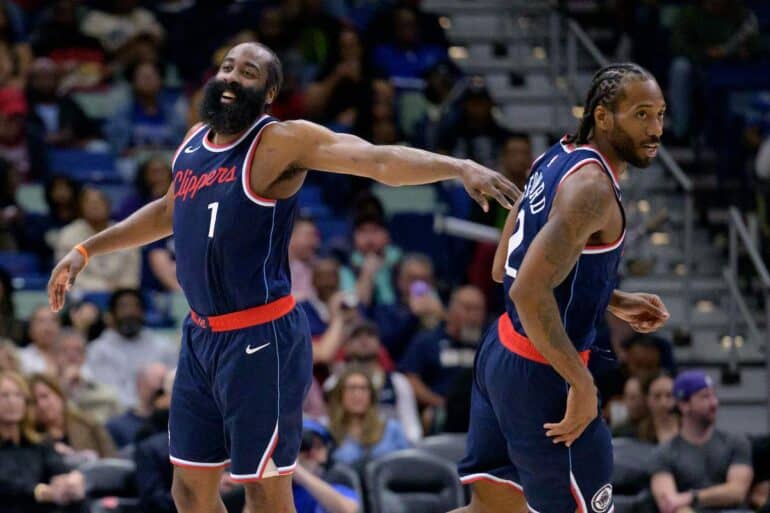
Last season, the Los Angeles Clippers were guided by two All-Stars: Kawhi Leonard and James Harden. But after adding Bradley Beal, Chris Paul and Brook Lopez this offseason, their tally of players with such a nomination grew to five.
This got my curious mind thinking: how often do we see a team accumulate five former or current All-Stars? And how far do those teams normally go in the postseason?
Methodology
For this study, we looked at teams through 2000, but we included All-Star appearances through 1995. So, if a player was on a team in 2000-01 and they were an All-Star in 1997, they would be classified as a former or current All-Star. But if they were only an All-Star in 1994, they would not be included.
We also added an 800 minutes played threshold. Since we anticipate all five of these players beings in the Clippers’ rotation, we wanted to make sure we were only comparing them to teams that prominently featured all of their former or current All-Stars. S0, we will only count a team as having a former All-Star if said player logged at least 800 minutes for them that season.
One last note, since there is no good way to measure whether someone was voted to an All-Star team, our analysis only recognizes players who have appeared in an All-Star Game. So, if you’re Kristaps Porzingis and you missed your only All-Star Game due to injury, you are technically not an All-Star in this study.
With all that laid out, here are the results our search yielded.
What We Found
Believe it or not, this threshold of All-Stars happens quite often. Since 2000, there have been 31 instances of a team playing at least five former or current All-Stars at least 800 minutes in a season (seven times in which a team has had six former or current All-Stars).
This roster construction has had some success in the past, with 19 teams (51.3 percent) winning at least one playoff series, 13 teams (41.9 percent) making it to the conference finals, nine (29 percent) making it to the NBA Finals and four teams (12.9 percent) winning it all.
All that said, success is not guaranteed with this model either. Twelve of the 31 teams (38.7 percent) failed to win a playoff series while three of them (9.7 percent) didn’t even qualify for the postseason.
So, some teams do well with five or more former and current All-Stars while others fail. That much is clear. But what differentiates the winners from the losers?
The big factor here seems to be the timing of when all these stars are fused together. The four teams which went on to win the title (2016-17/2017-18 Golden State Warriors, 2005-06 Miami Heat, 2020-21 Milwaukee Bucks) all had at least one or two of their former and current All-Stars still in the heart of their respective primes.
Meanwhile, among the three teams that failed to even make the postseason, (2012-13 Dallas Mavericks, 2023-24 Golden State Warriors, 2021-22 Los Angeles Lakers), most of their All-Stars were on the wrong side of 30.
What Does This All Mean For The Clippers?
In theory, the Clippers are kind of screwed. All five of their former or current All-Stars are over the age of 30 and tout an average age of 35.8 years old. Of the 19 teams that won at least one playoff series, none of them had a group of former or current All-Stars all past the age of 30. So, historically speaking, they’re more similar to those teams that didn’t make deep playoff runs than the ones which did.
In fact, only one of these 31 teams was in the same situation as the 2025-26 Clippers. That was the 2012-13 Mavericks, which failed to make the postseason with Dirk Nowitzki (34), Shawn Marion (34), Vince Carter (36), Elton Brand (33) and Chris Kaman (30).
To be fair to the Clippers, age is only a number. The real key, regardless of age, is some of the guys looking more like current All-Stars than former ones. Heck, with modern-day technology, one could do that in their age-40 season!
Looking at the Clippers’ former and current All-Stars, the new guys (Beal, Paul and Lopez) are clearly not what they once were (although, they are all still productive players in their own way). Harden remains a borderline All-Star, but no one can say he is the perennial MVP candidate of his prime.
That leaves us with Leonard. Last year, he showed he can still be a special, special player, yet he had to limit himself to 37 regular season games to do so. Can he do it for a good chunk of the regular season and an entire postseason next year? It’s been a long time since he’s pulled that feat off (2018-19, to be exact), but it isn’t out of the realm of possibility with a player of his caliber.
Even if Leonard can put this team on his broad shoulders, history tells us his Clippers are facing a major uphill battle to achieve significant playoff success.
The data for this article was collected on July 24, 2025 and is current as of that date. All data was pulled by Fran Huzjan (@FHuzjan on Twitter).