
The Miami Heat lost another season to the pits of mediocrity, finishing as the Eastern Conference’s eighth seed for the third straight year. Drama surrounding Jimmy Butler’s discontent finally bubbled over as the Heat shipped him to the Golden State Warriors at the trade deadline.
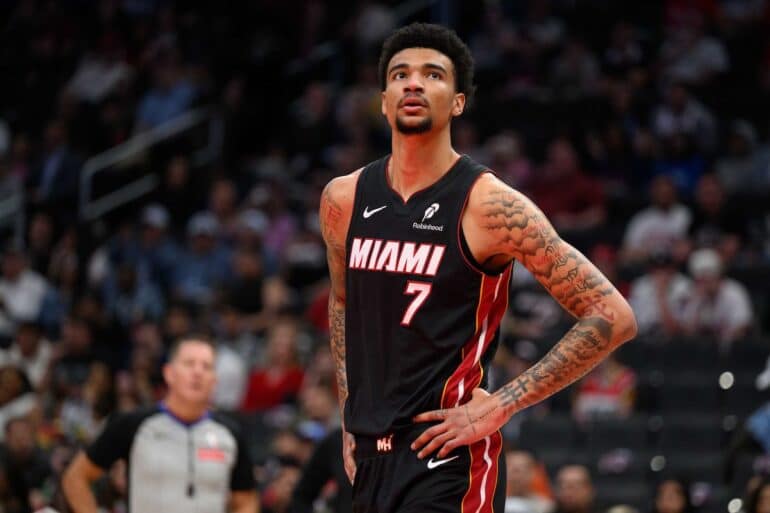
The Heat saw some bright spots during a broadly average season, one of those being the play of 2024 first-round pick Kel’el Ware. Ware, a 7-foot center out of Indiana, fell to Miami at the 15th overall, which looked like an ideal match. The Heat are known for developing players into the best versions of themselves and they needed a center like Ware with shooting and rim protecting potential.
Their partnership bore fruit during Ware’s first NBA season, as the big man made the All-Rookie Second Team to cap off a promising year. After earning more consistent minutes in the new year, Ware averaged 11 points, 8.9 rebounds and 1.3 blocks per game on an excellent 60.6 percent true shooting. Estimated Plus-Minus viewed Ware as an average player (minus-0.8, 54th percentile) and the fourth-most impactful rookie who played at least 20 minutes a night.
His effectiveness dipped on both ends in Miami’s playoff loss to the Cleveland Cavaliers. He fared as many rookies do in their first postseason, struggling to overcome their suddenly exposed weaknesses. Even beyond the playoffs, he has lots of room for growth, especially on defense.
Versatile Scoring
As a rookie, offense was his cleaner side of the ball. His impressive scoring toolkit translated from his time in college. Among rookies, only Ware and Zach Edey averaged at least 15 points per 75 possessions with a true shooting above 60 percent. Feathery touch and towering size fuel Ware’s impressive play-finishing.
Never-ending arms, springy vertical athleticism and touch make him a monstrous scoring threat as a roller, cutter and rebounder. He made 70 percent of his shots at the basket and a stellar 52 percent of his short midrange shots. He boasts an NFL-ready catch radius, capable of snaring off-targeting passes and converting alley-oops.
Athletes like Ware don’t often exhibit his intermediate scoring potential. He’s comfortable floating in hook shots as a post scorer, converting on short rolls or even pulling up for a little jumper. His scoring versatility extends the areas he can generate his own offense and how he can serve as a play-finisher for teammates.
kel'el ware's intermediate touch is his best offensive weapon, he shot 46.7% on floaters and 42.1% on hooks and 52.3% in short mid range last season.
he needs to improve his physicality and ball skills but the size, touch and athletic tools offer a high offensive ceiling pic.twitter.com/xIJjwca8zj
— ben pfeifer (@bjpf_) July 27, 2025
Though dribbling and passing improvement will always come in handy, reliable 3-point shooting is Ware’s obvious swing skill offensively. At times, he looked like an ever-valuable stretch center, converting 31.5 percent of 3.9 3-point attempts per 100 possessions (62nd percentile among centers for efficiency and volume).
Even if he can’t become an outside shooting threat, his scoring package could help him add value in the playoffs one day. Ware likely won’t reach that point without improving his physicality and willingness to play through contact. Despite great size and athleticism, he shot just 2.4 free throws per 100 possessions, placing in the eighth percentile among centers.
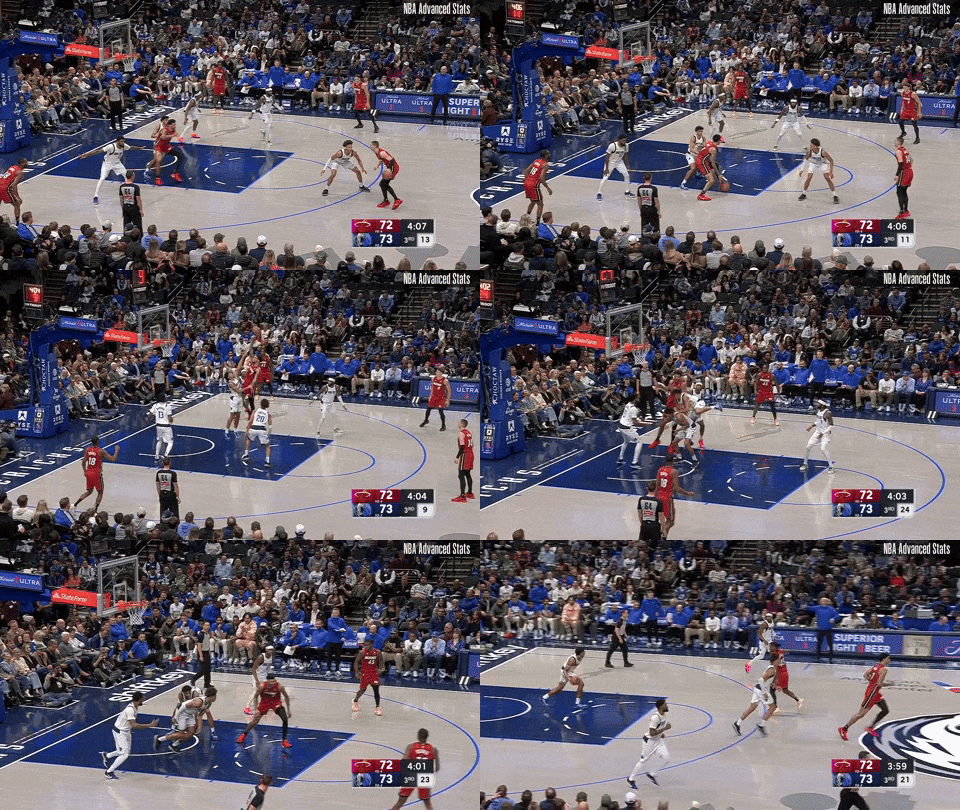
Excellent touch allows him to convert many of these plays, but he often makes life harder on himself than it has to be. Instead of carving out deep position against switches to shoot at the rim or draw fouls, Ware will resort to much tougher shots like this one against Max Christie:
Most rookies add strength as they age. Physicality and aggression are often tied to players’ internal wiring, making those traits harder to shift. His limitations embracing contact hinder Ware defensively and will show up in playoff games. Sharing the floor with an elite defender like Bam Adebayo, though, has helped maximize Ware’s best defensive skills.
Miami: Going Big, Not Going Home
Ware’s partnership with Adebayo unlocked his best defensive moments as a rookie. Double-big lineups are quickly becoming the NBA’s meta. Teams with synergistic centers like Ware and Adebayo are reaping the benefits. Miami’s minutes with both Ware and Adebayo on the floor produced a stellar plus-4.9 net rating with a defense 3.7 points better than the league average.
With Adebayo handling the primary pick-and-roll and point-of-attack duties, Ware roams behind him, looking for shots and passes to pounce on. His rim protection and help at the basket cover for one of Adebayo’s true defensive flaws, fueling a 91st percentile block rate (4.6 percent).
Miami’s best defensive moments often look something like the clip below. Adebayo defends Jayson Tatum’s pick-and-roll above the screen, forcing a pass to the rolling Kristaps Porzingis. Ware begins his rotation early and meets Porzingis at the basket for a rejection:
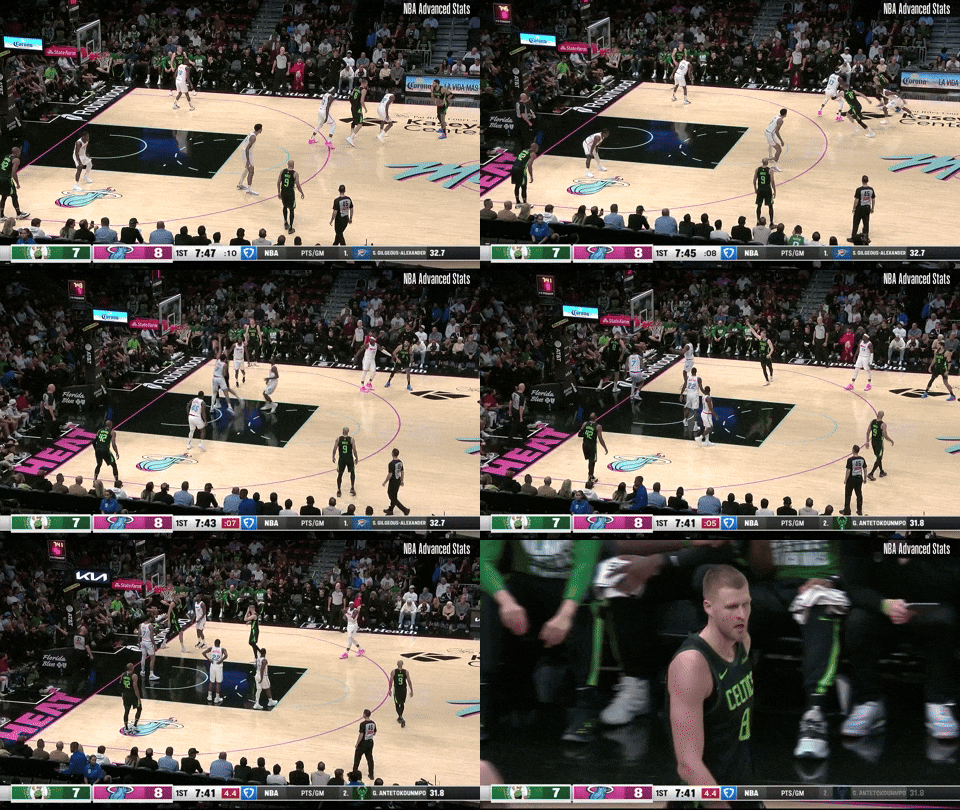
Opposing offenses attempted 1.2 percent fewer shots at the rim with Ware on the court. His presence as a roamer deters shots at the basket, but that only produces positive defensive numbers with an anchor like Adebayo alongside Ware. Flying around and swatting away shots inside boosts Miami’s defensive ceiling.
miami's double big lineups with bam adebayo helped kel'el ware show off some of his defensive strengths as a helper at the rim and a disadvantage defender while hiding his pnr weakness
bam + ware = 111.4 drtg
bam only = 113.1 drtg
ware only = 115.7 drtg pic.twitter.com/ik4nqldkTP— ben pfeifer (@bjpf_) July 27, 2025
When offenses target Ware as a primary defender, they often find encouraging results. Despite his shot-blocking and help defense, he isn’t yet a consistently impactful defender. Ware blocked plenty of shots as a rookie, but opponents shot just 1.8 percent worse at the rim with him contesting, placing in the 25th percentile among centers.
He primarily struggled as a pick-and-roll and off-ball defender, where his athletic limitations, inconsistent attention and rookie inexperience all contribute to poor outcomes. When Ware sat up at the level of the screen, quick guards like Damian Lillard regularly roasted him on drives. Here, he’s late to establish position and isn’t agile enough to recover and cut off the drive:
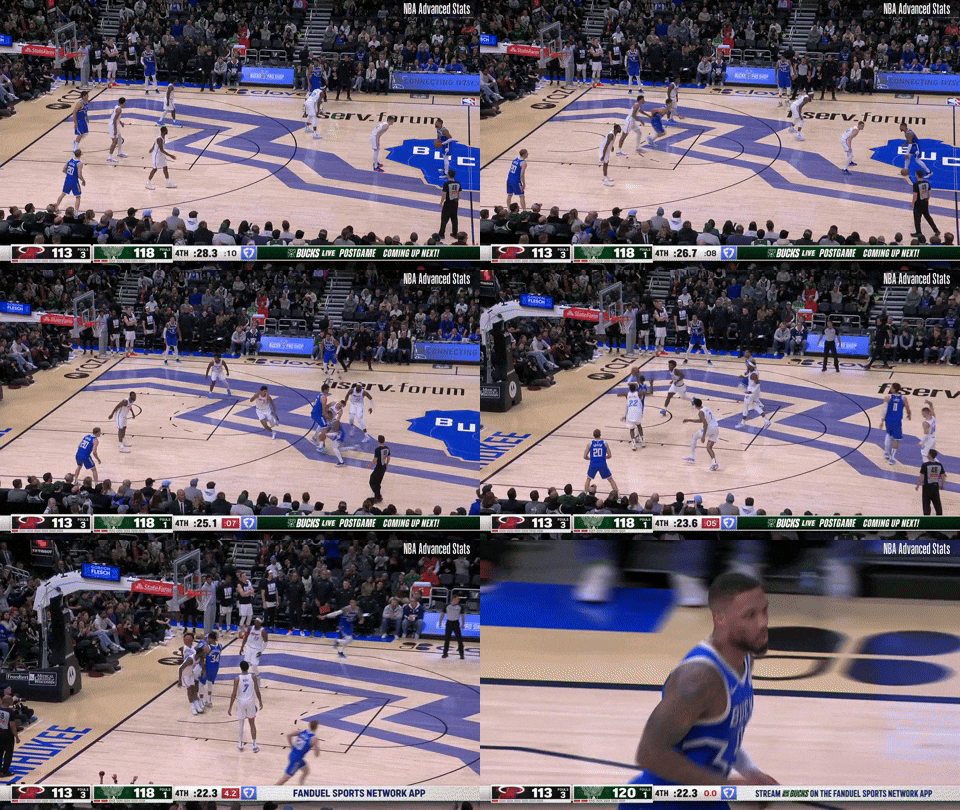
While Ware’s footwork and play recognition can improve with experience, it’s typically challenging to refine a player’s awareness, activity and motor. Those are all areas Ware found himself battling before he entered the NBA.
Although he isn’t always sleeping, he put too many possessions like these on tape, idling in drop coverage while Shai Gilgeous-Alexander jogs to the hoop:
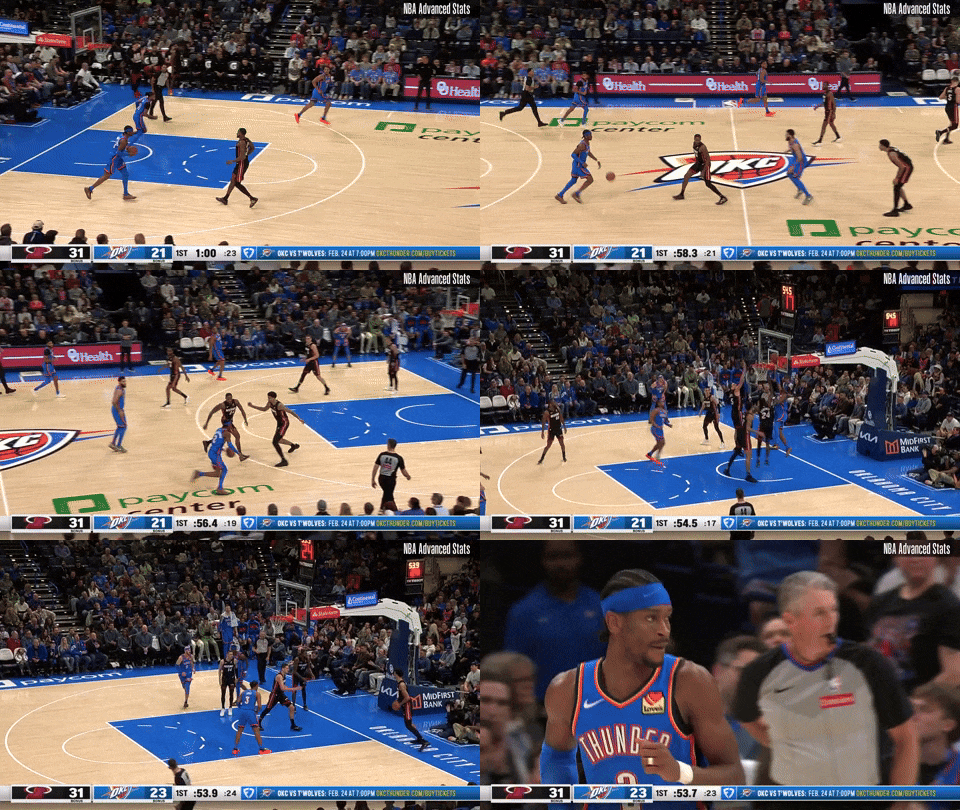
During the Las Vegas Summer League, head coach Erik Spoelstra called out his rising sophomore big’s underwhelming professionalism. Evaluating motor, effort and awareness solely on film often isn’t fully possible. Gaffes like these where Ware lets defenders skate by him, however, must show up less frequently.
Sharpening his defensive minutiae could determine whether Ware ends up a fixture of Miami’s long-term foundation or a blip in time like Hassan Whiteside nearly a decade ago. Crystallizing his defensive attention, especially to the point he could anchor lineups by himself defensively, would let the Heat pour more resources into offense.
An Intriguing Young Core?
Tyler Herro defends at a below-average level by most measures. Impact metrics like Defensive Estimated Plus-Minus (minus-0.7) view him as a 30th percentile defender and Defensive DARKO grades him near the 400th-best defender in the NBA. Herro’s STOP rate and forced turnover rate both sit in the bottom 10th percentile among guards. Miami’s defense improved by 2.5 points when Herro sat on the bench.
Despite Herro’s glaring defensive issues, lineups with him tethered to Adebayo and Ware defended 3.1 points above league average. For those 462 minutes, the Heat crushed opponents, posting an excellent plus-6.4 net rating (excluding garbage time)
Two paint protectors let Herro run wild on offense, flexing his improved scoring and playmaking muscles. He quietly developed into an offensive engine last season for a mediocre Miami team, averaging 23.9 points and 5.5 assists per game on sparkling 60.6 percent true shooting. Progression as an on-the-move passer and increased rim pressure transformed his offense for the better.
Only six players last season eclipsed a 25 percent rate and 25 points per 75 possessions on true shooting three points above league average — Gilgeous-Alexander, Lillard, Nikola Jokic, Giannis Antetokounmpo, Stephen Curry and Herro. His one-man creation and scoring carried an offensively challenged group in Miami.
six NBA players last season eclipsed 25 pts/75 on +3.0 relative true shooting and a 25% assist rate — jokic, giannis, shai, curry, lillard and tyler herro
herro took a genuine leap last year as a passer and driver, refined skill and approach took him to a new level pic.twitter.com/B8xHTndWkX
— ben pfeifer (@bjpf_) July 27, 2025
Lineups featuring Herro and Adebayo without Ware held up defensively (minus-1.3 relative defensive rating) but bled value on offense (minus-2.5 relative offensive rating). Swapping Ware for Adebayo as Herro’s center partner sparked better offense (plus-1.0 rORTG) but much worse defense (plus-2.4 rDRTG).
A bounce-back season offensively from Adebayo could help remedy some of those issues, but his offense is limited even at its peak. Ware is a keystone for Miami. His complementary scoring and rim protection amplify his team’s two star players. Defensive growth and nuclear play-finishing will also benefit Kasparas Jakucionis, Miami’s 2025 first-round pick with immense offensive talent.
Returning to playoff relevance will require the Heat to inject more offensive talent into the roster. The Heat finished among the bottom 10 offenses each of the last three seasons, but adding players like Ware and Jakiucionis should help vault them up the rankings. This offseason, Miami also traded for Norman Powell, who will hope to build on a career-best 2024-25 in which he averaged 21.8 points on 61.5 percent true shooting.
While the Heat likely need one more perimeter star offensively to reach contention, an idealized version of Ware is critical as well. So many great modern teams employ floor-spacing, secondary scoring centers to compensate for lesser shooting perimeter players or bigs who defend well enough on their own to act as anchors for offensively-slanted lineups.
The 21-year-old Ware must progress significantly on both ends to reach that theoretical peak. Falling short of that mark might leave Miami stuck in neutral as it’s been for some time now. Ware approaching his ceiling not only matters for his own on-court impact, but for how his skill-set can simplify life for teammates and the Heat organization’s roster-building.