
We’re inching closer to the new college basketball season and ranking season is nearing its peak. Most great modern college teams feature one or more elite guards. Both national title teams, Florida and Houston, rolled out loaded guard rooms with future first-round picks and veteran college stars. A significant portion of teams projected to dominate this upcoming season sport elite backcourts.
Let’s rank the 10 best backcourts in college basketball for the 2025-26 season. There’s a major tier break after the fourth or fifth team on the list, and differences between teams ranked beside each other are minor. We’re projecting how these backcourts will contribute to winning for their teams this season with star power, depth and versatility.
10. Washington Huskies
Wesley Yates, Desmond Claude, Zoom Diallo, Quimari Peterson, JJ Mandaquit
Washington poached two guards from USC’s backcourt and Yates projects as an offensive centerpiece. As a redshirt freshman last season, Yates quietly developed into a dynamic shot creator and scorer, averaging an efficient 14.1 points per game (59.3% true shooting) driven by excellent skill, touch and physicality.
Claude, the other Trojan transfer, and East Tennessee State transfer Quimari Peterson add solid depth, but Washington’s young players could swing the ceiling of the backcourt. Mandaquit is a ready-made 3-and-D contributor and Diallo flashed impressive ball skills, mid-range scoring and passing flashes as a freshman. This backcourt fascinates me as much as any other on the list.
9. UCLA Bruins
Donovan Dent, Trent Perry, Skyy Clark, Eric Freeny
Dent’s transfer to UCLA was one of the summer’s most influential moves. He’s one of the best players in all of college basketball, averaging 20.4 points and 6.4 assists per game on 56.8% true shooting. Phenomenal pick-and-roll playmaking and athleticism make Dent a one-man offense who also contributes on defense.
Perry is a breakout candidate for 2025-26, as the rising junior thrived in a smaller role with high defensive impact and slashing as a change-of-pace guard. Clark carved a role as a savvy, two-way point guard and Freeny, a redshirt freshman this year, adds some scoring punch to the mix as well.
8. Florida Gators
Xaivian Lee, Boogie Fland, Urban Klavzar, AJ Brown, Alex Lloyd,
The Gators replaced their title-winning backcourt with two top-shelf portal additions — Lee from Princeton and Fland from Arkansas. While none are as game-changing as Walter Clayton Jr., both Lee and Fland bring pick-and-roll chops and shotmaking. Neither guards attack the basket and scores in the paint efficiently, which could limit the ceiling of the duo.
Florida’s backups aren’t as certain as other teams on the list without more potent duos. Klavzar was a sturdy, effective rotation guard last season and Lloyd is a four-star freshman with some upside to contribute immediately. A.J. Brown transferred in from Ohio to space the floor and defend, rounding out their complementary pieces.
7. UConn Huskies
Solo Ball, Malachi Smith, Silas Demary Jr., Braylon Mullins
Dan Hurley built a deep and diverse guard room through portal acquisitions and recruiting, none more pivotal than former Georgia guard Silas Demary Jr. The 6’5 junior significantly improved his 3-point volume this past season, which unlocked his explosive downhill athleticism and defensive playmaking.
Ball and Mullins, a five-star freshman, are both dynamic off-ball shooters with movement shotmaking acumen. Mullins has some passing chops while attacking closeouts and Dayton transfer Malachi Smith will contribute some pick-and-roll juice from the bench.
6. Kansas Jayhawks
Darryn Peterson, Melvin Council Jr., Elmarko Jackson
Darryn Peterson is good enough to stamp Kansas on this list regardless of his backcourt partners. He’s my pick to win National Player of the Year; Peterson creates shots, scores, passes and defends all at elite levels. Peterson’s on-ball creation will unlock a strong offense and he’ll produce like one of the better defenders in the country.
Council Jr. and Jackson are the other starting backcourt options and both could develop into useful complementary starters. Both players can improve as outside shooters, but Council Jr. especially brings the playmaking and defensive upside to add value next to a star lead guard like Peterson.
5. Alabama Crimson Tide
Labaron Philon, Aden Holloway, Latrell Wrightsell Jr., Houston Mallette, Jalil Bethea
The Tide carry as strong a guard room as any team in two key areas — shooting and continuity. Holloway, Wrightsell Jr. and Mallette are all excellent 3-point shooters and Bethea, a five-star freshman lost in the shuffle at Miami, was a highly touted shotmaker. Alabama’s backcourt ceiling will rely on the growth of returning sophomore Labaron Philon, who tabled his first-round draft stock to return to Tuscaloosa.
Philon generated draft buzz last season and he could have a sophomore breakout akin to Jaden Ivey or Tyrese Haliburton if he can improve as an interior scorer and 3-point shooter. He’s shown plenty of aptitude as a complementary player on great teams, but his excellent speed and passing could help him acclimate as a primary offensive option.
4. Houston Cougars
Milos Uzan, Emanuel Sharp, Kingston Flemings, Isiah Harwell
The Cougars are in an unusual position, as this iteration of head coach Kelvin Sampson’s squad features two consensus top-20 incoming freshmen guards. Harwell, the program’s all-time highest rated guard recruit, slots in easily to any lineup with his floor spacing, physicality and defensive chops. Flemings exists most comfortably with the ball in his hands, making him a more challenging early fit, but he’s talented enough to crack the rotation this season.
Houston returns two backcourt stars in a markedly less unusual move and will rely on Uzan and Sharp as the engines of the offense. Uzan turned a corner in 2024-25; his scoring issue began to catch up to his elite dribbling and passing skills. Sharp is an ideal complementary shotmaker and defensive guard, rounding out a balanced Cougar backcourt.
3. Kentucky Wildcats
Jaland Lowe, Otega Oweh, Jasper Johnson, Denzel Aberdeen, Collin Chandler
Aside from the team atop our list, Kentucky boasts the strongest trio of veteran guards, spearheaded by returning senior Otega Oweh. The 6’5 combo guard improved his ball skills last season, adding a deadly slashing component to an already elite defensive player. Head coach Mark Pope’s two veteran transfers, Lowe and Aberdeen, inject valuable live-dribble creation and complementary scoring into the room.
Those three players are strong enough to cement Kentucky on this list, but a few young players could boost the group even higher. They’ll add Jasper Johnson, a consensus five-star guard, and hope for another leap from sophomore returner Chandler, who flashed some 3-and-D promise as a freshman.
2. Purdue Boilermakers
Braden Smith, Fletcher Loyer, CJ Cox, Gicarri Harris, Omer Mayer
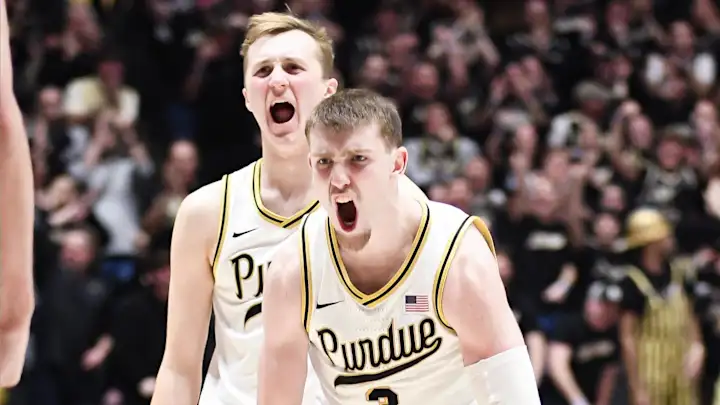
The Boilermakers will reach as far as Braden Smith will carry them. Having a preseason Wooden Award favorite makes Purdue an easy inclusion this high; in 2024-25, Smith posted 15.8 points and 8.7 assists per game on 54.8% true shooting with a huge 2.5% steal rate. His pull-up jumper offers Smith a primary scoring tool, but his pick-and-roll wizardry drives much of his offensive value.
Beyond Smith, Purdue has quite a few promising complementary options, starting with senior Fletcher Loyer, who has already established himself as an efficient complementary scorer. If one of their young pieces breaks out — Omer Mayer who excelled at the FIBA U19 World Cup or C.J. Cox, who flashed as a freshman — opposing defenses will struggle mightily to slow the unit down.
1. Louisville Cardinals
Mikel Brown Jr., Adrian Wooley, Ryan Conwell, Isaac McKneely
Dropping in Louisville at the top of the backcourt rankings might cause some controversy, but no other program matches their star power and well-roundedness. While they don’t have one of the five best players in the nation like Kansas or Purdue, Mikel Brown Jr. has a chance to finish as a top-5 pick. His exceptional shooting, off-ball feel and playmaking should let him fit smoothly with the other three guards.
Wooley dominated Conference USA as a freshman, scoring 18.8 points per game on 62.7% true shooting. Brown Jr. and Wooley will likely spend most of their time on the ball, while Conwell and McKneeley slant more towards off-ball offense. All four can operate with and without the ball, blessing the Cardinals with more backcourt options than any other team.