

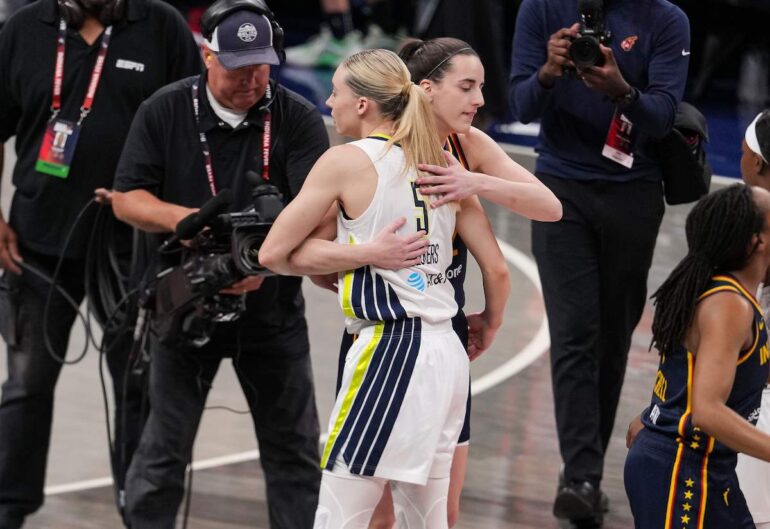
Comparing players in any sport has an intoxicating quality. Appreciating the greatness of both players probably benefits the long-term health of everyone involved. But who can resist a good side-by-side, especially between two players as high-profile as 2024 WNBA top pick Caitlin Clark and 2025 top pick Paige Bueckers.
If we must compare Clark and Bueckers, who both broke onto the scene and immediately established themselves as stars, we should do it thoughtfully. Sportscasting’s Fran Huzjan created a model aiming to project Clark and Bueckers’ career on-off swing, win shares per 48 minutes and usage rate from their rookie season. Here’s a quick explainer on the model from the creator:
“Using a dataset of current and former WNBA players — including stars like A’ja Wilson, Breanna Stewart, Elena Delle Donne, Brittney Griner and others — I built a predictive pipeline to estimate two key career metrics: Net On-Off Rating (a measure of a player’s overall impact when on the court) and Win Shares per 48 minutes (a measure of efficiency and contribution to team wins). The model is based solely on rookie-season statistics — such as Player Efficiency Rating (PER), Win Shares per 48, Offensive and Defensive Win Shares, Usage Rate and Net On-Off Rating — to project long-term career performance.
Based on this approach, the predictions for Caitlin Clark are a Net On-Off Rating of old value and a Win Shares per 48 of old value, while Paige Bueckers is projected at new value and new value, respectively. Since Paige is still in her rookie season, her final year-one performance could shift these projections. The dataset currently covers a selection of notable WNBA players and expanding it to include more athletes from different eras would likely improve the accuracy and robustness of future predictions.”
Huzjan’s model (updated with data through Aug. 22) forecasts a slight edge in win shares (.19 vs .13) and net rating swing (8.9 vs 6.8) for Bueckers and higher usage for Clark (27.6 percent vs 25.1 percent). Let’s contextualize those stats with more numbers and film on each player.
What To Make Of Clark’s Second WNBA Season
It’s unclear how much concrete information we can glean from Caitlin Clark’s injury-riddled sophomore season. In just 13 games, her points per game dipped by 2.7, free-throw rate by 5.5 and her true shooting by a whopping 9.2 percent. Recurring lower-body injuries seem to have zapped a fair amount of her burst. Note this drive from the 2025 season, where rising star defender Leila Lacan easily cuts her off:

Clark’s shot frequency between 0-3 feet slightly decreased from 18.3 percent as a rookie to 15.8 percent as a sophomore. Only 23 years old, her athleticism should return. Her rookie year drives remain impressive, where she sharply changed directions with her handle to create space downhill:

More than straight-line speed, groin and quad injuries limit the force Clark can generate to shift her momentum, especially at high speeds. She’s losing her handle when defenders apply pressure and physicality more often, especially when she tries to change her speeds and driving paths:

To some extent, a tumultuous season clearly shook the confidence ofa normally ultra-aggressive Clark and she doesn’t seem to trust her creation as much. She denies acres of space to attack against drop coverage, instead hesitating before telegraphing a pass and turning the ball over:

Despite these conspicuous limitations, her turnover numbers are lower than a historically poor rookie campaign in that respect. Her turnover rate (25.3 percent -> 23.2 percent) decreased, despite an increase in usage (27.7 percent -> 31.4 percent). An already positive assist-to-turnover rate spiked as well (1.5 -> 1.7).
In 2024, Clark would turn the corner on a ball-screen with A’Ja Wilson dropping high at the level, trying a reckless pass over the top for a turnover:

Passing wunderkinds often sharpen their sage-like instincts as they age and Clark has started that process, especially in situations like those against pressure on the move. In 2025, she backs away from Wilson’s aggressive coverage before uncorking a tight-window layup pass:

Without her usual levels of force and explosiveness, Clark has leaned more on her intermediate game, which had been one of the weaker aspects of her skill-set. She’s turning toward short midrange jumpers and floaters on drives, significantly increasing her shot frequency between 3-10 feet (4.5 percent -> 10.2 percent).
When Lacan opens her hips to chase Clark toward the rim, Clark anchors and jumps off her left foot, floating backwards into an open look:

Within a sophomore slump marred by injuries, Clark’s progress as an intermediate scorer and decision-maker present silver linings. But she undeniably took a step back this season. Her statistics, impact metrics and film don’t measure up to those of Bueckers’. Their rookie numbers, however, look quite similar:
Paige Bueckers (2025)
18.9 points (55.9 percent true shooting), 5.3 assists (2.6 assist-to-turnover ratio), 3.7 rebounds, 1.6 steals, plus-8.9 on-off swing
Caitlin Clark (2024)
19.2 points (58.3 percent true shooting), 8.4 assists (1.5 assist-to-turnover ratio), 5.7 rebounds, 1.6 steals, plus-7 on-off swing
Clark scored a tad more than Bueckers on slightly better efficiency (and on higher usage). Bueckers makes up for a significant playmaking gap with far fewer turnovers and better on-off impact, but the two clearly aren’t that far apart, according to the box score.
Assessing Bueckers’ Rookie Year
We’ve been treated to some monster scoring games already from Bueckers. I’ll leave the granular analysis of her scoring and shotmaking prowess to our own Lucas Kaplan, who beautifully wrote about her 44-point explosion against the Los Angeles Sparks last month.
Bueckers generates her offense in a vastly different manner than Clark, despite them both thriving in the pick-and-roll. For her age, Bueckers marries her own scoring with brilliant off-ball movement as well as any player I’ve watched.
Off-ball movement is an underrated skill players often struggle to develop. Bueckers, though, is a natural. Without elite space downhill creation like Clark, Bueckers leans on subtle body feints and jukes, timing her cuts to score and find her bread-and-butter midrange:

Her special shotmaking quickly translated to the WNBA and she’s already one of the league’s best midrange shooters. She attempts over a quarter of her shots from 10-16 feet, converting a scorching 53.6 percent of them. Few rookies lean on tough shotmaking like she can with a bag of tricks as deep as hers.
That superpower comes with a caveat. Her reliance on off-the-dribble jumpers could limit her high-end on-ball ceiling. Bueckers struggles to create advantages downhill, attempting a meager 9.5 percent of her shots within three feet and posting a 27.8 percent free-throw rate. Even without her full athletic abilities this season, Clark generated far more rim pressure (15.8 percent rim frequency) with a slightly lower free-throw rate (25.5 percent).
Despite her veteran skill, awareness and basketball feel, Bueckers can struggle without the help of screens or motion. Lacking much other talent, the Wings rely on Bueckers as an offensive engine and, for the most part, she’s been a resounding success. Plays like these still prop up, where she’s missing the burst and explosiveness to beat elite defensive players:

A season of experience facing pros has helped her increase her physicality as the year’s progressed. Bueckers powers through defenders on drives more often now. She’s flashed the critical ability to pressure the basket and create shots for herself around the hoop, finishing this and-one:

Added strength will benefit her defense as well, already a positive in her game and offering some separation from Clark. Phenomenal instincts help her rack up steals on the ball and in passing lanes (2.4 percent steal rate). When Bueckers sits, Dallas’s defense drops by over three points per 100 possessions, missing her versatility and off-ball goodness.
So, Who’s Better?
Bueckers and Clark are comparable long-term prospects, both with massive upside and immediate star power. If we must, how do we determine who is “better?” Better box score stats? More wins and team success? More individual accolades? For me, it’s about comparing players through the lens of their respective skill-sets and how that means they contribute to winning at the highest level.
I’d lean toward Clark for her all-encompassing offensive package over Bueckers’s slightly more portable offense and defensive gap. The WNBA Twitter masses, at least from my perspective, seem to lean toward Bueckers, reinforced by the results of a recent poll I ran:
temp check, your preferred player long term:
— ben pfeifer (@bjpf_) August 27, 2025
Multiple replies cited her “scalability,” seemingly valuing her smoother fit next to other stars, a critical component of judging top-level value. I’ll slightly push back on this, even if Bueckers projects as the more scalable player than Clark, with wider possibilities of teammates capitalizing upon her off-ball gravity.
With so much of Clark’s value stemming from her off-the-dribble creation and special passing vision, moving her off the ball may not always feel frictionless. Her early career on-off data, however, doesn’t suggest a major limitation fitting next to the only other perimeter star she’s shared the court with so far in Kelsey Mitchell.
During 1,353 non-garbage time minutes together across the last two seasons, Clark and Mitchell produced an elite 109 offensive rating. In 319 minutes with Clark on the floor and Mitchell on the bench, Indiana’s offense plummeted to a below-average mark (102.5).
Small-sample on-off data features plenty of noise, but it at least signals Clark’s ability to run an elite offense with another offensive star in the backcourt. I’d trust her to hone her off-ball awareness and feel as she ages, even if her teams’ offenses will always be better with the basketball in her hands.
Superior on-ball creation and passing make me think Clark has better odds of peaking as an MVP-level player capable of driving championship-quality offense. I value that slightly more than Bueckers’s easy fit next to other great players. Her success at UConn alongside plenty of high-profile players should resemble her WNBA future whenever she’s eventually surrounded by strong teammates.
I can’t say definitively whether Clark or Bueckers will end higher on all-time rankings. We’ll have years to inevitably compare the greatness of these two players. But if their first acts are any indication, both will likely etch themselves into the annals of WNBA history.
Unless otherwise noted, all stats are accurate prior to games played on Sep. 3.