

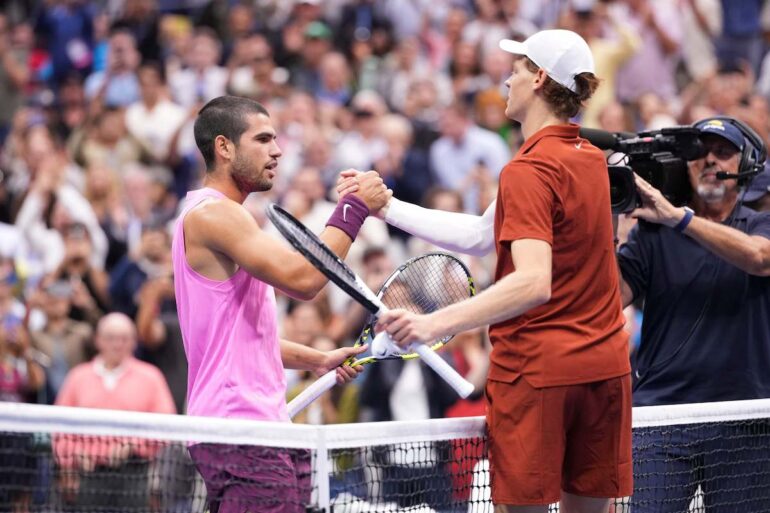
Carlos Alcaraz and Jannik Sinner are the two best players in the world, of that there is no doubt.
The Spaniard wrestled the ATP No. 1 ranking away from the Italian by winning the US Open final on Sunday. They have combined to win each of the last eight Major titles. They have contested each of the last three Grand Slam finals.
Sinner dropped three sets in winning Wimbledon. Alcaraz dropped a single set in winning the US Open. With Alcaraz at 22 and Sinner at 24 years of age, respectively, their domination should have a long runway ahead.
2025 also marked the first year since 2002 that Roger Federer, Rafael Nadal or Novak Djokovic didn’t play a Major final.
There are no guarantees in sport, though, that’s why they play and we watch. Djokovic, Nadal and Federer have combined for 66 Major titles and no one could’ve predicted they’d play as long as they have when they were still under 25 nor the twists and turns along the way.
“Thank God, that’s too far for me right now,” Alcaraz said when asked if he’d want to be playing at 38. “One person [Roger Federer] once told me that you don’t have to think about 35, 38 years old, still playing at that age. He told me you have to be focused on the next five years.
“From here to when I turn 27. Then, when I get to 27, think about five years more. It’s not about thinking in 15 or 20 years, it’s just about going year by year or thinking about five years maximum.”
Let’s leave the conversations about whether the ‘New Two’ can come close to or surpass ‘The Big Three’ for if it actually becomes relevant.
What could the remainder of this decade look like? Let’s take a look.
History Of Dominant Duos In Open Era
Bjorn Borg and John McEnroe are the original dominant duo of men’s tennis in the Open Era. From 1978 to 1981, Borg and McEnroe combined to win 11 of the 16 Grand Slams played. It’s worth pointing out that neither played a single Australian Open during that time.
That means the only player to impede their dominance at the 12 Slams either or both participated in during this stretch was Jimmy Connors at ’78 US Open. He beat McEnroe in the semis and Borg in the final to win that title.
Borg didn’t play a Major in 1982 and shocked the sports world with his retirement announcement in 1983 at the age of 26.
We remember Pete Sampras and Andre Agassi’s rivalry fondly but they never quite dominated simultaneously. They “combined” for 11 of the 20 Majors between 1993-97 but Agassi only won two of those. They did collect another eight between them from 1999-2003, Agassi claiming five.
Between 2004-08, Federer and Nadal combined to win 17 of 20 Majors. The only exceptions were Gaston Gaudio at the 2004 French Open, Marat Safin at the 2005 Australian Open and Djokovic at the same event in 2008.
From 2011-15, Djokovic and Nadal lifted 14 of the 20 Major trophies. Between 2018 and 2022, the same duo combined for 15 of 19 Majors. Bear in mind, Wimbledon wasn’t held in 2020 due to Covid and Djokovic wasn’t allowed to play the 2022 Australian and US Open.
Now, let’s tack on another two years on top of that because we’re looking ahead to 2030. In the case of Nadal and Federer, expanding their range from 2004-10 puts them at 24 of the 28 Majors won. Nadal and Djokovic won 18 of 28 from 2011-17 and 18 of 27 from 2018-2024.
Who Dares Stand in Alcaraz, Sinner’s Way?
In evaluating how dominant Alcaraz and Sinner could be, it’s worth considering who could disrupt their current flow state.
Borg and McEnroe dealt with the likes of Connors, Ivan Lendl, Guillermo Vilas and Mats Wilander. Sampras and Agassi saw plenty of Boris Becker, Jim Courier, Patrick Rafter and Goran Ivanisevic.
Federer’s initial rivals were Lleyton Hewitt, Marat Safin and Andy Roddick before Nadal and Djokovic entered the frame. There was Andy Murray, Stan Wawrinka, Tomas Berdych, Juan Martin Del Potro and Milos Raonic. Their longevity also enabled the likes of Dominic Thiem, Daniil Medvedev and Alexander Zverev to take a crack at them.
Djokovic has stuck around long enough to now see Alcaraz and Sinner on the regular. He will hope to return to the winner’s circle if Alcaraz or Sinner slip up at any point in 2026.
The ‘New Two’ look set to see plenty of Ben Shelton and Jack Draper (health permitting) in the years to come. They are fast improving lefties who have the game and moxie to cause ‘Sincaraz’ some problems. Shelton is currently 1-8 against them while Draper is 3-5.
Felix Auger-Aliassime has top five talent but needs to show top five consistency. He is a combined 5-6 against Alcaraz and Sinner. Lorenzo Musetti can certainly be a consistent threat to them on clay.
Time is not on Medvedev and Zverev’s side (turning 30 and 29 next year, respectively) so they will need a dramatic evolution to keep up. Holger Rune has plenty of maturing to do. Three names that could be threats in the near future are Brazil’s Joao Fonseca, France’s Arthur Fils and the Czech Republic’s Jakub Mensik.
How Much Of A Factor Is Health For Sinner, Alcaraz?
Alcaraz and Sinner are both all-court players. It’s a big reason they’ve dictated success at the Majors the last couple years. However, it also means a greater load on their bodies and their minds.
When looking ahead to the next five years, health has to be a serious factor. There is so much physicality to their games that it wouldn’t be surprising if there were at least a few hurdles to clear in that regard.
Sinner’s listed at 6’3″ but certainly seems an inch or two taller. That frame sliding back and forth on the baseline is bound to take a toll at some point down the line.
Alcaraz has had a couple of untimely injuries to this point, forced to withdraw from the 2023 Aussie Open with a right leg injury. He also had a forearm issue last year that forced him to miss Masters events in Monte Carlo and Rome ahead of the French Open.
It was all the more impressive that he showed up undercooked at Roland Garros and still went on to win the tournament.
Federer didn’t face major injuries until 35, arguably because his game was less physically taxing than Nadal or Djokovic. The Serb’s first major injury occurred at 30. Nadal has the most physically taxing game of the lot and it first overcame him at 26 after a second round exit at Wimbledon.
The Spaniard also had a degenerative foot condition that was first diagnosed when he was 19. Borg retired at 26 because of a lack of motivation. These are exceptions for greats, not norms. Sinner and Alcaraz should be pretty healthy over the next five years, we can only hope.
Final Verdict
Based on everything history tells us, Alcaraz and Sinner should combine for 12 to 14 of the next 20 Majors. If they can continue to split things evenly, that would put the Spaniard within striking distance of Sampras’ 14 by age 27. Sinner would be in double-digits, too, at 29.
If they achieve the high end of combining for 16 to 18 of the next 20, then Alcaraz in particular will be eyeing up Federer’s mark of 20.
Of course, history only tells us the stories of the past and doesn’t guarantee the future. Winning up to 14 of the next 20 Majors would be a special effort, getting up to 18 would be something we’ve never seen before in men’s tennis.
Over to you, Sincaraz.