

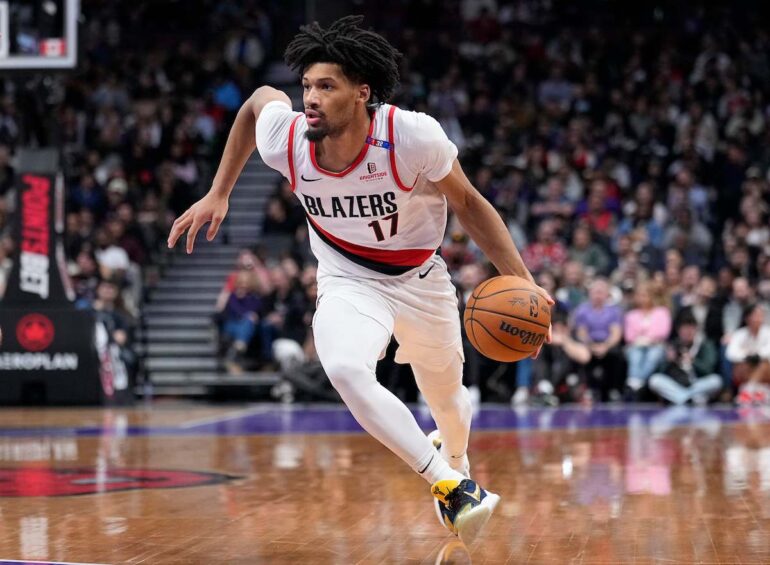
As the 2025-26 NBA season nears (preseason’s already begun!), the Sportscasting crew banded together to identify one particularly intriguing player for each team, someone whose performance, progress or stagnation could have grand consequences on the short- and/or long-term outlook for their club. Up next is the Northwest Division.
Let’s get to it.
Read our picks for most intriguing players in other Divisions: Southeast / Central / Atlantic
Denver Nuggets: Julian Strawther
In an offseason where the Denver Nuggets added Cameron Johnson, Tim Hardaway Jr., Jonas Valanciunas and Bruce Brown Jr., I’m still holding on to the idea Julian Strawther is their most fascinating player.
The league is fixated on wings with size, speed and skill who can shoot, attack closeouts and not kill you defensively. In theory, Strawther is exactly that. He’s 6 feet 6 inches with a 6-foot-9 wingspan, moves like the smoothest hooper at Rucker Park and possesses a solid package of floaters and finishes around the rim.
Julian Strawther showed flashes of a smooth drive/floater game.
I'm curious to see what Year 2 looks like for him. I think he's one of the most underrated players of the 2024 Draft Class. pic.twitter.com/1CgjlCWF58
— Mat Issa (@matissa15) July 25, 2024
Strawther also has the potential to be one of the best shooters in the Association – as evidenced by the fact he had the green light to take 9.2 threes per 75 possessions as rookie (93rd percentile). He’s still kind of frail and can get bumped off his spot on defense but his movement skills and length tell me he can turn into a positive defender as he matures (he’s only 23 years old).
We saw all these flashes when he came off the bench in Game 6 of the Western Conference Semifinals to score 15 points in 19 minutes and force a Game 7 against the eventual NBA champion Oklahoma City Thunder.
I don’t know how else to say it. The guy just has it. Yet, for some reason, he hasn’t really gotten a chance to show it for an extended stretch. And with all the Nuggets’ new veteran additions, Strawther probably won’t get a ton of run early on. But all the guys ahead of him on the depth chart have clear flaws which inhibit them from being true two-way playoff players. If the Nuggets plan on maximizing the remainder of Nikola Jokic’s prime, they’ll need Strawther to reach his full potential. -Mat Issa
Minnesota Timberwolves: Jaylen Clark
This offseason, the Minnesota Timberwolves lost Nickeil Alexander-Walker without bringing in anyone from the NBA’s other 29 teams to fill his place. So, they’ll be relying on internal development to maintain their standing as one of the most formidable teams in the Western Conference.
Most people will point to Rob Dillingham (a top-10 pick in the 2024 NBA Draft) and Terrence Shannon Jr. (who had some impressive flashes in the Western Conference Finals) as logical candidates to take a leap this season.
I agree they will need to level up for Minnesota to keep pace in the unforgiving Western Conference. But I’m also quite, for lack of another word, intrigued by Jaylen Clark and the possibility of him being the true successor to Alexander-Walker.
Few players defended the reigning MVP Shai Gilgeous-Alexander as well as Clark did last season. He’s got the lateral quickness and strength to be one of the best perimeter defenders in the league for a long time (92nd percentile Defensive Estimated Plus-Minus).
The real question with Clark is how much will he be able to provide offensively? He hit 43.1 percent of his threes on low volume (21st percentile in threes per 75) and shot just 50 percent at the rim (fourth percentile).
Clark will need to show he can take more threes and do more as a finisher if he’s going to be a playoff rotation-level player for Minnesota moving forward. If he proves up to the challenge, that’s one fewer thing the Timberwolves will need to worry about as they continue building their team out around Anthony Edwards. -Mat Issa
Oklahoma City Thunder: Chet Holmgren
The Oklahoma City Thunder completed their mission and won the 2024-25 NBA championship, cementing their status as one of the most well-constructed teams in NBA history. But while the Thunder were great, they also proved gettable. Both the Denver Nuggets and Indiana Pacers pushed them to seven games last postseason.
The main reason the Thunder were pushed so close to the edge was because of their offense – namely their inability to get consistent production from guys outside of Shai Gilgeous-Alexander. Jalen Williams stepped up when it mattered most but if the Thunder want to become truly unbeatable, Chet Holmgren will need to take a step forward.
Even with his lack of experience, Holmgren’s defensive impact is metronomic. He’s placed in the 91st (2023-24) and 98th percentile (2024-25) in Defensive EPM his first two seasons. But his offensive contributions are still relatively inconsistent. During this past playoff run, he had six games scoring 20 points or more and seven games scoring 12 points or fewer.
Holmgren is a good shooter (78 percent career free-throw shooter) with more ball skills than the average 7-footer (he hit 47.5 percent of his midrange jumpers as a rookie). All the pieces are there to become a future two-way monster (think of a modern Kevin Garnett). It’s just up to him to consistently put those pieces together. -Mat Issa
Portland Trail Blazers: Shaedon Sharpe
The Portland Trail Blazers are an ascending young team built around tenacious defense. To leap another tier and join the Western Conference playoff mix, Portland needs offensive difference-makers. Deni Avdija appears well on his way to stardom but a fully realized Blazers offense will need fourth-year wing Shaedon Sharpe to break out.
His offensive contributions become all the more critical after Scoot Henderson’s preseason injury, which means Portland may lean on Sharpe more than usual for offensive punch. There’s reason to hope there — he averaged 18.5 points per game on efficiency three points below league average last season.
In his third year, the then-21-year-old wing began to blossom as an on-ball creator and impose his will as a potent downhill athlete. Sharpe’s creation volume (7.9 -> 9.8 creation attempts per 100 possessions) and efficiency (minus-9.2 percent -> minus-0.9 percent relative true shooting) sharply improved from 2024 to 2025.
Sharpe’s rare blend of straight-line explosiveness, aerial prowess and flexibility renders him nearly unstoppable at times. But his inconsistencies in reading the floor and making wise choices hamper that talent, though he has improved his passing each season. Where his 3-ball levels out is also worth monitoring — he’s a career 33 percent long-range shooter whose percentages steadily decline each season, deflated to some extent by his ever-increasing shot difficulty.
Though his tools suggest some defensive upside, Sharpe hasn’t found a way to positively impact the game on that end to this point. Adding some secondary rim protection or boosting his on-ball motor would be nice but the Blazers will depend on his offensive progression. Portland’s strong defensive core, buoyed by an ascending offensive star, would be enough to crack the playoffs in a loaded Western Conference. -Ben Pfeifer
Utah Jazz: Isaiah Collier
After a crawl of a start to his rookie season, Isaiah Collier settled in once the calendar turned to 2025. In 42 games from Jan. 12 onward, the bulldozer point guard saw 30.6 minutes per night, averaging 12.3 points, 7.8 assists (3.3 turnovers), 3.9 rebounds and 1.0 steals. Over that span, he was among the league’s most prolific playmakers, sitting sixth in assists per game, fifth in potential assists and sixth in points created via assists, per NBA.com.
Despite Collier’s immense passing talent, he offered no semblance of a trusty jumper. He shot 25 percent from deep, 29 percent on long midrange jumpers (14 feet to the 3-point line) and 37 percent on short midrange jumpers (4-14 feet), all of which ranked in the 30th percentile or lower among point guards, according to Cleaning the Glass.
Narrow the criteria to that aforementioned 42-game sample once he became a primary rotational fixture for the Utah Jazz and the numbers still don’t look particularly rosy: 28 percent beyond the arc, 33 percent on long midrange looks, 37 percent on short midrange attempts.
The 20-year-old is downhill-oriented, consistently generating paint touches and subsiding on a heavy diet of shots near the basket. Across the entire season, his 34 percent rim frequency placed him in the 81st percentile while his 66 percent efficiency sat him in the 70th. Here, his power and 6-foot-5 wingspan shine, empowering him to finish through or around defenders without sacrificing optimal positioning.
But as he approaches his second season, he must develop an arsenal beyond four feet. His playmaking exploits can only guide him so far without a dependable scoring repertoire. Not only was he an inefficient scorer (49.4 percent true shooting, eighth percentile), he was a low-volume one, too (11.9 points per 75 possessions, 23rd percentile). Those are untenable marks for an effective NBA creator, no matter how talented they are setting up others.
Utah holsters a smattering of flawed, promising prospects, Collier included. There’s even a case he’s its most promising, given his passing and slashing gusto. Yet the scoring has to be significantly refined in the coming years, starting with 2025-26. If it is, the Jazz have a really useful player on their hands, one who can shepherd rather impactful offense. If not, the search for top-shelf creation amid their rebuild marches on, still lacking an in-house answer. -Jackson Frank