
As the 2025-26 NBA season nears (preseason’s already begun!), the Sportscasting crew banded together to identify one particularly intriguing player for each team, someone whose performance, progress or stagnation could have grand consequences on the short- and/or long-term outlook for their club. Up next is the Pacific Division.
Let’s get to it.
Read our picks for most intriguing players in other Divisions: Southeast / Central / Atlantic / Northwest
Golden State Warriors: Al Horford
It’s hard to believe the Golden State Warriors haven’t had a stretch big quite like Al Horford in the Stephen Curry era. Curry and Klay Thompson’s ability to stretch the floor certainly made it feasible for the more traditional center, but with Thompson no longer around, Horford makes for an all the more fascinating addition.
Horford doesn’t project to start but it’s easy to envision him closing games alongside Jimmy Butler and Draymond Green in the front-court. In fact, Horford’s outside shooting threat completely changes the dynamic of how head coach Steve Kerr looks to structure his lineups. Even Jonathan Kuminga becomes more viable for however much longer he’s around.
Defensively, Horford offers solid rim protection and can take a load off of Green’s shoulders in guarding centers. This creates a higher ceiling defensively, too, since Butler and Green can both be free to roam a bit more and use their tremendous feel to snuff out plays and wreak havoc.
Then, there’s the biggest piece of it all: What Horford adds to Curry’s scoring threat. It’s hard to believe there could be more to terrify defenders than everything we’ve seen of Curry but Horford’s floor-spacing, screen-setting and passing will only serve to amplify the greatest shooter of all-time’s strengths.
Certainly, at 39 years old, Horford’s minutes will have to be managed and he’ll need the entire night off from time to time. When he’s on the floor, though, the Warriors have the X-factor that could make them as devastating as they’ve ever been. -Vivek Jacob
Los Angeles Clippers: John Collins
Among the Los Angeles Clippers’ notable additions this offseason was John Collins, a multifaceted big man who can instill novel wrinkles into Los Angeles’ identity on both ends of the floor. Since Kawhi Leonard joined the Clippers in 2019, they’ve largely been undersized or lacking athleticism at the 4-spot. Whether it be Leonard himself, Paul George, Nicolas Batum, Amir Coffey, Derrick Jones Jr., Robert Covington, Marcus Morris or many others, it’s always felt like the Clippers’ power forward options were either shoehorned in there or presented too many drawbacks to play heavy minutes at the position.
Collins doesn’t offer those same caveats. He’s bouncy, stands 6 feet 10 inches with a 6-foot-11 wingspan and just turned 28 years old. Many seasons go, he broke onto the scene as a versatile play-finisher alongside Trae Young, capable of knocking down open long balls (36.6 percent from deep on 3.4 attempts per game since 2019-20) or exploding to the hoop for hang-glider finishes (career 72 percent shooter at the rim). On a Los Angeles team rostering pick-and-roll maestros, James Harden and Chris Paul, that skillful dichotomy should serve Collins well.
His dynamism can be an apt complement to the Clippers’ center rotation of Ivica Zubac and Brook Lopez, who are most comfortable in contrasting ways as ball-screen outlets. Zubac saunters inside for domineering finishes or deft touch shots while Lopez — who isn’t inept as a roller — prefers drifting beyond the arc to space the floor. Collins’ offensive profile enables him to play alongside either of them and gives Los Angeles the choice to upsize its lineups — a rarity for this group over the past half-decade. Or, if necessary, it can downsize and play Collins at center to get faster and more athletic. That’s certainly not his ideal role but he’s not completely untenable there either and it’s a welcomed tool to have available.
Collins’ arrival gives the Clippers more answers to potential problems throughout a game, series and season. He’s a good, malleable player who nestles in snugly alongside other key cogs. They’re better off — and more varied — with him in the fold. -Jackson Frank
Los Angeles Lakers: Austin Reaves
Sure, Luka Doncic’s body transformation may have been the story of the summer but we largely know what he’ll be this season and that he will be the face of the Los Angeles Lakers for the foreseeable future. LeBron James will likely put up another All-NBA-caliber season, something that can’t be taken for granted entering his age 41-season but something we’ve come to expect.
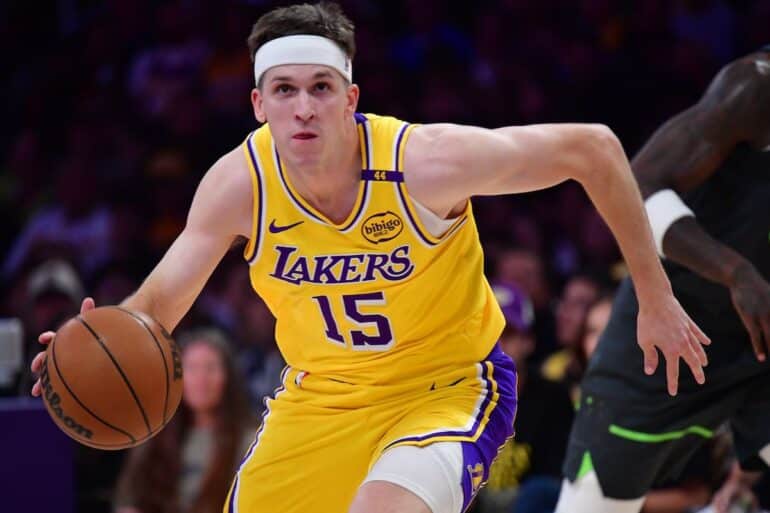
Austin Reaves, though, faces a compelling year ahead of him. The 27-year-old was dealt some hard truths against the Minnesota Timberwolves in the first round, dropping from 20.2 points in the regular season to 16.2, including shooting just 31.9 percent from three. We know he can get picked at defensively but this series showed how much he could be limited offensively by long, athletic wing players.
As the Lakers continue to pivot in retooling around Doncic, Reaves is arguably the most head-scratching debate of the lot. During the regular season, he’s an efficient 20-point scorer who provides more than handy playmaking. He can also be trusted in late-game situations and has come through on several occasions, including in the postseason. Then, there’s the defense that can make him a liability as well as the possibility longer, athletic teams can diminish his offensive impact.
He rejected a four-year, $89.2 million contract extension this summer and recently acknowledged the possibility it makes him a trade candidate. He has a player option worth $14.9 million next summer he is expected to decline. With James on his way out, the Lakers need money to bring in a suitable star next to Doncic.
Can Reaves make his case to be a building block in the Doncic era or does the dynasty start after him? -Vivek Jacob
Phoenix Suns: Ryan Dunn
Ryan Dunn defended like a pro as a rookie wing last season. A porous Phoenix Suns defense forced him to guard primary options night in and night out — Dunn logged the 10th-highest matchup difficulty in the NBA last year — and, for the most part, he held up. And yet, despite grading out as a positive defender by metrics like Estimated Plus-Minus, we haven’t seen his best yet, not even close.
How could Dunn, whom I viewed as the best defender in his draft class, transform a defense by himself, especially a bottom-five unit like Phoenix’s last season? His minutes fluctuated throughout the season, despite his defensive consistency. Head coach Mike Budenholzer neglected to trust his rookies (Dunn and fellow big man Oso Ighodaro), despite their clear defensive value on an offensively slanted team.
But the post-Kevin Durant Suns, for all of their faults, built an intriguing defensive roster. Dillon Brooks is one of the NBA’s better perimeter defenders and a likely stabilizing force on that end. Phoenix’s front office has invested in talented defensive prospects, selecting Khaman Maluach and Rasheer Fleming in this summer’s Draft to join their sophomore duo.
Defensive progression across the board will ripple out to Dunn, who won’t have to perform the jobs of three defenders this season. Will we see more of him flying around and erasing shots as a helper, digging and stunting off of the ball and varying his matchups? At his peak, Dunn could become a rare perimeter defender who could transform a defense by himself. And in more ideal circumstances, he’s likely closer to that point than many realize. -Ben Pfeifer
Sacramento Kings: Keegan Murray
Keegan Murray’s third professional season didn’t prove to be the breakout campaign perhaps many anticipated after a promising first two years. As a rookie, he delighted with off-ball shot-making (41.1 percent from deep) and keen feel for how to operate away from the action. As a sophomore, he only shot 36 percent beyond the arc yet became a pestering on-ball stopper and expanded his self-creation game ever so slightly. In 2024-25, he grew as a finisher (career-high 77 percent at the rim) but regressed again from deep (34.3 percent) and didn’t take another substantial leap defensively.
Some of that stagnation likely stemmed from an in-transit Sacramento Kings organization. During the offseason, they brought in DeMar DeRozan, a talented on-ball creator who undeniably reshaped how they played offensively. Early in the year, head coach Mike Brown was fired and replaced by Doug Christie, who remains head coach today. By midseason, De’Aaron Fox had been swapped for Zach LaVine.
That’s a whole lot of change to navigate over a four-month span. The environment Murray was drafted to in 2022 hardly resembled the one he saw just 2.5 seasons later.
Despite Sacramento’s tenuous outlook, 2025-26 could represent some stability for Murray, offering a full year to assimilate under Christie and alongside the DeRozan-LaVine-Domantas Sabonis core. Can he rediscover his rookie year jumper (or close to it)? Can he continue developing defensively and build upon the intrigue of 2023-24? How much room does he have to blossom as a complementary creator, using his strength and 6-foot-8 frame to forge space inside the arc? Can he grow as a passer?
The makings of a really good three-and-D wing who hounds perimeter stars, knocks down off-ball triples and burns inattentive or unqualified defenders is there. He’s sprinkled flashes of it all but rarely tied it together during his first three years. Now 25 years old and entering his prime, can he turn those enticing ideals into reality? -Jackson Frank