
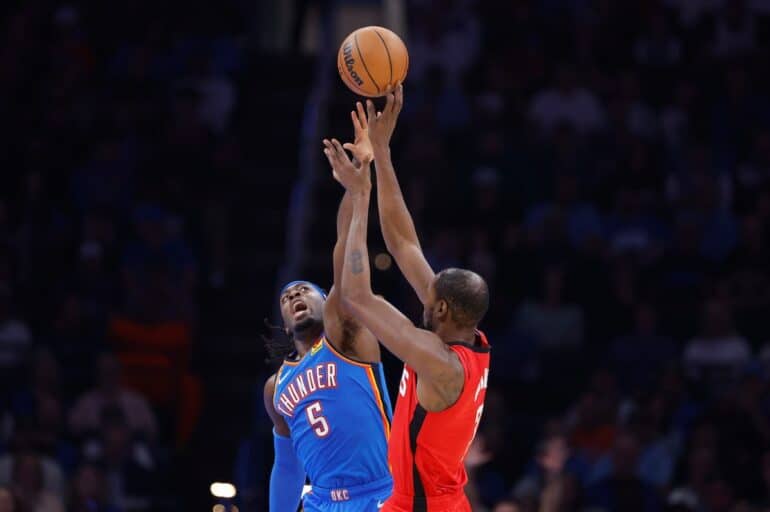
The Oklahoma City Thunder scraped by the Kevin Durant-led Houston Rockets on the NBA’s opening night. It took them two overtimes but the Thunder landed in a familiar spot, leaning on their stalwart defense to eke out a 125-124 victory without Jalen Williams.
On a night missing Williams, and with Chet Holmgren fouling out late, Lu Dort captained Oklahoma City’s defense. He fueled its success, especially against Durant, who finished with 23 points on 64 percent true shooting but took 47 minutes to get there.
Dort sat in Durant’s hip pocket from the opening whistle. His lone steal came in the second overtime but it was a massive one. It’s emblematic of how head coach Mark Daigneault’s group chose to defend Durant from wire to wire — apply constant physicality, make life hell on the passer and keep the pressure on.
per the NBA's tracking data, kevin durant was the most pressured player in the okc-houston game tonight with a pressure score of 0.878 (score is from 0-1 with 1 being the most pressure)
speaks to how well lu dort, alex caruso and cason wallace bothered KD all night pic.twitter.com/eh5HghZKlj
— ben pfeifer (@bjpf_) October 22, 2025
Last season, Oklahoma City’s league-leading defensive unit held opposing offenses to a staggering 106.6 points per 100 possessions. Houston managed a solid 109.7 offensive rating, well below league average but better than the average Thunder opponent.
Most of that success came early on, though, as Houston’s offensive rating dipped from 123.9 in the first half to 103.1 in the second half and overtimes. Durant scored nine points following halftime as OKC dialed up its trademark ball pressure. After defending fairly passively in the first half, the Thunder turned up the pressure early in the third quarter and never looked back. They forced 14 of their 21 turnovers in the second half.
Durant faced the brunt of that pressure, smothered with the ball and guarded out to half-court without it. The NBA released a new tracking-based metric measuring defensive pressure and Durant led the game in “pressure score” at 0.878 (ranging from 0 to 1).
The film certainly checks out. Pay attention to Dort and Durant in the far back corner of the front-court. He isn’t a viable passing option for Alperen Sengun on the open side, so Caruso and the rest of the unit can swarm and force a turnover.
dort deny durant out to half court pic.twitter.com/CIGYVGLu4R
— bjpfclips (@bjpfclips) October 22, 2025
It doesn’t end up mattering but Dort swiftly mirrors Jabari Smith Jr.’s weak corner cut when his teammates collapse on Sengun. If the pressure failed to bother him, Dort would have closed off the interior passing window. He defended sharply away from the ball all night.
According to the NBA’s tracking data, Dort spent 13 minutes, 31 seconds matched up with Durant (including on- and off-ball situations), good for about 70 percent of his defensive matchups in this game. Dort allowed Durant just four field goal attempts; he made three of them but that low total speaks to his incessant ball denial.
There isn’t a way to filter by half or quarter on the NBA’s website yet but I tweeted this screenshot of the aforementioned matchup data a bit before halftime. Durant already put up four shots, suggesting Dort didn’t allow him a single field goal attempt after halftime.
hasn't gone as well since i posted this, but KD is having success scoring on dort when he gets his chances and the rockets scored nearly half of their 1h points from the matchup
dort can only deny him the ball for so long https://t.co/F3YNrB5Cws pic.twitter.com/EGSeHtm7O3
— ben pfeifer (@bjpf_) October 22, 2025
The film mostly checks out, though that data doesn’t account for this play, where Dort fell over while defending Durant. Otherwise, he was sharp.
Dort fall over guarding KD pic.twitter.com/XdjWRZdryD
— bjpfclips (@bjpfclips) October 22, 2025
During those 13 minutes when Dort pressed up on Durant, Houston scored 46 points off of field goals. Intense focus and effort on off-ball movers inevitably opens up the court for isolation scorers to feast and Sengun benefited from Durant’s gravity.
From the very beginning of the game, Dort and the Thunder’s pressure and denials left Sengun alone in the middle of the floor to work. Open floors resulted in 39 points from Sengun on sparkling 67 percent true shooting (although, his five 3-pointers fueled that as well).
Sengun was a graceful battering ram, overcoming a slow first half and adjusting to Oklahoma City defending him primarily with guards like Alex Caruso and Dort. And while Sengun’s blistering stat line deserves praise, the Thunder will accept a big individual scoring night amidst a poor offensive night from the Rockets overall.
Oklahoma City gave up plenty of threes to a Rockets offense which ranked 27th in 3-point shooting last season. Despite an uncharacteristic 40.2 percent 3-point frequency, the Rockets made 28.2 percent of those shots. Durant took and missed four threes as OKC funneled outside shots to players like Smith (2-of-6), Amen Thompson (0-of-7) and Reed Sheppard (2-of-7).
Cason Wallace played a masterful game, racking up four steals and making big threes when most of his teammates couldn’t find pay dirt. Shai Gilgeous-Alexander pressured the ball and flew around on the weak side, logging two steals and two blocks for his troubles. Holmgren and Isaiah Hartenstein helped hold Houston to a 23.7 percent rim frequency, nearly 10 percent lower than last season’s mark.
The Thunder converted 13-of-52 3-point attempts and Gilgeous-Alexander scored 11 points through three quarters. Most teams can’t win games under those circumstances but Oklahoma City’s defense was up to the task. Its defensive riches allow for stylistic versatility and, most critically, to weather the storm of an 82-game NBA season.
Oklahoma City’s defense, paired with Gilgeous-Alexander’s offensive brilliance, is a championship formula. It’s already proven that much. Unlike most elite defenses, the Thunder win defensively in so many ways and have constructed a lineup where any of their defenders might be a game plan’s keystone player.
Sometimes, it’s Caruso battling with and slowing Nikola Jokic in a pivotal Game 7. It might be Williams anchoring an elite interior defense with Holmgren and Hartenstein sidelined. On Tuesday, it was Dort’s tone-setting physicality that disrupted Houston’s offense and minimized one of the league’s all-time great scorers.