

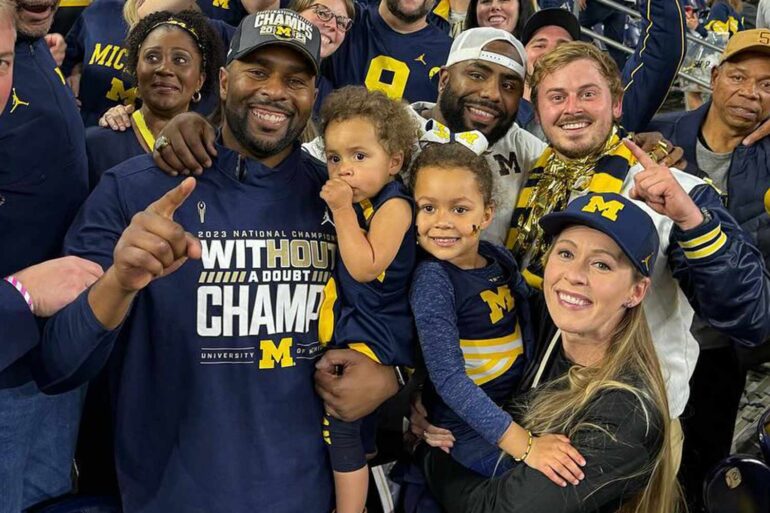
Following the abrupt firing of Sherrone Moore, Michigan has already lost at least two 2026 football recruits and seen another Letter of Intent released.
The University of Michigan’s 2026 recruiting class has been rocked by a trio of departures in the days since former head coach Sherrone Moore was fired “with cause,” triggering a wave of uncertainty for prospects committed to the program.
First came news that Billings West (Mont.) two-sport star tight end Matt Ludwig was released from his 2026 Letter of Intent following Moore’s dismissal.
Billings (Mont.) West four-star TE Matt Ludwig tells @Rivals he’s been released from his Letter-of-Intent: https://t.co/VwMLoRpibF pic.twitter.com/HMb1k756Hj
— Steve Wiltfong (@SWiltfong_) December 11, 2025
Ludwig, a standout tight end prospect in the Mountain West region, had signed his LOI in December before the coaching upheaval. With the staff in flux, Michigan granted his release, allowing him to pursue opportunities elsewhere without penalty.
In addition, Michigan has now lost its second recruit from the 2026 cycle since Moore’s firing.
Reports from The Detroit News confirm that another committed player, a talented defensive prospect, has reopened his recruitment, electing not to stay with the Wolverines amid uncertainty about the future staff and scheme direction.
That trend follows an earlier move by Michigan’s athletic department, which released recruits from their letters in the immediate aftermath of the coaching change.
A USA Today report noted that recruits affected by the situation were granted releases without the typical penalties, a gesture toward fairness but also a tacit acknowledgment of instability.
Why recruits are wavering: Moore’s exit vs. program clarity
Coaching changes always introduce risk into a recruiting class, but the sudden nature of Sherrone Moore’s dismissal, coupled with details from police dispatch audio and the bizarre legal situation that precipitated it, has accelerated concerns among prospects and their families.
The firing was not a typical parting; it was tied to misconduct allegations and a separate arrest, eroding recruits’ confidence about what their future would look like in Ann Arbor.
For recruits, the calculus in the modern NCAA landscape is razor-thin. Confidence in coaching continuity, scheme fit, and long-term development pathways often weighs as heavily as facilities or tradition.
Michigan just signed a top-15 recruiting class loaded with elite talent
Got to wonder if we see any recruits ask to be released from their Letter of Intent https://t.co/pUlyTolHPY pic.twitter.com/PmYSdo96LZ
— Josh Newberg (@josh_newberg) December 10, 2025
With Michigan’s staff in the early stages of reconstruction, prospects may see more certainty elsewhere, particularly at programs with already-established staffs and stable leadership going into the 2026 cycle.
Granting releases is also common practice in these scenarios, but the optics matter: when multiple signees depart in short order, it signals a class that could fracture unless the new staff acts swiftly to secure commitments and restore trust.
Implications for the 2026 class: quality, depth, and momentum
Losing multiple high school prospects, including tight end Ludwig with a strong regional profile, jeopardizes not only class size but also the positional balance Michigan had built.
Tight end is a premium spot in both pro-style and spread offenses, and Michigan’s early 2026 board included several players earmarked to develop into frontline contributors.
While departures at this stage don’t automatically doom a class, signees can be replaced, and coaches often pivot quickly, the timing (right before early signing periods and National Signing Day) complicates efforts to backfill.
Other programs will be actively pursuing these players, pointing to potential poaches from legacy competitors and rising contenders alike.
BREAKING NEWS:
5 Star RB Savion Hiter has asked to be released from Michigan, and plans to sign with Tennessee.
He is expected to be granted a release due to the firing of Michigan Head Coach Sherrone Moore.
This adds to an already loaded 2026 recruiting class for Tennessee. pic.twitter.com/Hq0aC9BXSw
— Maryland Vol (@MarylandVol) December 10, 2025
For Michigan, the key questions now become:
-
Can the new staff retain the remaining commits and reassure them of a clear vision?
-
Will Michigan target re-recruiting back those released signees once the staff is finalized?
-
How will the Wolverines adjust their offer lists and crystal ball predictions to salvage the class’s overall ranking and depth?
Michigan’s broader offseason turmoil
The recruiting losses are the latest chapter in a tumultuous period for Michigan football. Sherrone Moore’s firing, tied to NCAA and internal investigations, police dispatch audio reports, and a subsequent arrest, has not only upended on-field leadership but also shaken the program’s public image.
That kind of context can resonate with recruits, boosters, and fan bases alike, particularly as high-profile prospects reassess their collegiate path.
Assistant coaches, including defensive line coach Anwar Stewart, have been named to interim roles as Michigan attempts to steady the ship.
But until the head coach position and core coordinators are formally announced and marketed, uncertainty is likely to linger, which may further influence recruiting decisions in the early winter signing period.
What comes next: stabilization or further erosion?
Michigan’s top priorities remain:
-
Finalize the new staff quickly — bringing in reputable coordinators and retaining key recruiters on the current roster to reassure prospects.
-
Communicate consistently with recruits — hosting virtual and in-person meetings to reaffirm commitments and illustrate a clear strategic direction.
-
Monitor the transfer portal — both to add experienced players and to mitigate losses as recruits reassess options.
It’s not unprecedented for a program to recover from a turbulent offseason, but the speed and clarity with which Michigan moves will heavily influence how the 2026 class ultimately shapes up.
For now, the early departures serve as a stark reminder that recruiting and stability go hand in hand, and that repositioning a class in transition requires both strategic urgency and confident messaging.