
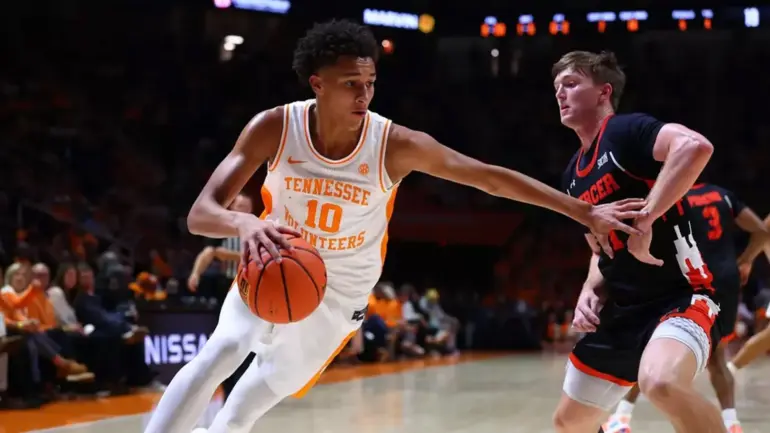
Prior to the 2025-26 college basketball season, few prospects received more 2026 NBA Draft buzz than Tennessee freshman Nate Ament. Draft media members like Jonathan Givony ascribed an enormous ceiling to the 18-year-old forward. Recent mock drafts from CBS’s Kyle Boone, Bleacher Report’s Jonathan Wasserman and ESPN’s Jeremy Woo (from mid-November) all placed Ament as top-10 pick at the lowest.
Through 10 games, his box score production (16.3 points, 7.1 rebounds and 2.8 assists per game) and his national media evaluation suggest he’s deserving of his status as a top pick in a loaded 2026 NBA Draft. But a more granular and detailed analysis of Ament’s college start paints a far murkier picture, one that portrays him as my 2026 NBA Draft class’s biggest faller.
Ament is struggling below the surface
Ament’s surface measurables and elevator scouting notes — a 6’10, teenage forward with elite outside shooting touch — resemble a slam-dunk top-five pick regardless of draft. Wasserman mocked Ament 10th in his recent mock draft, the lowest of any national publication I found, citing growing worries about the highly-touted freshman:
” The combination of 6’10” size and guard/wing skills will continue to create the idea of potential and upside with Nate Ament. However, scouts are becoming less enthusiastic about his current play and outlook as he’s struggling against Tennessee’s credible opponents…Ament is currently losing steam during a draft cycle with so many other exciting prospects.” – Bleacher Report’s Jonathan Wasserman
Wasserman cites some of his positive traits, but Ament’s film and underlying metrics, especially against top teams, depict Ament as a player who should return to school and develop for a few seasons before entering the NBA, not a top-five pick in an elite draft. According to my hand-tracked “Net Impact Plays” metric, which aims to attribute credit to every single play a prospect makes in a game, tagged through the lens of projection, he’s playing like one of the least-productive prospects in manners that translate to NBA upside.
I’ve charted six of Ament’s 10 games, three of those against high-major competition (Houston, Rutgers and Illinois). Of the 39 prospects with at least 90 total minutes tagged this season Ament ranks 35th in overall Net Plays per 40 minutes, 28th in Offensive NP/40 and 31st overall in Defensive NP/40. I didn’t chart individual sides of the ball in 2025, but Ament would rank last of the 33 players I charted last cycle.
Disappointing statistical production
My film-based ‘metric’ hasn’t been kind to Ament so far; let’s dive into why that is. Before even viewing any film, his advanced numbers begin to tell us how and why he’s struggled so far. Across the entire season, Ament scoring on 51.8% true shooting and carrying a massive 30% usage rate, making 42.3% of his twos and 28.9% of his threes.
Those numbers, especially the 2-point scoring ones, are already concerning, but they become even ghastlier in his four games against top 100 teams — 28.5% usage, 41.3% true shooting, 28.1% on twos and 20% on threes. That lines up with my hand-tracking, as Ament’s two worst games by a significant margin game against Houston (3.33 NP/40) and Illinois (-1.29 NP/40).
Projecting stars is a challenging endeavor, but intersecting of youth and dominance often points towards future NBA difference maker. My charting aims to quantify play-to-play dominance and Ament has not been that to this point. His admittedly great shooting touch should indicate positive 3-point regression and added strength boosted his slashing and foul-drawing production.
Through his first 10 college games, Ament is posting an excellent 58.5% free-throw rate, way up from 36% during his final AAU season (according to Synergy). He’s clearly added muscle mass and that’s dictating his play, as Ament’s downhill aggression is at its highest point. However, I’m fairly skeptical that leap indicates future athletic dominance.
Ament’s slight frame might limit his total mass capacity and, to my eye, his weight gain has already harmed his mobility on defense and speed on the floor. While he wasn’t ever a burner, Ament looks notable less sudden and fluid with the ball and especially on defense, which was a major strength for him before college.
Less mobility and explosiveness deflate his defensive impact, as he previously excelled on and away from the ball with exceptionally fluid hips, light feet and enough juice to defend the rim. In 20 games during his final AAU season, Ament blocked 32 shots. He’s blocked just one in 10 college games, clearly less athletic, attentive and intense on defense than before.
Nate Ament defensive lapses pic.twitter.com/MUnhYic8F2
— bjpfclips (@bjpfclips) December 12, 2025
How will his season finish?
Ament’s 3.3% steal rate is a solid mark, but that drops to a poor 1.5% in his four top-100 games. Whether it’s due to mobility/athleticism declines, offensive load or something else, he’s played poorly on defense and that’s a major blow for his profile which relied on that defensive upside to compensate for his offensive limitations.
Despite his poor outside shooting start, I’m not worried about his 3-point outlook. While 3-point percentage is an unreliable shotmaking indicator, his volume (9.3 3-point attempts per 100 possessions), free throw shooting (80.6%) and pre-NCAA shooting success all indicate he should develop into a dangerous floor-spacer and pull-up shotmaker.
Size and outside shooting should provide a reasonably high floor for Ament. The NBA loves his archetype of player and gigantic shooters have easy pathways to providing value as role players, spacing the floor with the theoretical frame to facilitate defensive schemes. But how can Ament, who can’t reliably create shots for himself and doesn’t pass or defend at a high level, return a top-five ceiling, especially in a stacked draft class?
There’s plenty of season left for Ament to play his way back into the top-five of my board, but for the moment, he’ll continue sliding down towards my mid-to-late first-round range. His pathways to NBA impact are clear but in a class with so many high-ceiling players, Ament shouldn’t leave the board within first 10 picks unless he significantly improves his on-ball creation, defensive aptitude and decision making by season’s end.