
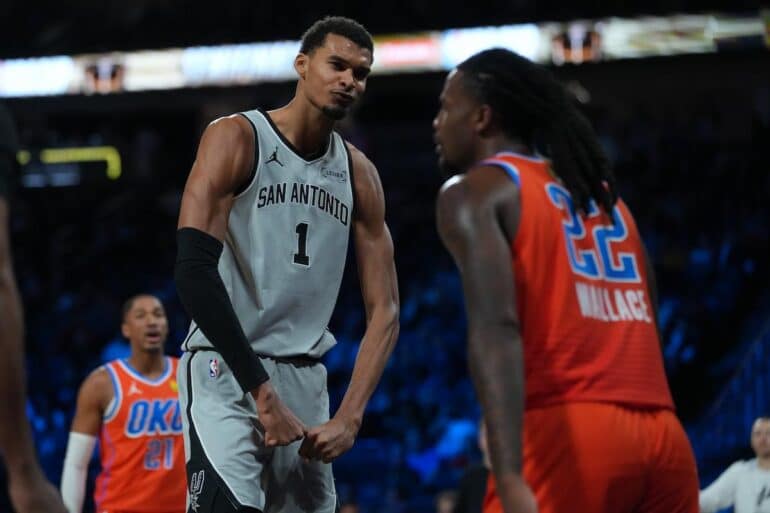
Victor Wembanyama’s triumphant return for the San Antonio Spurs in their NBA Cup Semifinal win against the Oklahoma City Thunder was timely. It powered the Spurs toward an opportunity to win a midseason accolade and reminded the general basketball public of why the 7-foot-4 French phenom is such a terrifying force, both in the manner with which he captains the defense and the way opponents are forced to have to shift their geometry around him.
Due to a left calf strain (which an alarmingly increasing number of players are suffering), Wembanyama missed 12 straight games after the Spurs’ loss to the Golden State Warriors on Nov. 14. Prior to this long absence, he was averaging 26.2 points, 12.9 rebounds, 4.0 assists, 1.1 steals, and 3.6 blocks, numbers on pace for All-NBA and All-Defensive Team selections, let alone frontrunner status for Defensive Player of the Year. But the time missed means there is little leeway for him to sit out and remain eligible for the aforementioned awards by playing 65 or more games.
Should he qualify and win defensive accolades, it would be much deserved. The Spurs’ defense gives up ~12 points per 100 possessions fewer with Wembanyama on the floor this season, with their defensive rating vaulting from 107.7 to 119.9 when he sits. That’s equivalent to a change from the league’s second-best defense to its 25th-ranked defense (garbage time eliminated).
And yet, despite Wembanyama’s 12-game absence, the Spurs were able to muster a 9-3 record over that period, behind an offense that averaged 121.5 points per 100 possessions – equivalent to the third-best offense in the league. Having to face the NBA’s undisputed best defense in the Thunder meant such offensive excellence would be difficult to replicate and sustain. To open their game Saturday, it very much seemed to trend that way.
Immediate Impact On The Boards
Under a minutes restriction, Wembanyama would enter the game in the second quarter, with the Spurs down by 11 points. His impact was immediately felt against an undersized Thunder bench lineup featuring 6-foot-9 Jaylin Williams as its tallest player, meaning Wembanyama was the tallest player on the floor by seven inches (generously).

Having to dedicate a significant number of defenders toward hauling in the defensive rebound against Wembanyama meant there would be unmarked players out on the perimeter – a fact Wembanyama’s entrance readily made apparent:

A Quick Return To Defensive Form
While Wembanyama would make plays defensively through his direct involvement, it was as if his insertion into the game gave the rest of his teammates a significant boost in their defensive abilities and effort. Switching guard-guard actions up top was the norm, forcing Shai Gilgeous-Alexander into making plays in isolation (which doesn’t sound like a raw deal at all for the best self-creator in the league). But having Wembanyama on the backline meant drives were virtually impossible, forcing Gilgeous-Alexander and company into long-range shots and in-between attempts.
To their credit, Wembanyama’s corps of perimeter defenders flashed their defensive chops, perhaps invigorated by the massive security blanket playing behind them. At the same time, the typically mistake-proof Thunder suddenly found themselves making more blunders with Wembanyama on the floor:

If any Thunder player dared challenge Wembanyama, it was a bold and risky choice to make. He won’t block every shot, nor change the trajectory or instill enough trepidation to prompt hesitation from even the most disciplined of shot-makers. But more often than not, shots will end up falling just short of their target, should they even get past his long arms:

The timing of lobs are altered because of Wembanyama’s uncanny ability to play the middle ground between ball-handlers and his own assignment. A well-oiled machine found itself hitting a snag in between the cogs, one that had Victor Wembanyama’s name written all over it:

And, of course, Wembanyama’s perceived rival, Chet Holmgren, wasn’t spared:

But just as Wembanyama’s impact was apparent in the overt defensive plays, the subtle ways through which he stamped his defensive dominance over the Thunder were equally impactful. He acted as a defensive floor general of sorts by shifting pieces around on the floor, mostly to keep himself in a position close to the rim and take such an avenue away from the Thunder.
Not long after Wembanyama blocks Holmgren in the sequence above, he doesn’t bask in the high of the moment. Rather, he tells De’Aaron Fox to switch onto Holmgren on the perimeter and keeps himself positioned as the backline defender:

When Wembanyama switches onto Ajay Mitchell in the possession below, he immediately communicates to Julian Champagnie to switch onto Mitchell, so Wembanyama can remain as the low man. The off-ball “scram” switch pays dividends when Gilgeous-Alexander drives and sees Wembanyama rotating to help. His presence forces Gilgeous-Alexander to abort and make a wayward pass to the corner, coaxing the typically turnover-proof superstar into an uncharacteristic error:

The Thunder were limited to a 19 percent rim attempt rate (seventh percentile) against the Spurs, no doubt influenced by Wembanyama’s presence. While the Thunder profile as one of the more infrequent rim attackers in the league (30.3 percent rim frequency, 19th in the league), being limited even further in that regard speaks to how impactful a rim deterrent Wembanyama was.

A One-Man Anchor
But even as the Thunder have proven they can overcome any obstacle presented in front of them, Wembanyama did not care one single bit about the Thunder’s pedigree, evidenced by the massive difference in the Spurs’ defensive rating between Wembanyama’s time on the floor (85.1) and his time off the floor (116.9).
Even more incredible: Wembanyama’s defensive impact, accompanied by a 22-point night in just 20 minutes and 39 seconds of play, translated into the Spurs outscoring the Thunder by 21 points in such minutes – in a game San Antonio won by only two points.
It would be a shame if Wembanyama had to miss more time, which would eliminate his candidacy for individual awards. He more than deserves a spot on an All-Defensive Team and votes for Defensive Player of the Year. Ultimately, team performance factors into such consideration and the Spurs are currently 14th in points allowed per 100 possessions during non-garbage time while the Thunder are a commanding first – which means the award will most likely be awarded to a Thunder player (specifically, Holmgren).
But for one night, Wembanyama – in his contributions behind the Spurs limiting the Thunder to 102.8 points per 100 possessions, well below their season average – was a superior anchor to the Thunder’s own brand of collective lockdown defense.