
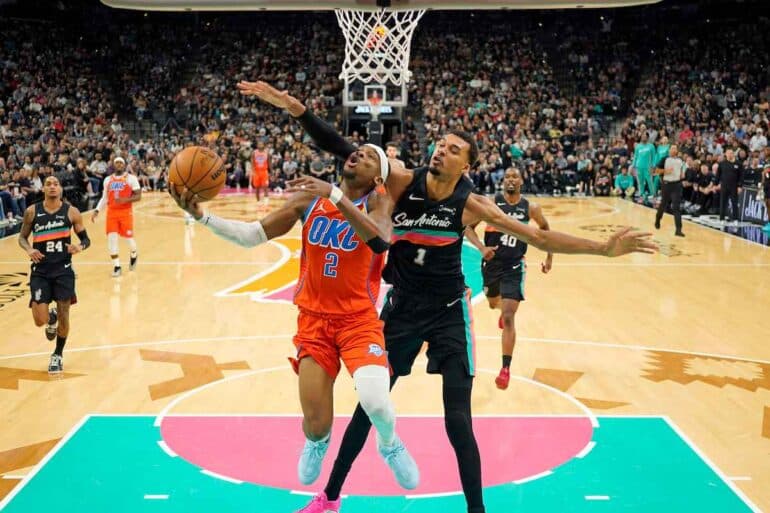
After the Oklahoma City Thunder’s Christmas Day loss to San Antonio — their second in three days and third over the last two weeks to the Spurs — a struggling Jalen Williams gave a simple answer when asked about the nature of his team’s issues:
Jalen Williams on their problems against the Spurs: “There’s this 7-foot-5 guy that takes up a lot of space on the floor.”
Said they remind him of the 2024 Thunder pic.twitter.com/0ExA6nPHO5
— Clemente Almanza (@CAlmanza1007) December 25, 2025
Is Williams correct? Can we sum up his club’s shortcomings against this Spurs team as concisely as he did? Oklahoma City’s record (26-5) and net rating (plus-15.1) both lead the league and the Thunder are still on pace for 70-plus wins. But this title-defending OKC team can’t seem to crack San Antonio and it’s hard to ascribe the bulk of the blame to anyone but Victor Wembanyama.
For the most part, Williams’s succinct assessment rings true — San Antonio’s Parisian wunderkind warps the geometry of the basketball court and changes how a dominant basketball team can operate. Even a casual observer can easily grasp how a player of Wembanyama’s stature can destroy game-plans, even those from historically good opponents.
The Spurs Are Built To Attack This Thunder Defense
While Wembanyama is the fulcrum of his team and the primary thorn in Oklahoma City’s side, Williams also mentioned San Antonio’s connectedness and collective hunger as reasons for its success. Nowhere is that more apparent (aside from the demeanor of its superstar) than in its trio of dynamic perimeter creators. None of OKC’s competitors comes close to matching the collective rim pressure and playmaking provided by De’Aaron Fox, Stephon Castle and Dylan Harper.
Oklahoma City unsurprisingly leads the NBA in defensive points per possession overall (0.934) and in the half-court (0.920). In three games against San Antonio, OKC’s defense posts the equivalent of the 29th-ranked unit overall (1.065) and half-court unit (1.036). Even with Wembanyama on the bench (178 possessions), a normally impregnable defense dips to the equivalent of 22nd overall (1.028) against the Spurs.
The Thunder still produce top-five half-court defensive results (0.979 PPP) against the Wembanyama-less Spurs but the Cerberus spearheading San Antonio’s backcourt matches up with OKC’s seemingly endless supply of perimeter defensive weapons better than any team in the NBA.
Fox boasts a deft enough handle and lightning quick pull-up trigger to create shots in a phone booth against airtight on-ball defense. Harper and (especially) Castle slash with physicality and athleticism most guards cannot. OKC’s opposing turnover rate dips from 18 percent overall to 13.9 percent against San Antonio. Many teams lack a single guard who can break down OKC’s sturdy perimeter shell but the Spurs roster three of them.
for my money, this drive was dylan harper's most impressive play of his career (aside from the winner against NOP), especially considering the opponent
how many guards, let alone rookie guards, crack the paint and force help w/o a screen cnc see/execute this absurd rim assist? pic.twitter.com/way35yaUMl
— Ben Pfeifer (@bjpf_) December 26, 2025
An OKC defense predicated on aggressive gap help ahead of two dominant paint-protecting centers predictably allows the league’s lowest opposing rim frequency (30.4 percent), which increases to a still-strong 33.1 percent against San Antonio. But with Wembanyama on the floor, that opposing rim rate skyrockets to 41.2 percent, slightly higher than the league-worst Brooklyn Nets (41 percent).
When offenses grind their way to the hoop against the Thunder, they’re almost always laying the ball up; OKC allows the second-lowest dunk frequency on rim attempts (14 percent), which jumps to 19.8 percent against the Spurs. Interestingly, toggling Wembanyama on and off doesn’t change that rate, which speaks to the impact of Luke Kornet and the Spurs’ collective guard talent.
against OKC's defense, 14% of opponent rim attempts are dunks, the second-lowest rate of any team, per synergy. when that opposing offense has victor wembanyama, OKC allows a 19.1% dunk rate on rim attempts bottom-6 rate!
not even OKC can stop this slam dunk machine pic.twitter.com/QSighYib9A
— Ben Pfeifer (@bjpf_) December 26, 2025
Simply put, Oklahoma City’s defense denies access to the highest-value shots on the court and the Spurs have a master key to the basket. Very few teams have been able to dominate the paint against the Thunder like San Antonio has this season, which is even more apparent when OKC has the basketball.
The Thunder Can’t Get To The Paint Against The Spurs
In three games against San Antonio, a top-five overall (120.3) and top-two half-court (104.1) offense plummets to the equivalent of a league-worst overall (107.6) and half-court unit (90.1). Just as they do offensively, the Spurs own the paint against Oklahoma City, forcing the Thunder to live and die by jumpers.
When Wembanyama takes the floor, Oklahoma City attempts 21.3 percent of its shots overall and 14.4 percent in the half-court at the rim, both ghastly figures. Against everyone else, including the Wembanyama-less Spurs, the Thunder post a much more normal 35.1 percent overall and 29.1 percent half-court rim rate.
We’ve watched playoff defenses replicate this formula to slow Oklahoma City’s methodical offense — pack the paint, show Shai Gilgeous-Alexander multiple bodies and force mediocre offensive role players to win as spot-up shooters and closeout attackers. Wembanyama and Kornet facilitate this game-plan as well as any team could.
Oklahoma City’s occasional reliance on role player shooting variance for offensive success is nothing new. But no team forces this win condition as well as San Antonio can, especially when that defense stations Wembanyama or Kornet as roamers off of a weaker offensive player like Alex Caruso, snatching control of the game from the offense.
Caruso yesterday had as damaging a game for his team's offense as I've ever seen.
He started 0-9 from three and *0-6* when "matched up" with Wemby, who was completely roaming off him.
Obviously, you cannot allow the best rim deterrent in the NBA to totally ignore one player. https://t.co/CUzYa5WCKY pic.twitter.com/YISM479p6T
— Carson Breber (@Carsobi) December 26, 2025
What The Thunder Can Do Differently
Therein lies a silver lining for the Thunder, though, which haven’t yet made threes at a reliable clip against the Spurs. The problems extend well beyond Caruso’s slump — Oklahoma City has converted 28.6 percent of its catch-and-shoot threes against San Antonio (28 attempts per game), compared to 37.3 percent against all other teams (29.3 per game).
In those three games, Caruso (3-of-17), Gilgeous-Alexander (3-of-17), Cason Wallace (2-of-13), Aaron Wiggins (2-of-9) and Chet Holmgren (2-of-8) all shot well below their averages. Only Lu Dort (8-21) and Williams (4-of-11) have found any 3-point shooting success in these games.
More fortunate 3-point shooting luck, alongside sharper offensive form from Williams as he continues to acclimate post-injury, might be enough to flip a win or two from the Spurs. But to regain control of the game and the paint from San Antonio, the Thunder might experiment with more double-big lineups against Wembanyama.
Lineups featuring OKC’s center tandem of Holmgren and Hartenstein produced efficient offense against San Antonio (1.089 PPP) on 79 possessions across their three matchups. But Wembanyama was on the floor for just two of those 79 possessions, one of those two an end-of-game swap for rebounding.
San Antonio’s stable of guards and offensively threatening forwards, such as Devin Vassell and Harrison Barnes, likely coax head coach Mark Daigneault away from his taller lineups. And the Spurs have deployed Wembanyama and Kornet together against OKC for 20 total possessions, rarely forcing the Thunder to match size with size.
But for the Thunder to conquer this edition of the Spurs, a team they very well might match up with in the postseason, they must return to dictating the game and, as Williams alluded to, regain control of space on the basketball court. Rolling out two elite big men, even against lineups with four smaller players flanking Wembanyama, could warp that space back towards OKC’s favor.
This young, feisty San Antonio team undeniably has the defending champs’ number like few other teams do. Even if they don’t face off in the playoffs, the Thunder and Spurs play twice more in 2026. Whether those are the final two face-offs between these rising juggernauts this season or just a precursor for what’s to come in the playoffs, overcoming San Antonio is Oklahoma City’s literal and figurative largest obstacle to a second-straight NBA championship.
All stats sourced from Synergy Sports, Cleaning the Glass, NBA and Dunks & Threes