
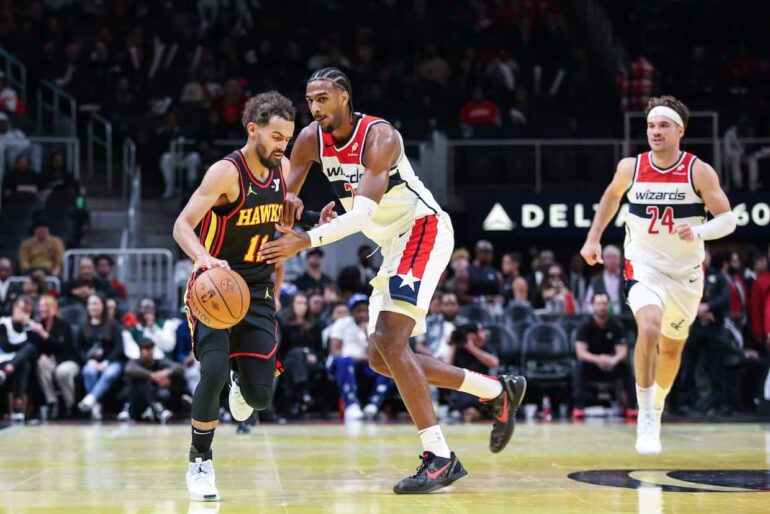
The 2025-26 NBA season was met with its first blockbuster trade on Wednesday, as the Atlanta Hawks sent their four-time All-Star point guard and franchise player for the last eight seasons, Trae Young, to the Washington Wizards in exchange for Corey Kispert and CJ McCollum.
BREAKING: The Atlanta Hawks are trading four-time NBA All-Star Trae Young to the Washington Wizards for CJ McCollum and Corey Kispert, sources tell ESPN. pic.twitter.com/WIf8rhrRFu
— Shams Charania (@ShamsCharania) January 8, 2026
With the Wizards emerging as frontrunners in the Young sweepstakes, his potential benefit to this team has been well-documented. In Young, the Wizards get one of the game’s great organizers to help nurture their cavalcade of young wings, forwards and bigs.
But what about the Hawks? Did they get the proper return package for Young? Or, did they sell low on their most accomplished player of the last half-decade?
Young Trade Makes The Hawks More Dangerous In The Short-Term
If you’ve been following this situation at any point, you’ve likely heard some variation of this statistic. The Hawks are 2-8 when Young is in the lineup this season and 16-13 when he is not. The explanation here is multifaceted.
Jalen Johnson’s emergence has given the organization a new primary building block. Young has been the victim of some poor opponent shooting luck. But mainly, his offensive impact has diminished to the point where it no longer justifies the immense strain his frail frame puts on the Hawks’ defense.
Still, the Hawks weren’t gangbusters without Young. During his 1,602 minutes off the floor, they had an unimpressive plus-0.3 net rating (per PBP Stats). While their defense improved vastly without Young (nearly 16 points per 100 possessions), their offense fell off a cliff (losing nearly eight points per 100). This stems from a lack of on-ball creation and shooting.
This is where McCollum comes in. The Lehigh legend has made well over $250 million dollars in the NBA thanks to his ability to put the ball in the net. Before this year, McCollum had 11 straight seasons averaging at least 20 points per game. And even this season with the downtrodden Wizards, he’s still managed 18.8 points per game on league average efficiency (58.2 percent true shooting).
Unlike Young, though, there is a lack of “stickiness” in McCollum’s game. He doesn’t need to dominate the ball to be effective. His lengthy tenure alongside Damian Lillard taught him how to oscillate between playing with and without the basketball and he has taken those lessons with him at every stop since.
Last season, McCollum averaged roughly 3.8 seconds per touch, which is 1.7 seconds fewer than Young’s average. This means he’ll be able to boost the Hawks’ gunky half-court attack without hindering the development of their other emerging stars. And while McCollum has never been known to be a good defender, his slightly larger frame and veteran guile allows him to be far less of a detriment than Young was on that end.
Kispert is one of the league’s premiere 3-point shooters — averaging 39.5 percent from downtown on seven attempts per 75 possessions (72nd percentile, per Dunks & Threes). In theory, he isn’t too different from Luke Kennard, a marksman who has struggled at times with Atlanta because of his lack of lateral agility.
However, Kispert is a little bit bigger than Kennard (his reported wingspan is two inches longer) and he’s a little more athletic (he has 48 more career dunks than Kennard, despite playing four fewer seasons). So, maybe, he can have some more success with the Hawks than Kennard has up to this point.
Plus, we’ve never seen Kispert on a team with this much talent. Maybe, his gift is amplifying good teams rather than buoying lackluster ones. At the very least, he makes for a nice depth piece on an affordable contract (three years, $40 million remaining after 2025-26).
The Hawks Now Have Long-Term Flexibility
It may seem odd seeing an All-Star change teams with no draft capital involved but you have to think about the financial aspect. Young is a good player (even with his polarizing skillset) but he is on a negative value contract. He’s owed $95 million over the next two years, which is a pretty penny to play for a small guard who requires a very specific team around him. The fact they were able to move him, get useful short-term pieces in return and not have to attach any of their own picks is a huge win for the Hawks.
On top of that, they have now set themselves up for financial freedom moving forward. Aging veterans like Kristaps Porzingis, McCollum and Kennard will be off the books after this season. Meanwhile, all their key young players are under bargain deals for the next couple of seasons.
The Young era did not go the way the Hawks thought it would when they chose him over Luka Doncic on draft night eight years ago. But the Hawks deserve credit for cleanly turning the page to the next chapter.