
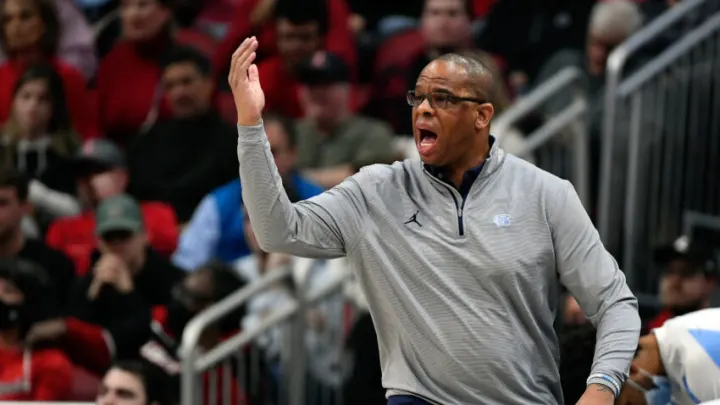
North Carolina’s recent losses under Hubert Davis have followed a familiar script. Opponents generate clean perimeter looks. UNC struggles to score for extended stretches late in games. Leads disappear without a clear adjustment that changes the flow. The Stanford loss fit that description closely, but it was not an isolated case.
What makes the current situation different from a normal rough patch is how often the same problems have shown up across multiple seasons. Different rosters have produced the same outcomes. That points the focus away from personnel and toward coaching.
UNC Basketball Losses Under Hubert Davis Follow A Repeating Pattern
The core issues are easy to identify because they keep resurfacing.
UNC are meant to be a powerhouse in college basketball. But too many times in recent seasons recurring issues are showing up.
Thye regularly allows opponents to get comfortable from three-point range. Closeouts are late. Shooters catch the ball in rhythm. When teams heat up, those runs tend to stretch because UNC struggles to string together defensive stops.
On the other end, the offense often bogs down late. Possessions become slow and predictable. Ball movement stalls. Scoring droughts turn manageable games into uphill fights.
These problems appeared again at Stanford, where UNC led for long stretches before a late collapse driven by perimeter shooting and a prolonged offensive lull.
Why The 2022–23 Season Still Stings for UNC
The 2022–23 season remains the clearest data point in assessing Davis’s tenure. A preseason No. 1 team missing the NCAA Tournament is not a normal variance outcome. It reflects systemic weaknesses.
That group struggled to defend consistently and could not manufacture offense when the jump shot stopped falling. Those same stress points are still present now. The names on the jerseys have changed, but the pressure points have not.
That season now reads as an early warning sign.
Late-Game Execution Remains A Major Weakness
UNC continues to have trouble closing games.
Extended stretches without a field goal late have become common in close losses. Sets break down. The offense relies heavily on individual shot-making rather than creating advantages. When opponents make a push, UNC often lacks a reliable counter.
Three-Point Defense Issues Have Persisted Across Seasons
UNC Tar Heel fans.. yall are gonna have to be vocal if you want to see a Change in effort.
Stop IGNORING
Snr Cpt SETH TRIMBLE DEFENSE has single handily cost NORTH Carolina the SMU & Stanford GMs!! PERIOD.
Literally 15-20 x BOTH gms!!
either intentional or laziness. #goheels pic.twitter.com/fH2MzKHCEG
— Jᴇssᴇ Jᴀᴍᴇs (@NotoriousJesse) January 15, 2026
Opponents consistently find space on the perimeter against UNC. That has been true with different lineups and different defensive looks.
When a problem spans multiple seasons and personnel groups, it stops being matchup-based. It becomes part of the program’s defensive identity.
Stanford’s three-point output was extreme, but it followed a familiar pattern of clean looks and limited disruption.
Free Throw Problems Reflect Preparation And Structure
Free throws continue to factor heavily in close UNC losses.
Missing double-digit attempts in tight games has happened too often to dismiss. UNC signs players capable of converting at the line.
When free throw shooting repeatedly becomes a late-game problem, it points toward practice emphasis and in-game accountability.
Hubert Davis Salary & Buyout
One reason coaching changes stall at major programs is contract structure. That is not a major obstacle here.
Hubert Davis is under contract through 2030, but his buyout is tied to base salary, not total compensation.
- Base salary: $1.25 million
- Estimated buyout during the 2025–26 season: approximately $6.25 million
- Estimated buyout after the season: approximately $5.0 million
For a program with UNC’s resources, that figure is manageable. It is not insignificant, but it does not prevent action.
The Risk Of Standing Pat Is Greater Than The Cost Of Change
The real concern for UNC is not making a coaching change too quickly. It is allowing familiar problems to continue without intervention.
When the same defensive breakdowns and late-game struggles persist across multiple seasons, waiting for organic improvement becomes a weak strategy. Another offseason does not address schematic shortcomings. Roster turnover alone does not fix game-management issues.
Why Another Season Is Unlikely To Produce Different Results
Arguments for patience assume that growth is occurring. The on-court evidence suggests repetition instead.
UNC has remained competitive in many games, but competitiveness without consistent execution has produced the same outcomes. Close losses driven by shooting runs, scoring droughts, and missed opportunities have become routine.
There is little indication that those issues are trending toward resolution.
The Case For UNC To Fire Hubert Davis
This evaluation is not about effort or loyalty. It is about results and sustainability.
UNC expects to compete deep into March on a regular basis. That requires a coach who can adjust during games, protect leads, and eliminate repeat vulnerabilities.
To this point, Hubert Davis has not shown the ability to correct the same issues that have followed his teams year after year.
If UNC wants different outcomes, it will need a different approach. That likely means a different head coach.