
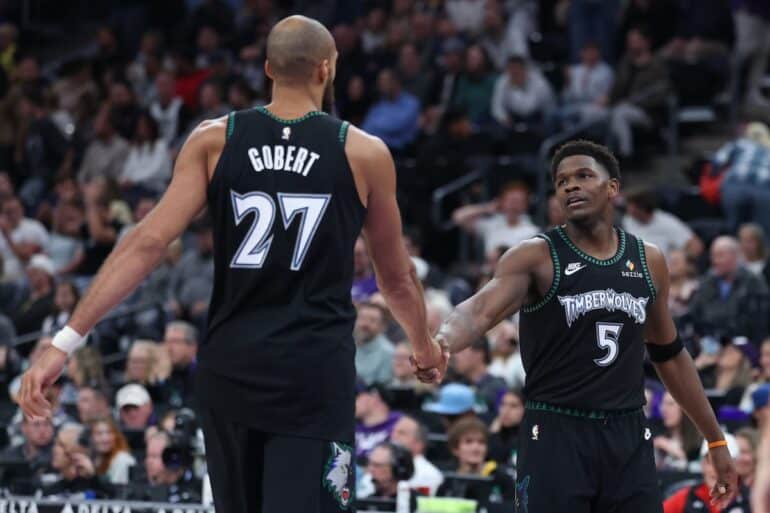
Roughly seven weeks ago, the Minnesota Timberwolves imploded against the reigning champion Oklahoma City Thunder. With just over three minutes remaining, the Timberwolves controlled possession in a 101-101 draw, a chance to take the lead late on the road against the then-17-1 Thunder — which were steamrolling virtually everyone at that point in the year — and potentially secure a season-altering win.
As a means to avoid Cason Wallace’s full-court pressure against Anthony Edwards, Donte DiVincenzo, typically an off-ball guard who moonlights on the ball in lower-leverage spots, initiated the offense. Shai Gilgeous-Alexander exploited that decision by poking loose a steal, inhaling a lofted pass from Wallace and scoring to give Oklahoma City the lead again at 103-101.
The Timberwolves and Thunder never drew even again, with Oklahoma City pulling away for a 113-105 victory amid a slew of wobbly Minnesota possessions featuring desperate, ambitious pull-up jumpers and more bewildering giveaways. The result pushed Oklahoma City to 18-1 and dropped Minnesota to 10-8, including a then-0-7 record against teams above .500.
Following that moment, the Timberwolves have rattled off 17 wins in 23 tries — tied with Oklahoma City for the league’s best record in that time — and vaulted to 27-14, good for fourth in the West and a game back of the No. 2 seed. They’ve since gone 9-3 against teams over .500, including a Dec. 19 crunch-time victory over the Thunder, led by Edwards’ two-way heroics.
According to Cleaning the Glass, Minnesota is tied for fourth in net rating (plus-6.6) while being one of three teams to sport a top-six offense and defense this season (Oklahoma City, Houston Rockets). Some fortuitous injury luck is at play; among the Timberwolves’ eight solidified rotation players, Edwards’ eight missed games are the high-water mark (soon to be nine, as he’s already been ruled out ahead of Friday’s game with Houston). DiVincenzo, Julius Randle and Naz Reid are yet to miss a game. Rudy Gobert and Jaden McDaniels have missed three combined outings.
Regardless, the Timberwolves, fresh off consecutive Western Conference Finals appearances, are very good and playing excellent basketball, particularly post-Thanksgiving. There should be zero surprise if they end up among the NBA’s final four again this year.
How Edwards Has Taken A Leap
Edwards spearheads these efforts. He’s leveled up as a seismic offensive force, sitting just south of the league’s greatest in this department nowadays. In previous years, his offensive footprint felt somewhat sporadic, liable to supernova spurts succeeded by dormant quarters because of an incomplete scoring arsenal. That’s no longer the case; his well-rounded bucket-getting shapes everything and rarely goes quiet.
The sixth-year guard is posting career highs in most relevant scoring categories: points per 75 possessions (29.5), 3-point percentage (40.9), two-point percentage (56.3), free-throw rate (.357) and true shooting percentage (62.6).
A pair of those, two-point and true shooting, are considerable jumps from his prior career-best percentages of 51.9 (two-point) and 59.5 (true shooting). They underscore Edwards’ emergence as a domineering interior operator who reliably scores at all five levels: beyond the arc, midrange, floater area, around the basket and at the free-throw line.
According to Cleaning the Glass, he’s among the 62nd percentile or better in around the rim, (88th percentile, 72 percent shooting), from short midrange (62nd percentile, 45 percent), from long midrange (62nd percentile, 44 percent) and from deep (82nd percentile, 41 percent), all of which are career highs.
The foundation of these vast exploits is Edwards’ unparalleled physical traits paired with cunning screen usage (re-screens, rejects, snaking picks), an improved handle and precise footwork. He touts the entire rainbow of traditional athletic gifts, downhill burst, vertical explosiveness and bulldozer strength, which render him a nearly impossible cover. Whereas supersonic burst and bounce used to compensate for a leaky handle and inconsistent jumper, he’s remedied both faults (especially the jumper) and become arguably the game’s strongest star guard.
In basketball, plowing through opponents is often more of a physics equation than a fair strength-on-strength battle. Offensive players have speed and force on their side and apply it accordingly for advantages. Edwards, though, is comfortable dialing down the tempo and bludgeoning through defenders at a snail’s pace, whether it be on methodical drives or try-to-stop-me backdowns — he’s notching a career-high post-up rate (4.9 percent) and efficiency (1.11 points per possession, 75th percentile, per Synergy) this year.
He’ll still mash the accelerator when necessary, like splitting traps, beating hedges or burning heavy-footed bigs to populate the paint. But he’s almost equally adept slowing to a crawl, keeping defenders on his hip/back or muscling through them, and navigating cramped quarters to find shooting or passing windows with evasive footwork, which he’s developed into a lethal weapon downhill and on the block. His change of pace is dizzying to try and contain.
He’s shooting a career-high 60.7 percent on 11.5 drives per game, good for sixth-best among 137 players averaging five or more drives per game this season, per NBA.com. It’s the byproduct of a longtime devastating slasher with immense, varying physical tools who now doubles as an elite shot-maker all over the court: off-the-bounce threes, patient midrange pull-ups, turnaround fade-aways and overwhelming, ambidextrous finishes.
While Edwards is scoring at remarkable, newfound levels, his assist rate (17.8 percent) has dwindled to its lowest since 2021-22, despite a career-high time of possession (6.2, per NBA.com) and on-ball rate (34.5 percent, per Databallr). But the film doesn’t convey a one-track mind superstar. Rather, he’s displaying the most discretion and patience of his NBA tenure, captaining plenty of advantages the box score does not capture.
His 10.7 percent turnover rate (74th percentile) is a career low, emblematic of the shrewd decision-making powering Minnesota’s sixth-ranked offense without manifesting in gaudy assist totals. As the scope of his scoring wonder has expanded, defenses are increasingly sending multiple bodies his way. They collapse on drives, double him in the post, load the gaps before he can ignite a drive or sell out well beyond the 3-point line on ball-screens, where he’s generating a career-high 1.10 PPP (94th percentile) in pick-and-rolls.
Edwards has responded by trusting his talented supporting cast, which includes Randle’s slashing and playmaking, DiVincenzo and Mike Conley Jr.’s shooting, Gobert’s off-ball screening and McDaniels and Reid’s dynamic play-finishing. Even Gobert as a roller/finisher is beginning to join Edwards’ inner circle; his 77 percent shooting at the rim is his best mark in four years with the Timberwolves while his 46 percent clip from short midrange (4-14 feet) easily surpasses his previous career-best of 32 percent in 2018-19.
The Timberwolves Have A Strong Supporting Cast Around Edwards
Edwards has undoubtedly reached a new plane offensively this season. He ranks fourth in Offensive Daily Plus-Minus (DPM) at a career-high plus-4.89. Yet he’s not the lone Timberwolf taking strides. McDaniels is logging career highs in points per 75 possessions (16.6), 3-point percentage (41.9), usage rate (17.4 percent) and assist rate (11.7 percent). For the first time in his career, his Offensive DPM is a positive at plus-0.1.
Minnesota is entrusting him more (career-high 11 percent on-ball rate) and he’s delivering. His 2.3 creation true shooting attempts per 100 possessions are a career high and he’s producing a career-high 59.1 percent true shooting mark on those opportunities.
He’s added a bit to the shot-making bag, tightened his handle and grown more confident attacking off the catch, punishing mismatches or commanding early offense sets. That sparkly 42 percent from deep doesn’t hurt either, making him a nifty release valve for Edwards who can bury triples or zip past hasty closeouts to punctuate plays in wide-ranging ways.
On the other end, Minnesota remains anchored by Gobert, who should probably be the frontrunner for Defensive Player of the Year. Wembanyama is marvelous but has missed nearly 40 percent of the season. Chet Holmgren is quite good but seems, to me, a bit off-kilter, beset by more fouls and ineffectual or late rotations than his first two years.
Gobert, meanwhile, is as imposing as ever. He’s barricading the rim at league-best levels and spry enough to wrangle on the perimeter — engulfing drives, rerouting plays away from the paint and warping possessions. The numbers below have changed a little following Tuesday’s game (15.0 points better per 100, 12.5 percent worse, 10.3 percent fewer shots) but nonetheless paint the portrait of a dominant stopper. For the 10th consecutive season, he leads the NBA in Defensive DPM.
Rudy Gobert is enjoying another DPOY-caliber season.
Minnesota is 16.2 points better defensively per 100 possessions w/him, opponents shoot 12.4% worse within 6 feet against him & teams take 10.5% fewer shots at the rim when he's out there — the league's largest on-off split. pic.twitter.com/U3QG0WF5nl
— Jackson Frank (@jackfrank_jjf) January 13, 2026
Can The Timberwolves Win It All?
All of Minnesota’s superlatives do not absolve it from pressing questions. The Timberwolves are good enough to reach another Western Conference Finals. That, however, is no longer the goal. They aspire for more as they enjoy the most lucrative era in franchise history.
Among them is the Gobert conundrum, which is not unique to 2025-26 or even the Timberwolves themselves; the Utah Jazz navigated it for years. With Gobert on the floor, the Wolves are a fortress defensively (allowing 108.0 points per 100) and mediocre offense (scoring 115.6 points per 100). Without him, they are a scattered hodgepodge defensively (123 points per 100) and gangbuster offense (127.5 points per 100). That amounts to 3.1 points better per 100 possessions overall with Gobert, a good but not great mark for someone so integral to a superb team’s identity.
Can these extremes be remedied by the playoffs? Is there anyone attainable on the trade market to back up Gobert at the five who doesn’t sink the defense and helps maintain high-level offense sans Gobert, even if it requires a slight shift in play-style or lineup configuration? It is a tricky riddle and rare archetype but one Minnesota must likely solve or find to reach S Tier contender status.
After ranking 18th or worse in turnover rate the past three years, the Timberwolves are ninth this season, including fifth during this 17-6 stretch. How genuine is that improvement? Can they sustain it against pressurized playoff defenses, namely the takeaway-inclined Thunder, which lead the NBA in opposing turnover rate?
Extending a trend of finishing 22nd or worse since 2022-23. the Wolves are currently 29th in clutch-time turnover rate. That is, perhaps, a number to monitor as the playoffs approach and Minnesota positions itself for an auspicious run.
McDaniels is playing tremendous basketball, the finest of his career, fueled partly by an aforementioned offensive uptick. Is it a playoff-proof jump, though? Over the years, as the requirements of ancillary players grow more complex, we’ve seen plenty of them progress during the regular season, only to regress when scouting reports and coverages intensify in the playoffs. Can McDaniels hold this level to provide Edwards and Randle necessary postseason help? The answer could swing a crucial playoff game or two.
Beyond Edwards, Minnesota’s creation options at guard are rather precarious. DiVincenzo is far better suited for off-ball scoring and connective passing while the Conley, Bones Hyland and Rob Dillingham triumvirate probably shouldn’t be relied upon deep into the postseason. Barring any substantial leap from the youthful Hyland and Dillingham, how aggressively will the Timberwolves scour the trade market to bolster their backcourt room? And if or when they do acquire someone, how will it pan out?
On pace for 54 wins, the third-most in franchise history, the Timberwolves are absolutely rolling and as deserving of praise as anyone out West aiming to dethrone the Thunder. Edwards is a brilliant, ascending superstar flanked by a copacetic group around him winning games on both sides of the ball. Evolving from very good to great is a painstaking, arduous achievement in sports. Can they do it?