
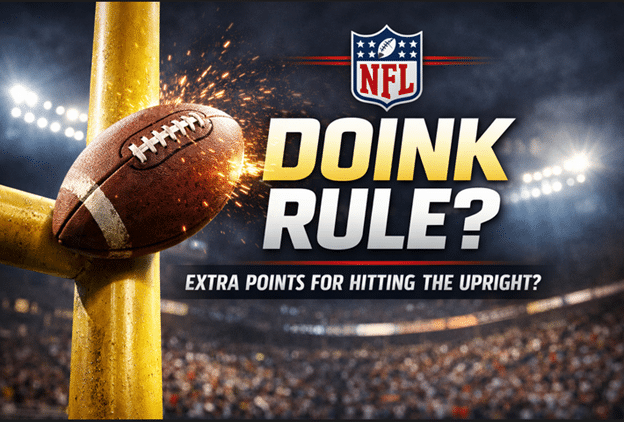
The doink rule is one of those football ideas that instantly grabs attention because it sounds equal parts absurd and logical. It came up during Super Bowl-week conversations about how accurate NFL kickers have become and whether the league should eventually rethink scoring. For now, it lives firmly in the realm of hypothetical changes rather than anything close to adoption.
What Is The NFL Doink Rule Proposal?
Can we interest you in a double doink? 👀 pic.twitter.com/wAbIQKto3A
— Eagles History (@EaglesHistory) November 26, 2025
The concept is simple.
If a field goal or extra point hits the upright, the kicking team would earn an additional point. That means a successful field goal that makes contact could be worth four instead of three, while a post-touchdown kick could count for two.
Today, a kick that strikes the upright and bounces out is worth nothing. The proposal flips that idea by rewarding extreme precision rather than treating it as a miss.
The suggestion was floated to kickers and special teams coaches during Super Bowl Opening Night as part of a broader conversation about the future of the kicking game.
Why The Doink Rule Is Being Talked About Now
NFL kickers are operating at a level the league has rarely seen.
Many train for the role from a young age, focus exclusively on mechanics, and practice with game-ready footballs throughout the season. Coaches openly describe the position as “changing football,” largely because teams are comfortable attempting longer kicks and treating stalled drives as scoring opportunities.
The result is a quieter shift in strategy. Games can tilt on reliable special teams play rather than explosive offense, which naturally leads to questions about whether scoring should evolve.
One path would be making kicks harder. Another would be increasing the reward for high-risk accuracy. The doink rule falls into the second category.
Has The NFL Competition Committee Discussed The Doink Rule?
There is no credible indication the Competition Committee has reviewed this idea.
When the league seriously considers rule changes, they typically appear as formal proposals ahead of the annual owners meetings. Recent committee submissions have focused on areas such as kickoff structure and replay mechanics, not bonus scoring.
Right now, the doink concept looks exactly like what it was introduced as: a thought exercise meant to spark debate.
Would Coaches And Kickers Actually Attempt It?
Even the people asked about the proposal sounded cautious.
Coaches said the decision would depend heavily on the kicker’s profile and the game situation. Accuracy specialists might justify the risk in certain moments, while power kickers probably would not.
Several acknowledged that intentionally hitting the upright on a consistent basis would be extremely difficult. One kicker summed it up bluntly by saying he would still aim for the middle.
That response tells you almost everything about the strategic reality. Coaches lean toward predictable points, especially in high-leverage moments.
Creative Kicking Rules Are Not Entirely New
The league has seen unconventional scoring ideas before.
Years ago, Baltimore proposed awarding a point for blasting a kickoff through the uprights. Other theoretical changes have included narrowing goalposts or modifying scoring values for long kicks.
Most never gained traction, but they show that offensive balance and special teams influence are topics the league periodically revisits.
Will The NFL Ever Adopt A Doink Rule?
Short term, it is very unlikely.
The NFL tends to prioritize competitive balance and player safety when altering the rulebook. Bonus-point creativity does not usually rank high unless the sport reaches a tipping point.
Longer term is harder to dismiss completely. If kickers continue pushing range and accuracy to the point where field goals feel automatic, the league could eventually explore structural adjustments.
Still, history suggests the first move would be making kicks harder rather than turning uprights into scoring multipliers.
How A Doink Bonus Would Change NFL Strategy
If the rule somehow became reality, the ripple effects would be immediate.
- Teams might prioritize precision over leg strength when evaluating kickers.
- Practice sessions could include upright-target drills.
- Late-game math would shift, especially for teams trailing by three.
It would also introduce a rare element into modern coaching decisions: intentional volatility. Missing the post means zero points. Hitting it delivers an unexpected edge.
That type of swing creates television drama but also forces coaches into uncomfortable risk calculations.
The Reality Of The NFL Doink Rule Conversation
The doink rule is best viewed as a reflection of how dominant kickers have become rather than a preview of an imminent rule change.
Ideas like this surface whenever a position begins altering the texture of the sport. Most fade once the offseason turns toward concrete proposals.
Unless the Competition Committee signals real interest, this remains football debate fuel rather than future policy.
Entertaining? Absolutely.
Likely to appear in the rulebook anytime soon? That is a much tougher sell.