
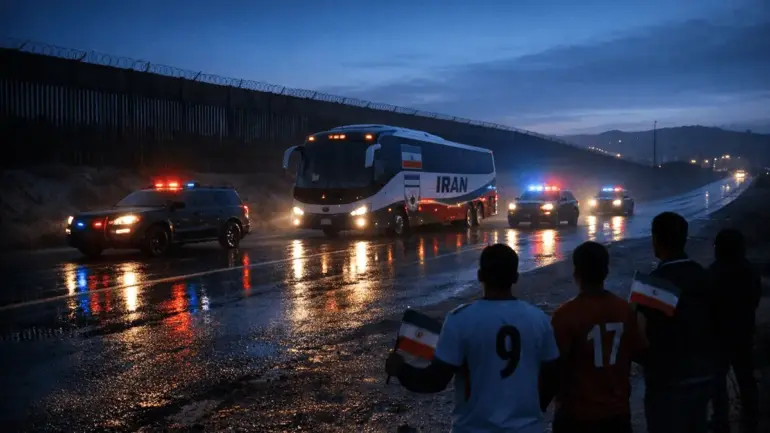
Team Melli touched down in Tijuana at 5:00 am on Sunday – escorted by a convoy of heavily-armed Mexican police and military – and the shadow hanging over that arrival had nothing to do with football. About 15 delegation officials were denied U.S. visas before the tournament began, including federation president Mehdi Taj, and the team is competing in a World Cup hosted partly by a country that conducted airstrikes against Iran in late February.
This is what Iran World Cup 2026 looks like before a single ball is kicked. The logistics are constrained, the politics are combustible, and the fans who showed up to greet their team in the dark did so carrying more than just flags.
A 5 AM Welcome on the Border for Iran
The welcome party in Tijuana was small – about a dozen fans at the airport – but the commitment was real. Sadegh Galavi, a mechanic and Tijuana resident, woke before dawn to stand at the curb as the team’s bus pulled away. Wearing the white jersey with green and red trim, he told AFP: “My national team is coming to my city, and being here is a small thing I can do just to welcome them.”
Hossein Nikyar, an engineer in his forties, drove overnight from Los Angeles with his son to be there. He already holds tickets to see Iran play in Los Angeles. The scene was modest by World Cup standards – no crowds, no fanfare – but the fans present understood exactly what it meant to show up.
Iran originally planned to base itself in Tucson, Arizona. Two weeks before arrival, the federation moved the camp to Tijuana. The team will train at Estadio Caliente and cross into the United States only on match days, under a restriction imposed by U.S. authorities requiring the delegation to enter and leave on the same day as each game.
Iran Visa Denials, IRGC Ties, and What It Costs to Operate at a Tournament
The visa row is not a diplomatic abstraction – it has direct operational consequences. Approximately 15 delegation officials were denied U.S. visas ahead of the tournament, according to Iranian state media, including senior figures such as Mehdi Kharati, Hedayat Mombini, and Mohsen Motamedkia alongside federation president Mehdi Taj.
Taj’s denial carries the clearest explanation: he previously served in Iran’s Islamic Revolutionary Guard Corps, designated a terrorist organization by Washington. U.S. officials approved visas for the players themselves – clearance that didn’t come through until Friday, June 5, after months of uncertainty – but framed the staff denials as a security matter, not a political one. Tehran called it political interference. The Iran-US conflict over who gets credentialed at this tournament has been running since late 2025, when Iran threatened to boycott the World Cup draw in Washington over visa restrictions.
The practical result: Iran’s coaching and administrative staff is operating at reduced capacity for a tournament where preparation logistics already carry added complexity. The organizational failures surfacing at other World Cup venues have shown how quickly logistical friction compounds under tournament pressure. Iran is managing that friction with fewer personnel than they planned for.
Pride vs. Politics – The Iran Fan Divide Is Real and It’s Complicated
The fans who gathered in Tijuana are not a representative cross-section of Iranian opinion on this World Cup. World Cup fever inside Iran is, by most accounts, muted – dimmed by war, economic hardship, and a long-running fracture between the national team and a significant portion of the public that sees the squad as an instrument of a government they oppose.
The diaspora picture is equally split. Hossein Nikyar made the point directly: “It’s safer for them to be here than in Los Angeles anyway, because many Iranians in LA are royalists who want to take down the government.” Sina Moghadam, who traveled from San Diego, took the opposite emotional register – defiant, proud, looking ahead to a potential Iran-US knockout match he described with undisguised relish.
The honest accounting here is that both reactions are legitimate expressions of a fanbase that has been asked to separate sport from a political context that keeps making that separation impossible. Galavi said it plainly: “It makes no sense to me. Sport is supposed to be a symbol of peace, so when you mix politics and sports, it doesn’t work.” FIFA insists the two can be separated. The Iran fans in Tijuana know they can’t.
What’s at Stake for Iran – On the Pitch and Beyond
Strip away the World Cup politics and Iran’s group – New Zealand, Belgium, and Egypt – represents a genuine opportunity. Iran has never advanced from the group stage in World Cup history. This is the most realistic path they’ve had to change that. The broader 2026 tournament outright market doesn’t price Iran as a contender, but group-stage advancement is a different and more achievable target.
Whether the off-field chaos costs them on it is the real question. A depleted delegation operating under same-day travel restrictions to U.S. match venues – Los Angeles and Seattle – is a genuine disadvantage, not a talking point. Nikyar’s frustration landed with precision: “FIFA claims that there’s no politics in the World Cup, and it’s all about the football fair play. But in fact, we see that it’s not true.”
Meanwhile, the USMNT enters the same tournament with its full roster and full institutional support – a contrast that is not lost on Iranian supporters who are already watching for a potential Iran-USA knockout-round collision.
Bottom Line
Team Melli is in Tijuana, cleared to play, and sitting inside a genuinely winnable group – and none of that fully resolves what the Iran World Cup 2026 situation actually is: a national team competing in a host country that struck their homeland militarily four months ago, with their federation president barred at the border and their staff operating at reduced capacity under same-day travel rules.
The fans who drove through the night and woke before dawn to stand at a Tijuana curb deserve that honest framing. Their passion is real. The structural disadvantage their team is carrying into this tournament is equally real. Watch whether Iran’s preparation holds under the logistical constraints – and watch Group Stage Matchday 1 against New Zealand on June 15 in Los Angeles as the first real stress test of whether the football can outlast the politics.