

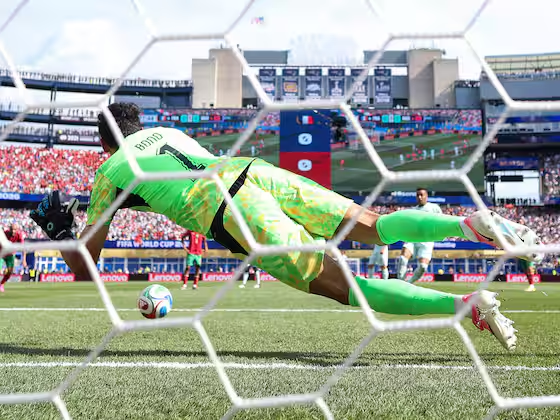
Kylian Mbappe’s penalty miss for France against Morocco was the latest in a series of World Cup spot-kick flops where the taker employed the stutter-step technique.
For over a decade, the stutter-step penalty looked like a cheat code.
Our research into penalty data from the past two seasons and the 2026 World Cup shows that advantage has collapsed, and goalkeepers are now landing the bigger blow.
| Sportsbook | Welcome Bonus | Claim Offer |
|---|---|---|
 |
$250 Welcome Bonus For World Cup | Bet Now |
 |
50% Up To $250 In Free Bonuses | Bet Now |
 |
125% Welcome Bonus Up To $1,250 | Bet Now |
 |
100% Welcome Bonus Up To $2,500 | Bet Now |
What The Stutter-Step Penalty Actually Is
A stutter-step run-up is when a taker breaks their rhythm before striking the ball, watching the goalkeeper rather than committing to a side in advance.
It differs from an illegal feint, which happens after the run-up is complete and draws a caution if the ball still goes in.
Jorginho, Bruno Fernandes, and Neymar helped popularize the technique, and it remains a staple for stars including Cristiano Ronaldo, Harry Kane, and Robert Lewandowski.
The Historical Advantage Was Real
Football psychology professor Geir Jordet analyzed five years of Premier League penalties and found the stutter-step gave takers a boost of up to 10 percent compared to a traditional run-up.
Separate set-piece analysis found consistent run-ups converted at 76 percent, while stuttered or tempo-varied run-ups rose to 80 percent.
That gap explains why so many elite players built the technique into their routine over the last two league seasons.
Our Research: The 2026 World Cup Flipped The Script
Our research into this year’s World Cup tells a different story.
Of 11 stuttered penalty run-ups tracked during the tournament, six missed.
That puts the stutter miss rate above 50 percent, even before factoring in Harry Kane’s saved and retaken effort against Croatia.
Justin Kluivert missed his stuttered penalty in the Netherlands shootout defeat to Morocco.
Kai Havertz and Nick Woltemade both had stuttered penalties saved in Germany’s shootout loss to Paraguay.
Brazil’s Bruno Guimaraes also missed a stuttered attempt against Norway in the Round of 16.
Miss Rate Comparison
| Period | Technique | Success Rate | Miss Rate |
|---|---|---|---|
| Last 5 PL seasons (pre-2025) | Stutter-step | Up to 80% | Around 20% |
| Last 5 PL seasons (pre-2025) | Straight run-up | 76% | 24% |
| 2026 World Cup (knockouts) | Stutter-step | Under 50% | Over 50% |
| 2026 World Cup (all penalties) | All techniques combined | 66.1% | 33.9% |
The 2026 World Cup already has the lowest overall penalty conversion rate of any tournament since 1966, and stuttered penalties are missing at an even higher rate than the tournament average.
Why Goalkeepers Are Winning The Arms Race
Jordet describes the current period as an arms race between takers and goalkeepers.
Morocco’s Bono has become the clearest example, refusing to commit early and instead feinting one way before diving the other, sometimes feinting twice in the same kick.
That approach unsettled Justin Kluivert enough to miss the target entirely, and it also affected Crysencio Summerville during the same shootout.
Jordet says a bigger sample size is needed, but goalkeepers currently appear to be ahead in the contest.
What This Means Going Forward
Robert Lewandowski, long one of the technique’s biggest advocates, has reportedly realized he needs to adapt his own approach after years of success with it in the Bundesliga.
Our research suggests the stutter-step has not disappeared, but its once-reliable edge can no longer be taken for granted.
Takers who rely on it without variation may now be walking into a trap that goalkeepers have specifically trained to counter.