
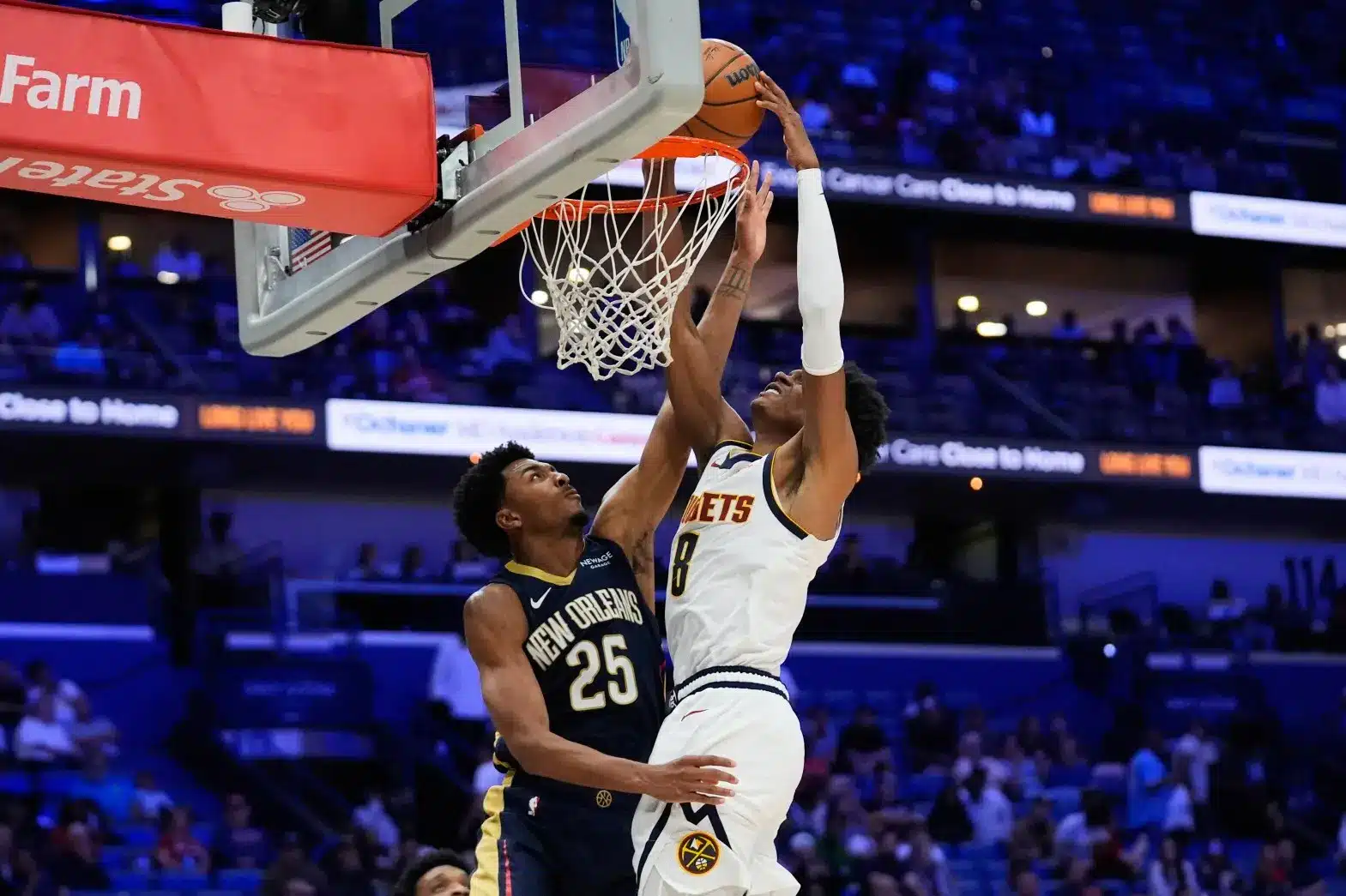
The Cleveland Cavaliers acquired Peyton Watson from the Denver Nuggets in a multi-team trade that sent Max Strus to the Los Angeles Clippers, according to ESPN.
Watson agreed to a four-year, $88 million deal with Cleveland that includes a player option and a trade kicker.
The move gives Cleveland an athletic wing with shooting potential and defensive versatility.
What Is Confirmed in the Peyton Watson Trade
Cleveland sent an unprotected 2031 first-round pick and a 2032 second-round pick from the Sacramento Kings to Denver to complete the framework.
The Cavaliers also sent Tre Mann, cash and a 2027 second-round pick from the Clippers to the Washington Wizards for Cam Whitmore, while the Wizards sent Julian Reese to Denver.
Here’s the full ledger of who got what:
- Cavaliers: Peyton Watson (new four-year, $88 million deal) and Cam Whitmore
- Clippers: Max Strus
- Nuggets: 2031 first-round pick, 2032 second-round pick, Julian Reese
- Wizards: Tre Mann, 2027 second-round pick, cash considerations
Why Cleveland Chased This Wing All Offseason
The Cavaliers have spent years pursuing the athletic-forward archetype, investing resources in players including Isaac Okoro, Strus and De’Andre Hunter.
Watson averaged 14.6 points on just under 50% shooting across 40 starts last season.
That production, paired with the departures of Dean Wade and Keon Ellis in free agency, made Watson a significant swing for Cleveland.
Grading Every Team in the Deal
Cleveland received a B, with the fit balanced against the risk of trading a 2031 first-round pick when Donovan Mitchell will be 34 and earning nearly $76 million.
Denver received a D- since Julian Reese, the only player coming back, is expected to be waived off his two-way deal immediately, effectively leaving the Nuggets with draft compensation only as Nikola Jokić’s championship window remains a central concern.
The Clippers received a C+ for adding Strus, a useful wing on an expiring deal, to a roster that includes Brandon Ingram.
Washington also received a C+, adding ball-handling in Mann while also acquiring a second-round pick and cash considerations.
| Team | Grade | Key Return |
|---|---|---|
| Cavaliers | B | Peyton Watson, Cam Whitmore |
| Nuggets | D- | 2031 first, 2032 second, Julian Reese |
| Clippers | C+ | Max Strus |
| Wizards | C+ | Tre Mann, 2027 second-rounder |
The Betting Angle Nobody’s Talking About
This move is not a minor lineup tweak.
Cleveland is betting on Watson holding up over a full 82-game workload.
He started 40 games last year after Denver did not offer him a rookie extension, leaving a relatively limited sample of starter-level production.
Bettors eyeing Cleveland’s East odds should watch how quickly Watson is integrated defensively.
The source analysis projected that he could be asked to guard wings and point guards alike behind Evan Mobley and Jarrett Allen.
Denver’s outlook is complicated by its payroll situation: with 13 players signed, its payroll stood near $285 million, according to cap analyst Yossi Gozlan.
What Happens Next for Denver and Cleveland
Cleveland retains a core that includes Mitchell, James Harden, Mobley and Allen alongside Watson.
Denver now holds a 2031 first-round pick that could theoretically serve as a trade asset for near-term help, though the second-apron restrictions described in the source analysis could make that route difficult to execute.