
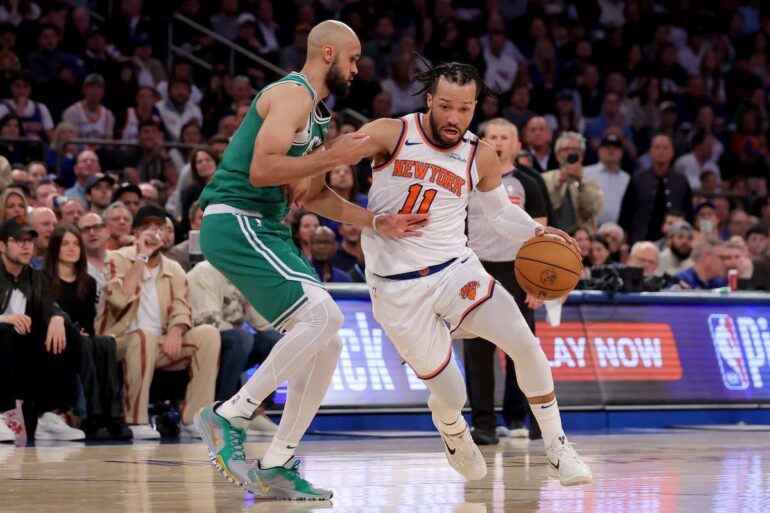
As the 2025-26 NBA season quickly approaches, the Sportscasting crew has teamed up to posit one important question for every team this year. Up first is the Atlantic Division.
Let’s get to it.
Boston Celtics: What Long-Term Takeaways Can They Make?
With Jayson Tatum expected to miss all (or most) of 2025-2026 after tearing his Achilles during last season’s playoffs, the stakes are much lower for this Boston Celtics team compared to their usually championship-driven aspirations. But this season isn’t without consequence. Of course, long-term, the final result of this season is rather innocuous for the Celtics. Despite that, there are still things they can glean about how to build their roster moving forward.
For starters, how much more juice can Jaylen Brown and Derrick White squeeze out of their respective potentials? Both players will see an uptick in usage. They’ll handle the ball more than they ever have in their careers. In Brown’s case, there will be more responsibility than ever before as playmaker. White has flirted with All-Star candidacy over the last few seasons. With the extra opportunity, can he make the leap and become a bona fide star?
By that same token, what will Payton Pritchard do with more on-ball opportunity? The reigning Sixth Man of the Year was an off-ball marksman in the Celtics’ offense last season and has shown potential of breaking through in a major way. Can he establish himself in Most Improved Player conversations? Does Anfernee Simons, who matches the Celtics’ 3-point-heavy offense, stick around for the entire season or is he used as trade bait at the deadline? With Kristaps Porzingis and Al Horford gone, which of Boston’s current bigs are part of its long-term future?
All of these questions must be answered with one goal in mind: building another championship-worthy roster around Tatum once he returns. Right now, they don’t have that. But the road to that goal will become clearer as 2025-26 unfolds. –Es Baraheni
Brooklyn Nets: Will Any of Their Prospects Emerge As True Difference-Makers?
A Brooklyn Nets team that won 26 games last year and drafted five first-round rookies doesn’t leave many options for salient questions. The Nets’ season will revolve around the development of their young players to position them for a brighter future. While their oft-maligned draft haul provides plenty of opportunities to swing at franchise cornerstones, stacking rookies as they did raises as many questions as it brings reasons for optimism.
At the moment, four of Brooklyn’s five draft picks (excluding high-flying wing Drake Powell) are most comfortable with the ball in their hands. The Nets also just traded for former Atlanta Hawks first-round pick Kobe Bufkin, who has mostly played with the ball in his hands throughout his young career as a developing point guard. Prioritizing passing and ball-handling makes sense in theory, but in practice, extreme overlapping skillsets will force head coach Jordi Fernandez to work even harder to fit all of his new puzzle pieces together.
The Nets will likely prioritize the development of Egor Demin, their forward-sized passing wunderkind on whom they spent a top-10 pick. He’s a brilliant playmaker but lacks shooting and scoring consistency, which could bog down Brooklyn’s offense. Fielding competent NBA offenses with one or two players who struggle to exist without the basketball is a challenge. How will the Nets fare when Demin, Ben Saraf, Nolan Traore and Danny Wolf all share similar weaknesses?
Despite his improvements, Cam Thomas, who took the qualifying offer this offseason, profiles as a heliocentric offensive player based on shot usage. Michael Porter Jr. has thrived as an off-ball scorer on great Denver Nuggets teams but who knows how he’ll approach offense on a probable bottom-feeder.
Shrewd player development requires more thought than chucking promising prospects on the court together. In his first year, Fernandez proved himself a rising star head coach. His application and deployment of his rookies and other developmental pieces will be key, as the Nets must leave the season feeling positively about at least a few of those players’ NBA futures. –Ben Pfeifer
New York Knicks: How Do They Remedy Their Jalen Brunson/Karl-Anthony Towns Dilemma?
All things considered, the 2024-25 New York Knicks had a successful NBA season. But the main reason they ultimately fell to the Indiana Pacers in the Eastern Conference Finals was the less than perfect way their two best players complement each other.
During the regular season, the Knicks had a plus-4.4 net rating when Jalen Brunson and Karl-Anthony Towns shared the floor (per PBP Stats). That’s a solid mark but far from what you want to see with two All-Stars on the court. As a reference, the Denver Nuggets had a plus-10.8 net rating when their stars, Nikola Jokic and Jamal Murray, shared minutes.
To be clear, Brunson and Towns quarterbacked a great offense (the Knicks had a 122.2 offensive rating with them on the floor). It was the team’s defense when they were both out there that slowed the Knicks down (117.8 defensive rating).
Brunson and Towns are two moving targets who need to be hidden during a playoff series. This team-building obstacle ultimately became too much for the Knicks to overcome against the Pacers. What will change this season?
As I mentioned in a recent article cataloguing their offseason additions, I don’t think the personnel changes they made will do anything to remedy this situation. What about their new head coach Mike Brown? Does he have a neat trick up his sleeve? Did Brunson and Towns miraculously take steps toward becoming better defenders? Or, will history repeat itself for New York once more and hamstring this group’s championship aspirations? –Mat Issa
Philadelphia 76ers: How Much Does Paul George Have Left In The Tank?
It’s easy to dunk on the Philadelphia 76ers for signing Paul George to a four-year, $211.6 million max contract last summer. But people forget just how good he was during the 2023-24 season. In 74 games, he averaged 22.6 points (61.8 percent true shooting, 80th percentile), 5.2 rebounds, 3.5 assists and 1.5 steals. He was seventh in the NBA in Estimated Plus-Minus (EPM) and named to his ninth All-Star team.
Yes, George will turn 36 in May and it’s normal for athletic forwards to fall off abruptly in their mid-30s. But what if last year was more a byproduct of nagging injuries than it was a signal of the end of George’s prime?
If that’s the case and he can return to even 85 percent of the player he was in 2023-24, the Sixers have one of the best two-way tertiary options in the NBA to complement their already-intriguing top five. Now, if he’s not, the Sixers are straddled with a virtually untradeable contract for the next three years – likely terminating any chance they have of winning a title in the Joel Embiid era. Which version of George will we get? Well, that’s what makes this question so fascinating and pressing for Philadelphia. –Mat Issa
Toronto Raptors: How Does Their Core Fit Together?
Despite the recent addition of a top-10 pick in Collin Murray-Boyles, whom they selected ninth overall in this summer’s NBA Draft, the Toronto Raptors are built to win now. Brandon Ingram and Jakob Poeltl are squarely in their primes. Scottie Barnes, Immanuel Quickley and RJ Barrett are all approaching or starting theirs. That entire group is solidified. Barrett and Ingram (2027-28 player option) are locked down through 2026-27. Quickley is signed through 2028-29. Barnes and Poeltl are secured through 2029-30.
Yet such significant financial investment has come without this group playing a single second together. Due to injury, Ingram didn’t suit up for the Raptors following his trade from the New Orleans Pelicans last season. Omit Ingram from the equation and the 1.5-year sample still doesn’t swell all that much. Since Barrett and Quickley arrived in Toronto, the Quickley-Barrett-Barnes-Poeltl quartet has played just 374 minutes (plus-3.88 net rating, per PBP Stats).
Ingram is a very good and talented, albeit domineering, player. His presence often molds and defines the offensive play-style of his teams and lineups. That will likely occur in Toronto, which is banking on him to elevate a rather scoring-deprived unit with his immense creation and playmaking exploits. Can he do so in a way that cohesively uplifts the surrounding foursome? How do he and Barnes coexist offensively?
Ingram, Barnes and Poeltl are each most comfortable maneuvering from the elbows inward. Barrett is also at his best as a downhill force, though has displayed improved comfort and efficacy beyond the arc with the Raptors (36.2 percent). Quickley is a moldable offensive weapon, a dynamite off-ball cog who’s progressed as a floor general during his Raptors tenure. Even then, can he be the lead ball-handler of a viable NBA offense capable of reliably bending defenses to prime the likes of Barrett, Poeltl, Barnes and Gradey Dick as play-finishers? And simultaneously, can he fire enough threes to buoy a 3-point-averse offense, given the preferences of Ingram, Barnes and Barrett, all of whom figure to command sizable usages?
It’s a tricky, pressurized dynamic for Quickley, one underscoring the greater, complex situation at hand he, his teammates and the Toronto coaching staff must navigate as they eye a playoff berth this season. -Jackson Frank