

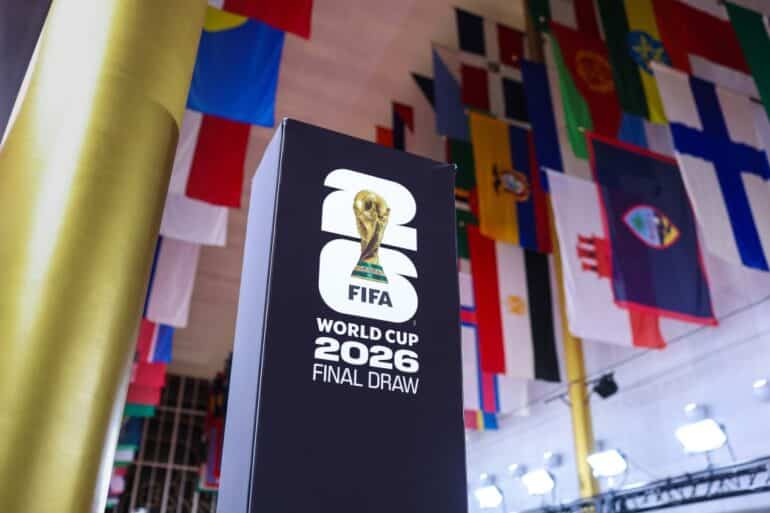
FIFA’s 2026 World Cup draw on December 5 set 48 teams into 12 groups under a four-pot structure. Hosts US, Mexico, and Canada seeded; full group draws to be released soon.
This year’s edition of the World Cup marks a major inflection point. On December 5, 2025, the official draw for the expanded 48-team tournament will be held at the John F. Kennedy Center for the Performing Arts in Washington, D.C.
The draw will set the stage for what promises to be the biggest, most global World Cup in history, with 12 groups of four teams each.
Get excited for the World Cup draw 🤩 pic.twitter.com/t55jqKJRot
— B/R Football (@brfootball) December 5, 2025
The expansion from 32 to 48 teams greatly broadens representation across continents.
Forty-two teams have already qualified; the remaining six will be determined via playoffs in March 2026. Those playoff placeholders are already assigned to the lowest seeding pot (Pot 4).
For scheduling, the three host nations, the United States men’s national soccer team, the Mexico national football team, and the Canada men’s national soccer team, are pre-placed: Mexico in Group A, Canada in Group B, and the U.S. in Group D.
How the pots and group draw work
FIFA seeded the 48 teams into four pots of 12 based on the November 2025 men’s world rankings and qualification status. Pot 1 includes the three hosts and the nine highest-ranked qualified nations. The remaining teams are assigned to Pots 2 through 4 in the order of their rankings.
When the draw takes place, each of the 12 groups will receive exactly one team from each pot, ensuring a distribution of strength across all groups.
🌍🏆 The World Cup Group Stage draw pots… pic.twitter.com/w0qhBiWzpi
— Football Tweet ⚽ (@Footballtweet) December 5, 2025
In addition, FIFA has instituted confederation constraints: generally, no group can have more than one team from the same non-European confederation.
In UEFA (European) competitions, groups can have 1 or 2 teams. This helps preserve continental balance and avoids “group of death” clustering from the same region.
Happy World Cup draw day, one and all 🏆
Here’s Steve Kornacki explaining how it works 🔢pic.twitter.com/99sj7w7jxy
— Men in Blazers (@MenInBlazers) December 5, 2025
Finally, FIFA has also announced a new knockout-bracket structure for 2026, which aims to prevent the highest-ranked teams from meeting until much later, as late as the semifinals, provided they win their groups.
That is especially impactful with powerhouses like Spain, Argentina, France, and England involved.
What’s confirmed and what remains to be revealed
What we know for sure:
-
The tournament will feature 48 teams in 12 groups of 4.
-
The hosts (USA, Mexico, Canada) are pre-assigned to Groups D, A, and B, respectively.
-
A four-pot seeding system ensures balanced groups and prevents any pot from being overloaded with top-ranked teams.
-
Confederation and regional constraints are in effect to prevent teams from the same region facing off too early, with limited exceptions for UEFA.
What is still pending:
-
The identity of the final six teams, winners of the March 2026 playoffs, will fill the six Pot 4 slots.
-
The full group-by-group draw: who plays whom, and when, matchups across Pot 2–4 are still unknown.
-
The detailed match schedule: stadium assignments, kick-off times, rest days, host-city logistics, and more. FIFA plans to release that the day after the draw.
Special guests for a special day 📸
Visit https://t.co/zJTWWlvUsi to find out where you can watch the Draw in your territory.
— FIFA World Cup (@FIFAWorldCup) December 5, 2025
What this draw and the 2026 format mean for fans, underdogs, and powerhouses
-
More nations, more inclusivity: With 48 teams, smaller or historically underrepresented countries have a greater shot at qualifying. That’s good for global exposure and could lead to Cinderella stories in the group stage.
-
Balanced competition: The four-pot system and regional constraints make “group of death” scenarios less likely to be lopsided, but with 48 teams, there’s still a chance of surprises.
-
Strategic knockout bracket: By seeding top teams into different bracket paths, FIFA ensures that elite national teams likely won’t meet until later rounds, which may result in fewer early upsets but more high-stakes games in knockout rounds.
-
Host advantage, with structure: The U.S., Canada, and Mexico avoid each other early, giving them, in theory, easier group phases and potentially increasing their chances of deep runs, given home-field crowds and familiar conditions.
Why this draw matters and what to follow next
This draw is more than a formality. It sets the roadmap for what could be the most unpredictable, wide-open, and globally representative World Cup yet.
For fans, it means new matchups, greater global participation, and broader stakes beyond traditional powerhouses. For hosts, especially the U.S., with a growing fan base and infrastructure, it could be transformational.
Over the next few days, watch for the final six playoff qualifiers, then the full group draw, and finally the match schedule.
For those planning travel or viewing parties: seats at the stadiums, ticket sales windows, and viewing-party bookings will open fast.
This could be the biggest show in football history.