
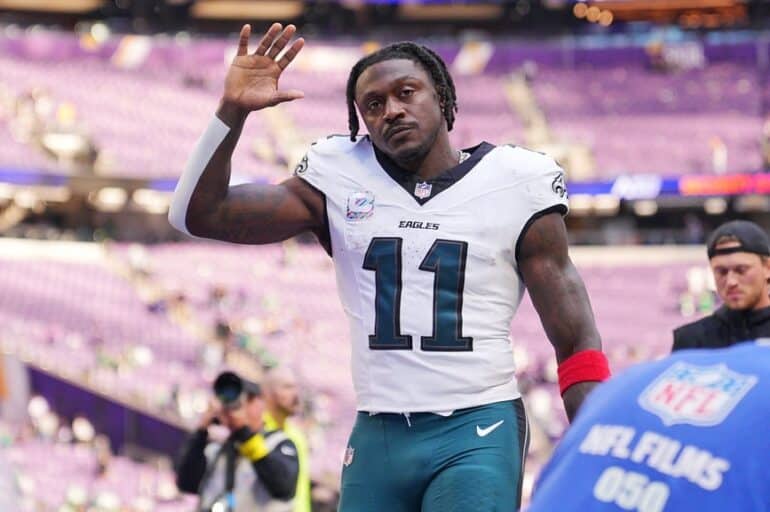
The Philadelphia Eagles’ offseason has been defined by one word: uncertainty. And at the center of it all is AJ Brown.
At their pre-combine press conference, Eagles head coach Nick Sirianni was asked point-blank whether the three-time Pro Bowl wideout would be back in Philadelphia.
“I can’t guarantee that,” he said.
GM Howie Roseman was equally noncommittal: “You’re listening to offers for everything and anything.”
Those two quotes, delivered on a national stage, told the NFL world everything it needed to know.
Brown is on his way out of Philadelphia.
A.J. Brown Can Still Play
Let’s start with what the numbers actually say because the noise around Brown’s attitude has obscured how good he still is.
In 2025, Brown posted 78 catches for 1,003 yards on 120 targets. His aDOT (average depth of target) was 11.9 yards, placing him firmly in the boundary-bully, intermediate-to-deep tier.
His 3.3 yards per route run ranked second in the entire NFL, behind only Puka Nacua. His +0.58 EPA per target ranked seventh among all receivers. And his tight-window target rate — balls thrown with less than a yard of separation — was 26.8%, which he converted at a +10.5% catch rate over expected.
These are not the metrics of a declining player. They are the metrics of a WR1 operating in a dysfunctional offensive system.
A.J. Brown Top Trade Destinations
If the Eagles decide to move on from Brown, it will most likely happen via a post-June 1 trade. There are several contenders who could use a proven WR1, but a reunion with his former coach Mike Vrabel might be the most interesting landing spot.
Below, we’ll break down the top trade destinations for A.J. Brown heading into the 2026 season.
1. New England Patriots
Brown played under Mike Vrabel in Tennessee, making this the most fascinating destination from a narrative standpoint. The relationship clearly endured, and his on-camera wink when Julian Edelman said “we’re all Patriots” didn’t feel entirely like a bit.
The move makes football sense too.
Drake Maye is 23 and ascending, but the Patriots’ leading receiver in their Super Bowl run was Stefon Diggs at 32 — a possession target whose 8.1 aDOT reflects a very different role than Brown fills. Diggs is also a potential cut candidate in 2026, as his base salary is set to balloon to $20.6 million. If he’s released, it would leave a giant hole in the Patriots offense.
New England ranked outside the top 15 in explosive pass rate last season. Brown’s 11.9 aDOT and career 15.3 yards per reception are exactly the vertical threat Maye needs to take the next step. The Patriots have the cap space, the coaching fit in Vrabel, and the urgency.
Compensation expectation: a late first and a third.
2. Buffalo Bills
Buffalo ranked in the bottom third of the league in explosive pass rate in 2025, largely because they don’t have a receiver who wins consistently against press coverage. Brown’s strengths are precisely the profile the Bills have been missing.
Buffalo still has players, like Khalil Shakir, who can separate in the slot and win underneath. Brown, on the other hand, is a boundary weapon who wins contested catches and does some of his best work in the red zone.
Josh Allen’s arm would unlock parts of Brown’s game that Hurts’ limited passing structure never allowed. Buffalo has long searched for a true No. 1 WR, and if they make this move, they will have finally found their guy.
Compensation expectation: a first-round pick plus a receiver swap (Keon Coleman?). A first is too ambitious given the dead-cap dynamics.
3. Los Angeles Chargers
The quietest fit may be the cleanest for the 28-year-old receiver.
Justin Herbert has never had a true WR1, at least not on Brown’s level.
Ladd McConkey is an excellent slot receiver, who can separate with ease and gain easy yards after the catch, but he doesn’t threaten the field vertically. When operating as the clear-cut No. 1 receiver in 2025, McConkey regressed considerably, finishing with only 789 yards and seven touchdowns.
The Chargers ranked poorly in both explosive pass rate and red-zone efficiency in 2025, the two areas where Brown’s advanced metrics are most dominant.
The Chargers project to carry among the most cap space in the NFL in 2026, making the financial burden a non-issue. And Jim Harbaugh’s demanding, accountability-driven culture is precisely the environment where Brown stops being a headline and becomes a weapon.
Compensation expectation: a first-round pick.
Should Philadelphia Even Make a Move?
Trading Brown before June 1 triggers a catastrophic $43.5 million dead cap hit, which would be the fourth-largest single-season figure in NFL history. That means the likelihood of a pre-draft deal is essentially off the table.
A post-June 1 trade splits that number across two years ($16.3M in 2026, $27.1M in 2027), making it more manageable, albeit still painful. For the acquiring team, Brown’s actual cap charge lands around $29 million, closer to fair market rate for a legitimate WR1 with one year of real financial commitment remaining.
There is precedent for this kind of move. Green Bay received a first and second for Davante Adams in 2022. Kansas City received five picks, headlined by two premium selections, for Tyreek Hill.
Brown is comparable in talent but comes with more complexity: a motivated seller, public dysfunction, and dead cap baggage. Realistic compensation is a second-round pick, potentially with a player or conditional sweetener.
The locker room case for moving on is also a potential factor.
Brown’s public “s—show” comments, sideline confrontations with Sirianni, and reported multiple trade requests throughout 2025 have fractured what should be a foundational relationship.
But here’s the harder truth: much of Brown’s frustration traces upstream to Hurts, not the organization. Philadelphia averaged fewer than 195 passing yards per game in 2025 with elite weapons. That’s a one-read quarterback problem that no trade resolves.
Moving Brown frees cap space for Jalen Carter, Quinyon Mitchell, and Cooper DeJean’s second contracts.
It also means betting that the disconnect is permanent.
Roseman is clearly doing that math.
Bottom Line
AJ Brown hasn’t formally demanded a trade this offseason.
But Sirianni couldn’t guarantee he’d be back, Roseman admitted he’s taking calls, and the contract math makes a post-June 1 deal the most logical path. Wherever he lands, his advanced metrics say he has not declined.
The only real question is who moves first.