
The NFL trade market doesn’t move on press releases – it moves on signals, and A.J. Brown has been sending them.
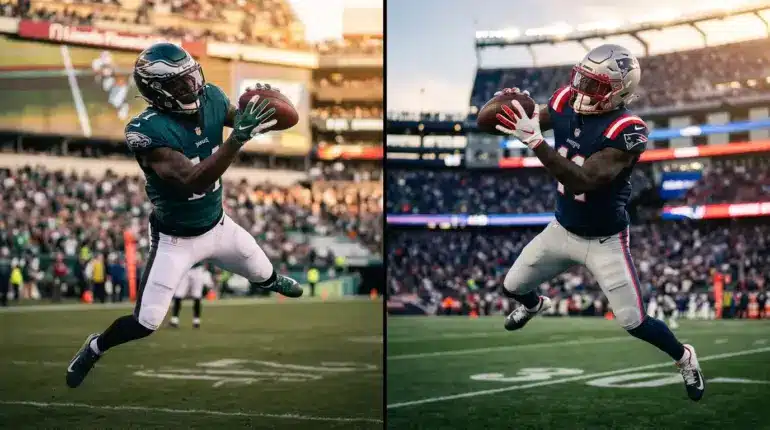
A late-May social media posting spree from the Eagles’ star receiver set off a wave of speculation that has not quieted, and the New England Patriots are sitting at the center of it. ESPN’s Adam Schefter has confirmed the broad strokes of Brown’s trade request, and Albert Breer has since reported that a framework for a deal sending Brown to New England is in place, with the post-June 1 window now open.
Brown has since walked it back publicly, stating plainly, “I want to be here,” and the Eagles have maintained that he is a core piece of their roster. That is the official version. The reporting landscape tells a more complicated story.
The Triggering Signal – What Brown’s Social Media Activity Actually Means
A.J. Brown’s late-May posts weren’t a random venting session – they were a professional athlete with a decade of NFL experience choosing to put friction on the record. That is not impulsive behavior. That is a calculated message to an organization about where things stand.
Brown has a documented history of using social media as a pressure valve when contractual or organizational frustrations mount. The pattern here mirrors what preceded his departure from Tennessee: public signals, public denials, then a trade on draft night that no one saw coming until the moment it happened. His subsequent statement – “I want to be here” – doesn’t erase the original signal. It manages the optics of it.
Josina Anderson reported that a league source described the Eagles and Patriots as having recently “grappled” over trade compensation components, including a potential swap of draft picks. You don’t grapple over the specifics of a trade involving a player both sides believe is staying put. The social media activity was the match. The grappling over compensation is the fire.
Why the Patriots Are On the Clock – The Football and Financial Logic
New England needs a true Wide Receiver 1. That is not a preference. That is a roster fact. Drake Maye showed genuine franchise-quarterback upside in his rookie season, and the Patriots are building an offense around him – but without an elite perimeter weapon, that development has a ceiling. The Patriots enter the 2026 season with real momentum and legitimate Super Bowl window ambitions under Mike Vrabel. Brown provides the missing piece directly.
The Vrabel factor is not a footnote here – it is a structural advantage. Brown and Vrabel share history from their Tennessee tenure, a relationship built on mutual respect through friction. Brown famously chafed under Vrabel early in his Titans career before the two developed genuine trust. That pre-existing dynamic matters enormously when asking a player to accept a trade to a rebuilding franchise. Brown already knows what it looks like when Vrabel builds something worth playing for.
The June 1 cap mechanics are Howie Roseman’s lever, not just a calendar footnote. A post-June 1 trade allows Philadelphia to spread the dead money hit across two years – pushing a significant portion of Brown’s remaining cap charge into 2027, which makes the math survivable for an Eagles team managing multiple large contracts. Insider reporting from Rickey Scoops has already surfaced the framework of an Eagles-Patriots agreement, suggesting both organizations have at least stress-tested the structure of a deal. New England, meanwhile, carries the cap space and the draft capital to absorb a $100 million extension player without dismantling their roster construction.
Ian Rapoport and others have noted it is effectively “Patriots or no one” – no other team has been seriously linked as an active suitor in current talks. That framing cuts both ways: it gives New England leverage, but it also puts the entire burden of closing the deal on their willingness to meet Philadelphia’s price.
The Complication – Honest Pushback on a Trade That Could Still Fall Apart
Here’s the honest pushback: A.J. Brown said he wants to be in Philadelphia. Brown’s contract runs through the 2026 season, and the Eagles have shown no public indication they are shopping him. Roseman’s reported asking price – a future first-round pick, widely understood to mean 2027 – has not been matched, and Rapoport has explicitly characterized the two sides as “not particularly close,” with the Patriots still balking at surrendering any first-rounder.
Philadelphia is also in the middle of rebuilding its receiver room. Losing Brown doesn’t just create a depth problem – it creates an identity problem for an offense that has leaned on him as its primary weapon since draft night 2022. The Eagles have real reasons to hold their price, and if New England won’t meet it, Roseman is capable of bringing Brown back into the building and moving forward.
The counterargument is that none of those obstacles explain why league sources are actively discussing compensation structures with reporters. Trades that aren’t happening don’t generate that level of specific, sourced detail about pick swaps and framework agreements.
What Happens Next – The Checkpoint That Converts Rumor Into Reality
June 1 has arrived, which means the cap mechanics that make a Brown trade palatable for Philadelphia are now operative. The immediate post-June 1 window – the next several days – is the period Breer identified as the most likely timeframe for a deal to materialize, assuming final compensation details can be resolved.
Watch for any reporting that the Patriots have agreed to include a 2027 first-round pick in the package. That is the specific variable Roseman has reportedly been pushing for and New England has resisted. If that number moves, the deal moves. No other team is currently positioned as a realistic alternative destination, which means the NFL trade market on this one has exactly two serious parties.
If the window closes without a deal, the attention shifts to mandatory minicamp – and whether Brown shows up, and in what mood.
Bottom Line
The Eagles’ Eagles Rumors machine has been running hot for weeks, and the underlying reporting structure – framework in place, compensation being grappled over, Patriots as the sole serious suitor – points in one direction. A.J. Brown to New England is not confirmed. But the architecture of a deal exists, the financial mechanics are now favorable, and the football logic for both sides is compelling enough that this is the most credible trade scenario in the NFL right now.
The one deciding variable is whether the Patriots will meet Roseman’s price on a first-round pick. Everything else is already in place.
When New England blinks on that first-rounder, Brown becomes a Patriot – and Drake Maye gets the Wide Receiver 1 his career has been waiting for.