
For most NBA organizations, trading one’s franchise superstar heralds an era of reset and rebuilding. For reasons both in and out of their control, the relationship between the player and the team falters. Blame gets thrown around; either the player thinks he isn’t being surrounded with the requisite help he needs to thrive or the organization thinks the player hasn’t lived up to his billing. With the Atlanta Hawks — as is almost always the case in similar circumstances — the true reason falls somewhere in the middle.
The breakup between Trae Young and the Hawks may have indeed involved one or few of the factors above but it has been one of the NBA’s rare breakups to end on good terms. Young got what he reportedly wanted: a trade to the Washington Wizards, which only had to cough up CJ McCollum and Corey Kispert without the need to include any draft pick in the package.
On the surface, the Hawks may have gotten the short end of the stick, due to their zero-draft-pick trade haul. In the long-term, that may turn out to be the case seeing as they are currently 20-21 and are destined for eternal Play-In Tournament status in the Eastern Conference, seemingly always teetering on the thin line between being a few pieces away from bonafide contention and a few losses away from a standings free-fall.
Moreover, they are as middle-of-the-pack as an NBA team can be, represented by a middling offense (115.0 points per 100 possessions in non-garbage time, 18th), a middling defense (115.4 points allowed per 100 possessions, 15th) and a slightly negative point differential (minus-0.4, 17th). They profile as a below-average rebounding team and are otherwise nondescript in several aspects, both on offense and defense.
Yet, despite how they underachieved with Young as their main driver, they’ve been forming a bit of an identity without their now-former franchise point guard. This rather paradoxical development stems in huge part from the fact they are being steered by an exceptional head coach in Quin Snyder, one of the more acclaimed tacticians in the league who has had his wards play at a level slightly higher than their on-paper talent level.
A deeper look into what constitutes that level of play reveals a team makeup built to succeed in the modern NBA.
A Modernized Approach Across The Board
A peep at the Hawks’ roster post-Young reveals a highly modernized makeup of lengthy and rangy wings and guards. At 6 feet 1 inch, two-way-contract player RayJ Dennis is their shortest player; above him is the 6-foot-3 McCollum. In between them and 7-foot-2 Kristaps Porzingis (who is currently sidelined with left Achilles tendinitis) is a surfeit of athletic and skilled wings and bigs, ranging from 6 feet 5 inches to 6 feet 11 inches.
The versatility these players possess in spades has allowed Snyder to unleash them upon unsuspecting opponents who may see such combinations as undaunting and unintimidating. However, the luxury these players provide have been seen on both ends of the floor, particularly on defense.
Nickeil Alexander-Walker’s ability to pressure the ball, Dyson Daniels’ exceptional perimeter defense and the fact every other Hawk on the floor can capably switch and defend up and down the positional spectrum makes facing them in the half-court a deceivingly difficult endeavor. But perhaps the most striking aspect of their defensive makeup stems from their lack of “huntable” targets at the point of attack.
In one possession, it can be 6-foot-8 Jalen Johnson guarding the likes of Jimmy Butler; another can have 6-foot-11 Mouhamed Gueye trying to contain Butler out on the perimeter. Both prove to be equally adept at stopping Butler in his tracks:

If and when someone manages to get past the first line of defense at the point of attack, another layer of long arms and tall bodies presents itself to intimidate shot attempts:

Since the turn of the calendar, the Hawks have kept opponents to 105.4 points per 100 possessions — fourth-stingiest over that period.
To either miss a shot or turn the ball over against the Hawks heralds near-certain doom. Per Cleaning the Glass, they profile as one of the league’s best transition offenses. Seventeen percent of their offense is triggered by transition opportunities, fifth-most frequent in the NBA. They score 133.5 points per 100 transition plays, also fifth.

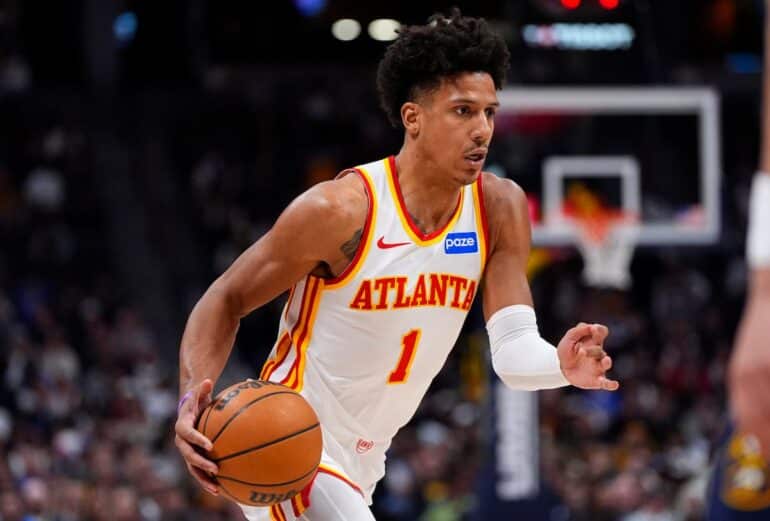
Along with their team-wide defense and transition attack have been standout individual performances. Alexander-Walker has blossomed in a primary role, averaging a career high in points (20.6) that is more than double his career mark (9.6), all while continuing to excel at the point of attack against his counterpart ball-handlers.

Without Young, the playmaking duties have been democratized. Daniels has shared in the collective playmaking on the Hawks, seeing his assist numbers go from 3.7 per game while sharing the floor with Young to 6.7 per game without Young on the floor. An underrated aspect of his offensive game – one historically bereft of outside shooting – has come to the forefront with Young’s departure.

The addition of further scoring juice in the form of the veteran McCollum has also been welcomed. He won’t need much acclimatization within this system, as his role is to simply provide off-the-dribble juice and self-creation for a team that just lost its offensive fulcrum. McCollum won’t ever become the center of an offense Young once was for this team but all he needs to provide is enough advantage creation for teams to bite and commit:

In that regard, McCollum’s drive-and-kick ability shall do wonders (and already has done wonders, if Sunday’s game against the Golden State Warriors is an indication) for a catch-and-shoot specialist in Luke Kennard, who will see his 3-point volume increase alongside an on-ball threat capable of spraying passes out of advantage situations. This pairing, while not particularly inspiring as a defensive tandem, will most certainly have nights of offensive excellence, as they did against the Warriors in a commanding win.
However, perhaps the main factor behind the Hawks staying afloat without their franchise superstar is the emergence of yet another potential star.
The Rise Of Jalen Johnson
Johnson is unquestionably performing on a level previously not reached throughout his career. He’s averaging a near-triple double: 23.7 points, 10.3 rebounds. and 8.2 assists, while shooting 58.2 percent on twos, 37 percent on threes and 78.9 percent on free throws, all consisting of a scoring efficiency mark of 61.5 percent true shooting — a career-high.
His transformation into a toolsy, do-it-all offensive player has come at an opportune time for the Hawks, providing them another foundation with which to build upon in the post-Young era. Such numbers portend an All-Star selection for the Hawks forward and he would be much deserving of that accolade should it occur this season.
The Hawks’ potent transition attack comes in huge part due to Johnson’s talents as a transition player, both as a scorer (1.281 points per transition possession, 12th among 86 players with at least 100 transition possessions tallied, per Synergy tracking):
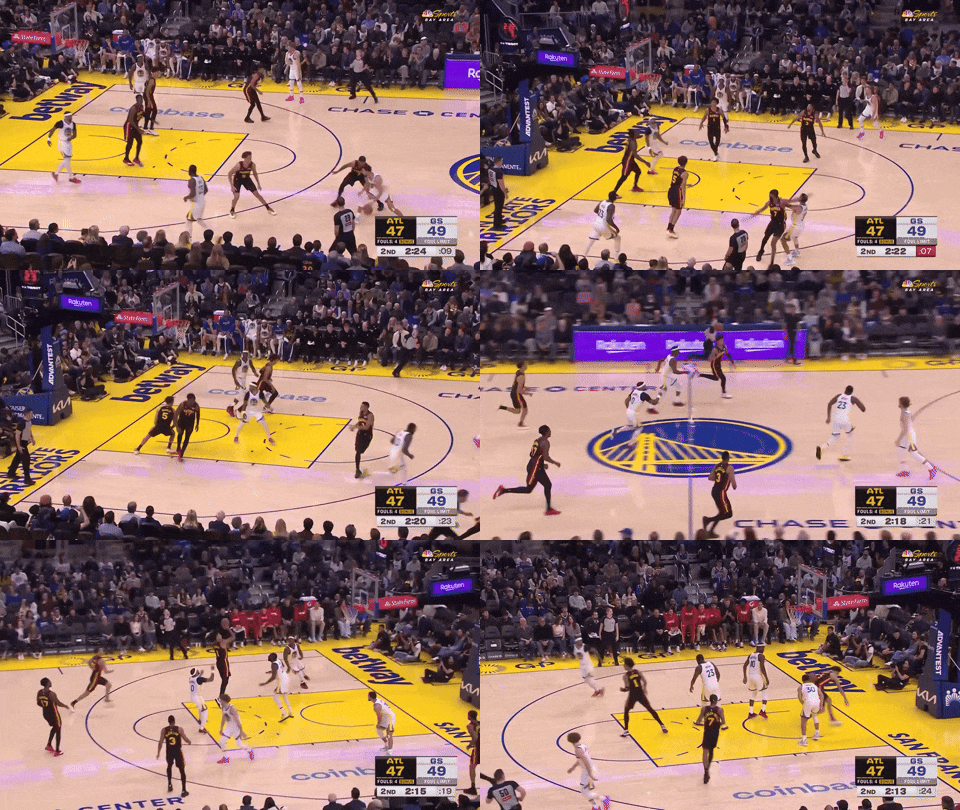
And as a passer:

While Johnson’s jumper has shown promise in half-court situations, his best course of attack in such situations has been his exploits at the rim, a distance in which he’s making 74 percent of his shots (90th percentile among forwards) on a rim-attempt rate of 39 percent (60th percentile).

Half-court passing has also become a forte of his, with a blend of kick-out passes toward the perimeter created by the pressure he places on the rim:

And threaded dimes to cutters that are hallmarks of a truly elite passer:

While his defense has waxed and waned this season, Johnson’s profile as a 6-foot-8 wing with a 7-foot wingspan, along with his athleticism, allows him to scale up as a perimeter and help defender capable of being versatile in whichever defensive role he may be placed. But where his athleticism and size have stood out is on the boards. For a mediocre rebounding squad, Johnson is hauling in a career-best 10 rebounds per 75 possessions.
Johnson has become the face of a Hawks team identifying itself as long, athletic and potentially suffocating to opponents that don’t account for their advantages. It remains to be seen whether Johnson’s leap is sustainable in the long run — enough for the Hawks to commit around him as their next bonafide foundation. In the same vein, it remains to be seen whether the Hawks can build off of their choice to pivot from Young in a manner that will launch them toward bonafide contention.
As 2026 has shown so far, the thrill behind watching these Hawks is seeing how far they can go with this current iteration, a fun bunch steadily making noise in more ways than one.