
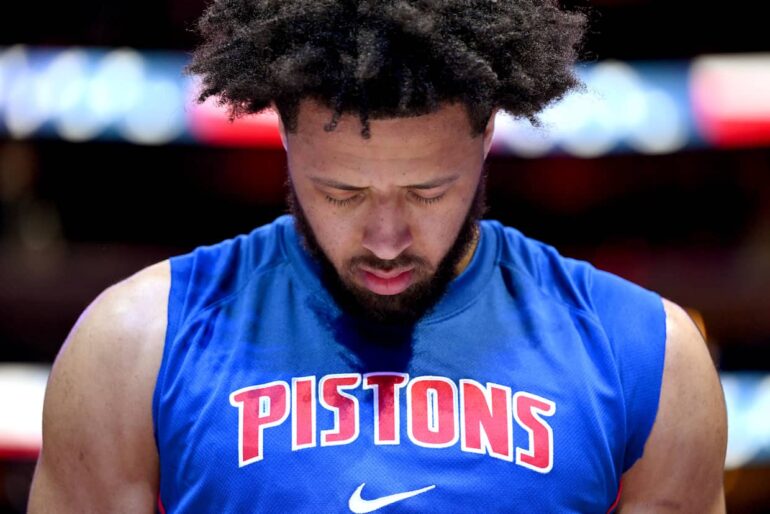
Last season, Cade Cunningham finally arrived as a bonafide star player, earning the first All-Star and All-NBA nominations of his carer. Despite his growth, I remained skeptical of Cunningham’s ceiling and viewed him more as a solid All-Star than someone who belonged in top-10 player conversations.
The reason was simple. He was a very good scorer but not a great one. He was a very good passer but not a great one. He’s a good defender, especially for how high his offensive usage was, but again, not a great one. And since he loves having the ball in his hands (second in time of possession, per NBA.com), he isn’t someone you can easily pair alongside another a ball-dominant star — so, the Jayson Tatum pathway was kind of closed off for him.
During Media Day in September, I asked Cunningham how he planned on elevating his game a step further. The premise of his response involved sharpening his decision-making.
Having heard/been around a decent bit of these types of settings, I can tell you what Cunningham said was a pretty PC response. But after seeing how he’s come out the gate to start 2025-26, I’m beginning to think his response was more than a generic answer to appease reporters.
How Cunningham Has Grown
At the risk of sounding like a broken record, Cunningham does legitimately look sharper. To vault himself into the top-10 discussion, he needed to level up his scoring or playmaking. So far, it seems he’s chosen the latter. Like I said, he’s always been a gifted distributor. But I’m now starting to believe he’s an elite one.
The best shot you can get in basketball is a shot at the rim and Cunningham has become something of a layup-producing machine. Only Nikola Jokic — the best offensive player on the planet — has more rim assists (38) than Cunningham this season (per PBP Stats). And when he’s on the floor, the Pistons are taking 37.6 percent of their shots at the rim, which is up by 3.2 percent from last season (per Cleaning the Glass). Cunningham himself is averaging nearly one more rim assist per 100 possessions than he did in 2024-25.
It helps Cunningham is flanked by athletic interior finishers like Jalen Duren and Ausar Thompson. But just like Steve Nash once did for Amar’e Stoudemire and Shawn Marion, Cunningham is the one gifting them with these opportunities.

Above, Cunningham flows into a pick-and-roll with Duren. Since Kevin Love is playing a more aggressive pick-and-roll coverage, his teammate, Kyle Filipowski, tags the roller. In that situation, most players would opt for the pass to their open teammate on the wing (a sequence commonly referred to as shake action). An open three is a good shot but Cunningham knows a layup is a superior one, so he instead squeezes that ball between a thicket of defenders like he’s Matthew Stafford on a Sunday.
In the clip below, the Memphis Grizzlies blitz Cunningham after the ball-screen. Standard protocol in this situation would call for a flip to the strong side, so the Pistons could swing it to the roller before the defense has time to recover (this is known as a Gator Pass). But going this route leaves things to chance. Instead, Cunningham takes matters into his own hands and rifles the pass over two defenders to Duren (this is where his size really helps him as a primary initiator).

There is also an audacious element to Cunningham’s passing vocabulary. This outlet opportunity wasn’t clearly open, but when you’re Cunningham, there isn’t a throw you don’t think you can make.

Again, I don’t want to discredit Duren here. He had to finish all these plays. But they were available to be completed because of Cunningham’s willingness and ability to make them.
Cunningham’s turnover rate, which has been a massive criticism of his game, is also tied for a career-low and down 2.4 percent compared to last year — further adding to the notion his guitar is more fine-tuned than before. He’s also passing on a higher percentage of his drives, which makes him a more balanced and unpredictable attacker.
Scoring-wise, Cunningham has shown some growth. His midrange and 3-point percentages are down but that’s most likely a result of an early season cold streak rather than a sign of true regression. More importantly, he’s taking strides as a finisher, another key weaknesses of his.
Despite the Pistons’ spacing being worse than last year (they’re taking 4.4 fewer threes per game), Cunningham is converting on rim attempts at the highest rate of his career (58.3 percent). His free-throw rate (6.4 attempts per 75) is also a career-best — evidence he has become more comfortable absorbing contact.
I don’t blame you if you don’t see any of the glamor in this. What I’m pointing out right now are subtle details. But it is the little things which help already great players become even better ones. If Cunningham keeps on with his current trajectory (remember, he’s still only 24 years old), he’ll become the exact type of No. 1 option who can lead a well-constructed team to an NBA championship.