
The Los Angeles Chargers’ first depth chart of the offseason is already reshaping fantasy value, according to Daniel Popper of The Athletic. Justin Herbert returns as the unquestioned starter, but the skill-position picture underneath him just got a lot more interesting for bettors and fantasy managers alike.
Justin Herbert’s Weapons Get A Facelift Under Mike McDaniel
Herbert keeps Trey Lance as his backup after Lance beat out Taylor Heinicke for the job last camp. Lance started Week 18 against Denver and led the Chargers in rushing with 69 yards behind a patchwork offensive line, a small but real signal of his upside.
New offensive coordinator Mike McDaniel was in San Francisco when the 49ers drafted Lance third overall in 2021. That history matters less for 2026 usage and more for how comfortable McDaniel feels deploying him in relief duty.
McDaniel has also reworked Herbert’s own mechanics, adjusting his shotgun stance to get the ball out earlier and in rhythm. The Chargers have won 11 games in back-to-back seasons under Harbaugh, reaching the postseason both times without a playoff win, and this offense is the clearest attempt yet to close that gap.
Omarion Hampton Headlines A Deeper Chargers Backfield
Omarion Hampton was breaking out before a freak broken ankle ended his rookie season in Week 5. He remains the starter, and Popper called his fit in McDaniel’s scheme immense.
The Chargers added Keaton Mitchell, not tendered by Baltimore, giving the room a true edge-speed changeup. Kimani Vidal returns on a cheap extension after a career year, and this group is objectively stronger than it was a season ago. For managers building draft boards, that depth chart shift is worth weighing against broader fantasy draft value and risk profiles across the league.
Ladd McConkey’s Path Runs Through A Keenan Allen Decision
Ladd McConkey, Tre’ Harris and Quentin Johnston sit atop the receiver depth chart, with Derius Davis and KeAndre Lambert-Smith behind them. Keenan Allen, who led the Chargers in targets and receptions last season, remains unsigned as a free agent.
Hortiz and Harbaugh have publicly said they want Allen back, but Popper argues the Chargers should build the passing game around McConkey instead. McDaniel scripted Tyreek Hill and Jaylen Waddle open constantly in Miami, and McConkey’s shiftiness fits that same motion-heavy toolkit. That kind of unresolved target competition echoes the receiver-room drama that played out in New York’s own camp battle for snaps.
Fullback And Tight End Get McDaniel Imports
Scott Matlock is out at fullback, replaced by Alec Ingold, who spent four seasons as McDaniel’s fullback in Miami. Matlock now projects as a defensive lineman, the position he was drafted to play in 2023 before Harbaugh moved him.
Charlie Kolar steps in as the starting tight end after signing away from Baltimore, where Isaiah Likely and Mark Andrews limited his targets. Popper loved the signing, noting Kolar handles run-blocking duties while still getting open often enough to be a real receiving factor.
Offensive Line Health And Left Guard Battle Loom Large
Rashawn Slater is returning from a torn patellar tendon, and Joe Alt is coming back from a serious ankle injury. Swing tackle Trey Pipkins has a lengthy injury history of his own, which makes this room the biggest variable on the entire roster.
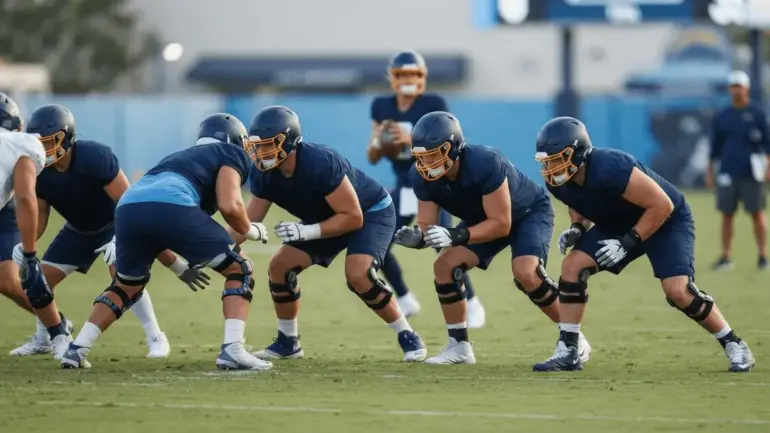
The Chargers signed Tyler Biadasz at center as a clear upgrade and Cole Strange at right guard, where he played for McDaniel in Miami. Left guard remains the one genuinely open competition on the line. Kayode Awosika has historically taken the most reps with Herbert’s group, but Trevor Penning, second-year lineman Branson Taylor, and rookie Jake Slaughter have all rotated through, with Pipkins recently working with the first team there as well. Harbaugh has described the job as a real four-man race rather than settled business.
Interior Defensive Line Adds Size Over Familiarity
The Chargers let Da’Shawn Hand walk to Atlanta and replaced him with Dalvin Tomlinson, cut by Arizona. Teair Tart already re-signed on a three-year extension earlier in the offseason.
Popper was surprised the Chargers picked Tomlinson over Hand, partly a comp-pick calculation given Tomlinson’s down 2025 season and higher price tag. Defensive line coach Mike Elston has earned trust developing low-cost veterans, and that track record is doing a lot of the heavy lifting on this bet.