

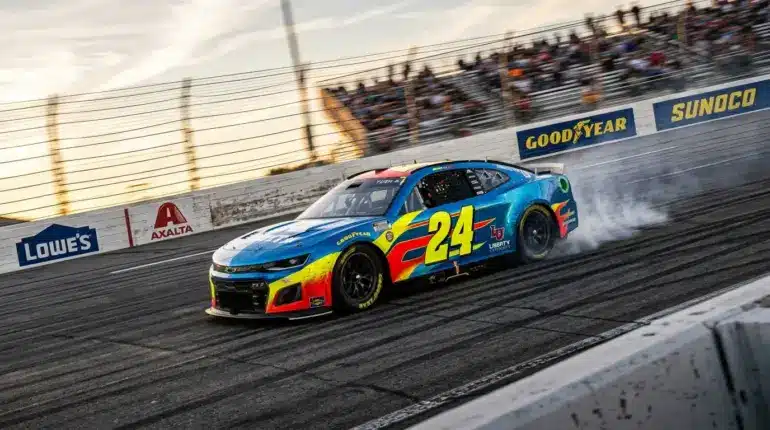
Cleetus McFarland is not coming for the Daytona 500 – and the fact that he said so out loud is actually the most interesting thing that has happened in the NASCAR crossover conversation this month. The YouTuber-turned-racer went on the Door Bumper Clear podcast and made his position unambiguous, telling listeners he has no near-term plans to race in the Cup Series or chase NASCAR’s most prestigious event. That kind of self-aware honesty from a creator-athlete is rare enough to stop the conversation cold.
The story did not end there. McFarland’s candor about the scale of the skill gap – delivered with zero spin – reframed the entire question from when is he going Cup to is there actually a credible path at all. Those are very different questions, and the answer to the second one is more complicated than his critics want it to be.
What McFarland Actually Said – And What It Signals Beyond the Headline
On Door Bumper Clear, McFarland was direct: “I have no intentions of running Cup or the Daytona 500 anytime soon. Because I would just get absolutely wrecked, literally. It’s just a way bigger skill gap than I imagined and I realized that immediately.” That is not false modesty packaged for content. That is a racing driver absorbing real feedback from real competition.
The context matters here. McFarland’s 2026 Truck Series debut at Daytona ended with a crash in the opening laps, and NASCAR responded by restricting his eligibility to tracks under 1.5 miles – a tangible institutional consequence, not a slap on the wrist. His O’Reilly Series results with Richard Childress Racing reflect those early growing pains: a 33.5 average finishing position in a series that demands precision and racecraft he has not yet built.
That is not a failure. That is a development curve made visible in real time. The SiriusXM NASCAR amplification of his quote – and the immediate debate it triggered across NASCAR social circles – confirms that the audience watching this story is enormous and genuinely invested in where it goes.
Why the Case for McFarland’s Long-Term Viability Is Harder to Dismiss Than It Looks
Start with the ARCA numbers, because they tell a different story than the O’Reilly results. McFarland carries an 11.0 average finishing position in ARCA this season and has led 19 laps – a figure that reflects a driver who belongs on a racetrack, not a celebrity coasting on borrowed equipment. He had top-10 finishes at Talladega and Charlotte in his 2025 ARCA debut with Rette Jones Racing. The trajectory is real.
The structural backing is also real. RCR did not hand McFarland a charity start – the team built a dedicated No. 33 Chevrolet entry and contracted him for three O’Reilly starts per season over two years. The symbolic dollar-a-year salary is beside the point; Richard Childress Racing investing infrastructure and garage real estate in a part-time entry is not a stunt. That is an organizational bet on long-term value.
And then there is the audience. McFarland has 4.7 million YouTube subscribers and a fanbase that crosses directly into NASCAR’s core demographic. For a sport that has spent years chasing younger eyeballs, a legitimately developing driver who brings a pre-built audience of millions is a competitive asset. That is not a guess. That is a verdict the sport’s own ratings history supports.
His plan to run full-time in the ARCA Menards Series alongside Squirrel McNutt is the right next step. More laps, more racetracks, more repetition at a level where he is genuinely competitive – that is exactly how developmental drivers build the racecraft that closes the gap to higher series. The path is narrow, but it exists.
The Honest Pushback – What McFarland Still Has to Prove Before This Conversation Gets Serious
Here is the honest pushback: a 33.5 average finishing position in the O’Reilly Series is not a developmental benchmark – it is a warning sign. The series sits one rung below Cup, and McFarland is not yet competitive at that level on a part-time schedule. Closing that gap in any realistic timeframe requires a volume of seat time and coaching investment that has not been publicly confirmed.
The criticism that NASCAR fast-tracked his access because of social reach rather than merit has not gone away. That debate is legitimate, and it carries real stakes for the drivers who spent years working through lower regional series without a YouTube audience to open doors. McFarland did not create the conditions of his own access, but he is operating inside a system that benefited him in ways a conventional developmental driver would not have.
The track-length restriction NASCAR imposed after his Daytona crash is also a ceiling with no public removal date. Until NASCAR formally lifts that limitation, his O’Reilly schedule stays artificially constrained – and his competitive sample size stays small.
What Happens at the Short Tracks Is the Only Variable That Matters Right Now
McFarland’s next visible checkpoints are his short-track O’Reilly starts and the Nashville Superspeedway date with RCR, all operating under the current track-length restrictions. Those events will tell us more about his development arc than any podcast appearance can. Watch for whether his average finishing position in the O’Reilly Series moves meaningfully toward the mid-20s – that would signal genuine progression, not just exposure management.
The secondary signal to monitor is whether NASCAR moves to relax the eligibility restriction. If they do, it means the sanctioning body has internally evaluated his skill development and decided the risk profile has changed. That would be a louder endorsement of his trajectory than anything he says on a podcast. Until then, for fans tracking the NASCAR Cup Series racing and wagering landscape, McFarland remains a compelling storyline without a clean on-track verdict.
Bottom Line
Cleetus McFarland told the truth about where he stands, and that honesty reframes the story in his favor more than any bravado would have. The ARCA results are credible, the RCR infrastructure is real, and the audience he brings to the sport is a legitimate asset that NASCAR organizations do not walk away from easily. The O’Reilly numbers are not there yet – and the track restriction means the competitive sample is still thin. The gap between YouTube sensation and NASCAR Cup driver is vast, and McFarland knows it. The question is whether the development path he is actually on – ARCA full-time, short-track O’Reilly starts, genuine seat time – is wide enough to close it. That answer gets written at the short tracks, not on a podcast.