
The Death Valley debate isn’t new, but it’s been reignited in full force ahead of the 2025 season. Social media has been full of trash talk between Clemson and LSU fans, with coaches and players from both sides weighing in.
The Battle for “Death Valley”
It started when LSU head coach Brian Kelly, speaking at SEC Media Days, confidently referred to Tiger Stadium as the real Death Valley. He doubled down days later, calling Clemson’s stadium “Death Valley Junior” during a Rotary Club appearance in Baton Rouge.
"Death Valley Jr. not THE Death Valley."@LSUfootball HC Brian Kelly tosses some shade @ClemsonFB during his remarks in front of fans. #LSU
@WAFB pic.twitter.com/chbhXGpsEc— Ethan Tuttle (@EthanTuttleWAFB) July 23, 2025
That didn’t sit well with Clemson. Defensive lineman T.J. Parker said, “We’ll handle that on August 30.” Defensive coordinator Tom Allen told reporters the team was tuning out the noise with “earmuffs and blinders.” Even Peter Woods briefly reposted Kelly’s quote before deleting it.
Asked Clemson junior DE TJ Parker about Brian Kelly calling Clemson’s stadium “Death Valley Jr.” Parker: “They can have their opinion. We’re gonna handle all that on August 30” pic.twitter.com/Wz3FO02mn4
— Chapel Fowler (@chapelfowler) July 24, 2025
Dabo Swinney, for his part, responded with a history lesson—reminding everyone that the nickname originated with Clemson back in 1948, courtesy of Presbyterian coach Lonnie McMillian.
This turned into a full-blown online fight. LSU fans pointed to their night-game atmosphere, national championships, and the SEC. Clemson fans hit back with their higher win percentage at home, longer claim to the name, and dominance in the ACC.
Where Did the “Death Valley” Nickname Come From?
Clemson’s Memorial Stadium picked it up in the late 1940s. Presbyterian’s coach referred to it as a place “teams go to die,” and the label stuck. Frank Howard later leaned into it, adding Howard’s Rock and the famous hill entrance.
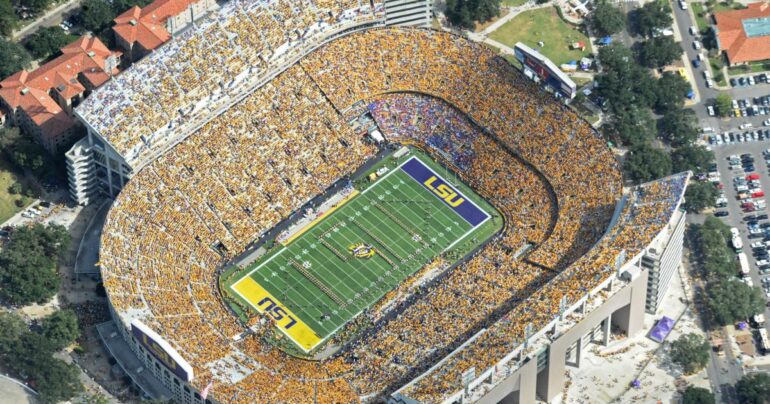
LSU’s Tiger Stadium started as “Deaf Valley,” referencing the noise levels, before morphing into “Death Valley” by the 1950s. It became part of the lore as LSU grew into a national power.
Clemson vs LSU: Where is the Real “Death Valley?”
Rather than just listing facts, we’ve scored each key category to reflect its importance. National championships carry more weight than attendance, while head-to-head performance matters more than who had the nickname first.
Here’s how the scoring works:
– National Championships: 10 points
– Conference Championships: 7 points
– Head-to-Head Record: 8 points
– Home Win Percentage: 6 points
– Record Attendance: 5 points
– Average Attendance: 5 points
– Stadium Capacity: 4 points
– Stadium Age (older = more points): 3 points
| Category | Clemson | LSU | Points (Clemson) | Points (LSU) |
|---|---|---|---|---|
| National Championships | 3 titles | 4 titles | 0 | 10 |
| Conference Championships | 25 | 16 | 7 | 0 |
| Head-to-Head Record | 1–3 | 3–1 | 0 | 8 |
| Home Win Percentage | .757 | .733 | 6 | 0 |
| Record Attendance | 86,092 | 102,321 | 0 | 5 |
| Average Attendance (2024) | 80,806 | ~102,000 | 0 | 5 |
| Stadium Capacity | 81,500 | 102,321 | 0 | 4 |
| Stadium Age | Opened 1942 | Opened 1924 | 0 | 3 |
| Total | 13 | 35 |
So, Who Really Owns “Death Valley”?
If you go by tradition, Clemson got there first. If you go by dominance, LSU makes a stronger case. LSU holds the edge in size, attendance, national titles, and head-to-head wins. Clemson has the better home win percentage and more conference success.
But in 2025, the conversation isn’t about who said it first. It’s about who backs it up.
The final score: LSU 35, Clemson 13.