
No amount of regular-season success would satisfy the 2025-26 Cleveland Cavaliers, bouncing back from a historic 2024-25 campaign followed by another playoff collapse. But through their first 30 games, a 17-14 start forced the regular season back into the forefront for this floundering Cavs team relative to last year’s heights.
In 2024-25, Cleveland held the league’s second-best net rating (plus-9.8), fueled by a top-ranked offense and a top-eight defense. That net rating has plummeted to 10th (plus-2.6) with the 10th-best offense and 15th-best defense this season, slotting the Cavs at seventh place in a strange Eastern Conference.
What’s limiting a team that’s grown accustomed to regular-season success across the last few years? Let’s discuss five reasons for Cleveland’s underwhelming start to the season, listed in descending order of short- and long-term magnitude.
5) 3-pointers Aren’t Falling
Cleveland’s buzzsaw offense in 2024-25 rained threes on opposing defenses regardless of their contests or intentions to take the shot away. That team launched 43.8 percent of its shots from beyond the arc, converting 38.7 percent of them, the second-highest mark in the league. In 2025-26, the Cavs have made 35.2 percent of their 3-pointers, ranking 2oth league-wide.
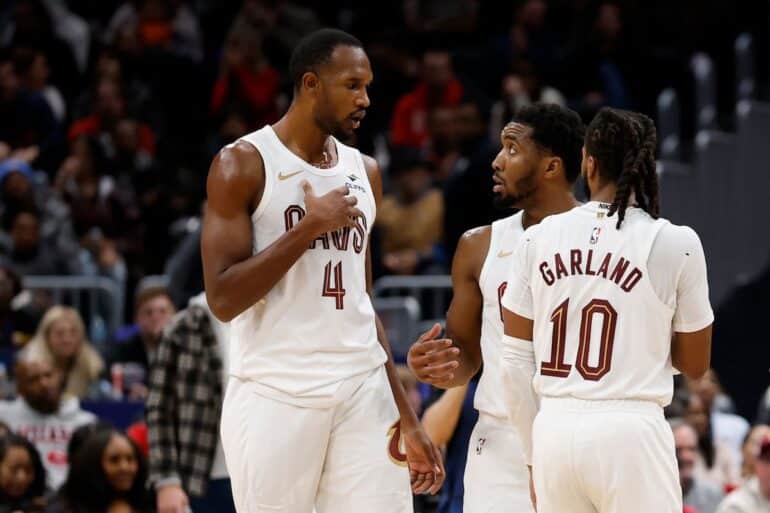
Aside from Donovan Mitchell and Sam Merrill, all of Cleveland’s highest-volume outside shooters have disappointed from deep. Darius Garland (35.3 percent), De’Andre Hunter (31.1 percent) and Lonzo Ball (26.3 percent) are all enduring the least efficient 3-point shooting seasons of their NBA careers.
While history might remember the Cavs’ searing shooting 2024-25 campaign as an outlier, the club has posted a 3-point percentage lower than this year’s mark just once since 2012. Losing an excellent outside shooter in Ty Jerome hurts the team’s shotmaking overall (more on this later but Cleveland’s 3-point assisted rate and shot quality overall are nearly identical to last season’s, according to PBP Stats.
Max Strus’s return will inject outside shooting and Jaylon Tyson’s breakout contributes there as well, though he won’t make 44.6 percent of his threes all year. It’s reasonable to anticipate players like Garland, Hunter and Ball to rise closer to their career averages, even if they can’t reach deadeye status again.
Verdict: Expect some regression to the mean.
4) Poor Transition Play
Following a historic offensive season and top-eight defense last season, Cleveland’s offensive and defensive efficiency have dipped significantly to become mediocre units. A chunk of that difference stems from poor transition play; the Cavs are at least average both offensively and defensively in the half-court.
In the open floor, the Cavs have fared poorly, ranking 25th in transition points per 100 possessions (120) and 17th in opponent points per 100 possessions (126.9), compared to first and eighth in 2024-25. Offensively, natural variance should course correct Cleveland to some degree. A similar enough roster won’t make 30 percent of its transition threes (down from 38.8 percent last season), ranking 29th league-wide.
Remedying the defensive transition woes might require a bit more tinkering and effort than hoping for positive shooting regression. Head coach Kenny Atkinson has instructed his squad to crash for offensive boards more often than last year, resulting in a 1.3 percent increase in offensive rebounding rate. That detail leaves fewer players tracking back to guard the hoop when Cleveland doesn’t secure the rebound.
The Cavs’ transition issues stem beyond their head coach’s decision-making, though, as the players’ effort and execution have often disappointed. Despite four-on-three numbers advantage favoring Cleveland after a miss at the rim, Ayo Dosunmu waltzes to the hoop uncontested:

Transition frequency declines in the postseason as teams tighten their focus and defensive schemes while more jovial team-wide vibes might naturally improve open-floor defense. There’s work to do here but this shouldn’t finish as a season-defining problem.
Verdict: Schematic changes and increased focus should clean this up.
3) The Cavs Miss Ty Jerome
At this stage of the list, the panic meter spikes from the first two issues, as none of these next three have easy solutions. And Cleveland has undeniably felt the loss of Ty Jerome, who the team elected not to re-sign after his breakout year. Due to injury, he hasn’t yet played for his new team, the Memphis Grizzlies, but a once-unstoppable Cavs offense would benefit greatly from one of the league’s most effective per-minute scorers a season ago.
Jerome’s contribution stemmed beyond his offensive output but his former club most sorely misses on-ball scoring and shot creation. He shouldered a notable offensive load, posting a 28.7 percent on-ball rate on elite efficiency (plus-6.9 relative true shooting), often spelling Mitchell or Garland without hindering a dominant offense.
Nobody has stepped into that on-ball vacuum for the Cavs this year; second-round rookie Tyrese Proctor carries the third-highest on-ball rate on the team in his limited minutes (22.8 percent). Ball, whom Cleveland traded Isaac Okoro for this offseason, ranks fourth in on-ball rate (20.7).
Cleveland hoped Ball would replicate some of Jerome’s impact but he’s scoring at league-worst levels, averaging 5.6 points per game with frigid outside shooting on first percentile true shooting (43.2 percent). Lineups with Ball perform 4.6 points per 100 worse on offense than lineups without him and tethering him to Mitchell and Garland still produces below league-average offense.
While Ball’s sagacious — I stole this word from my colleague and editor, Jackson; his vocabulary is ridiculous — passing lets him excel as a connective, quick-hitting passer, he lacks the handle or scoring punch to threaten defenses with the ball or the outside shooting to mirror Jerome’s spacing and screening.
At his best, Mitchell is good enough to carry playoff offenses on his own and we’ve seen Garland score and create at All-NBA levels when fully healthy. Strus’s return will infuse the offense with some secondary playmaking and Evan Mobley, once healthy again, could rebound closer to his All-Star offensive level a season ago.
Jerome’s offensive spark fizzled out in the second round against the Indiana Pacers, which undoubtedly factored into the Cavs’ decision to let him walk. But his contributions helping shepherd Cleveland to that playoff setting were evident last season and are arguably even more conspicuous now.
Verdict: Improved health would help but this could sink the season.
2) The Cavs Can’t Stop Dribble Penetration
The aforementioned Ball for Okoro swap created consequences other than Ball’s inability to meet expectations. Notably, it’s helped spur the cratering of Cleveland’s perimeter defense. Constructing a team around two shorter guards brings inherent tradeoffs but Mobley and Jarrett Allen anchored a top-five half-court defense last season anyways.
Removing Okoro from the roster was an understandable decision after how poorly he acquitted himself offensively in the postseason. But Okoro is one of the NBA’s best point-of-attack defenders and often was the hot glue that bound Cleveland’s defensive shell made of sticks and papier-mâché.
Okoro’s presence bumped every other defender down a notch but already limited perimeter defenders are suddenly underqualified for their roles. Nowhere is this more apparent than the play of De’Andre Hunter, who’s posting the lowest Defensive Estimated Plus-Minus (minus-1.6, sixth percentile) and block rate (0.5 percent) of his career.
Hunter hasn’t ever been a standout defender but his size and length brought necessary big-wing stopping to the Cavs last season. But teams have exploited his focus, awareness and lateral movement on and especially off the ball:
De'Andre Hunter defensive gaffes pic.twitter.com/YC6yIvvwkF
— bjpfclips (@bjpfclips) December 24, 2025
Fortunate health for Dean Wade hasn’t been enough to buoy Cleveland’s perimeter defense and Mobley’s injury won’t lighten the burden on anyone. Offenses routinely target smaller players like Garland or Sam Merrill on switches, especially late in games. And the Cavs are fouling at a bottom-six clip (23.4 percent), posting their highest opposing free-throw rate since 2008.
Cleveland has slashed its zone defense frequency nearly in half, down from 8.4 percent last year to 4.3 percent this season. The results this year haven’t been pretty (1.095 PPP, 26th percentile) but they’ve had some bright moments stretches defending in their 3-2 or 2-3 matchup zones against teams like the Portland Trail Blazers with big wing initiators:
Cavs zone stops pic.twitter.com/w8mo5BRRyy
— bjpfclips (@bjpfclips) December 24, 2025
Maybe, there’s something to unearth with different zones and screen coverages but Cleveland just lacks the defensive talent to match up with potent perimeter scorers and creators, especially after losing its top shutdown corner. Nae’Qwon Tomlin provides some defensive juice but his offense probably renders him unviable in the playoffs just like Okoro.
Like in transition, improved focus and attention to detail could spark some positive regression. In 2024-25, Cleveland posted top-five efficiency defending sideline and baseline out of bounds plays but rank among the bottom six defending both types this season. A full-capacity version of this Cavs team wins games with elite offense anchored by impregnable backstop centers but that formula hasn’t proven successful in the playoffs yet.
And at this rate, Cleveland might not have the chance to prove otherwise.
Verdict: Some potential solutions exist but reinforcements are (likely) not on the way.
1) Everyone Is Always Injured
But Cleveland’s unquestionably most problematic bugaboo has plagued the club for years, facing devastating injuries as the playoffs roll around like clockwork. The injuries didn’t wait until May to prop up this season for the Cavs; Strus, Garland, Merrill, Mobley, Allen and Larry Nance Jr. have all missed at least 10 games. Max Strus hasn’t played this season while Mobley recently went down with a calf strain, which will sideline him for two to four weeks.
In a neutral situation, optimists might point to this early injury misfortune as an indicator for positive regression once the team returns to good health. But this group of Cleveland Cavaliers always seems to face injuries at pivotal moments in the season. Why will this year be any different, especially with a slightly weaker roster than last year’s?
I have staunchly believed in this edition of the Cavs as true title threats with perfect health but more frequent injuries are reality in the modern NBA. They’re star-laden and well-coached enough to bounce back but the team hasn’t proven itself durable or resilient enough to match up with the NBA’s Western Conference titans.
Positivity for Cleveland’s long-term health has already waned. Inevitable attrition will complicate vital schematic tweaks and player upswings. Their collective medical barriers have plagued the Cavs for years and show no signs of stopping for this wonderful but snakebitten core.
Verdict: The alarms haven’t stopped blaring.