
The price of winning in college basketball has never been higher.
ESPN analyst Seth Greenberg finally put a number down to help put things into perspective.
“If you’re trying to compete at the very highest level, you need $12 million, maybe more,” Greenberg said.
It’s a number that would have sounded absurd five years ago. Today, it’s table stakes. Power 4 schools are pushing toward the $20.5 million revenue-sharing cap this season, and according to Opendorse, the average NIL roster spend across power conferences now sits between $7 million and $10 million.
Kentucky Spent $20 Million But Didn’t Get Results
At the extreme end, the Lexington Herald-Leader reported that Kentucky assembled the most expensive roster in college basketball history, spending roughly $22 million on its 2025-26 squad.
The Wildcats even reportedly offered one player between $7 million and $9 million in the transfer portal.
Coach Mark Pope made no apologies for the arms race. “Put NIL, put the transfer portal on the list,” Pope said. “Our job is to go be the best at everything.”
But that roster didn’t lead to results, as the Wildcats were ousted in the first round of the NCAA Tournament.
ESPN’s Jeff Goodman was less charitable. “Anything short of a Final 4 is a disappointment for Mark Pope and Kentucky with that payroll,” he posted on X.
High Point Proves Smaller Programs Can Still Compete
Greenberg also pointed to the exception that proved the rule: High Point University, which pulled off one of the tournament’s most notable first-round upsets.
“The one mid-major that made a little run, or low-major from the Big South Conference — High Point — they spent $5–6 million on their roster,” he said.
That investment is significant for a program of High Point’s size. Schools without football programs hold a unique NIL advantage, as they don’t have to spread their budget across an 80-plus man roster, allowing them to concentrate spending on basketball. The Panthers rode that edge to an 83-82 win over Wisconsin, one of just seven first-round games where the lower-budget team won.
Their run didn’t last, but the blueprint was clear.
By Greenberg’s math, High Point spent less than half of what it takes to truly compete at the top — and still managed to make noise in the Big Dance.
The ROI Question Nobody Can Answer
The numbers behind that arms race are staggering on their own.
Total NIL spending across college basketball has surged from $314.4 million in 2021 to roughly $932.5 million in 2025-26, and now includes direct revenue-sharing payments for the first time.
One anonymous high-major coach in the Midwest told CBS Sports what a lot of people in the sport are thinking but won’t say publicly: “The guys aren’t worth the money they’re going for. I could spend $15 million, but the roster I’d put together wouldn’t win a national championship. There are bad players going for big money.”
The 2026 tournament backed him up.
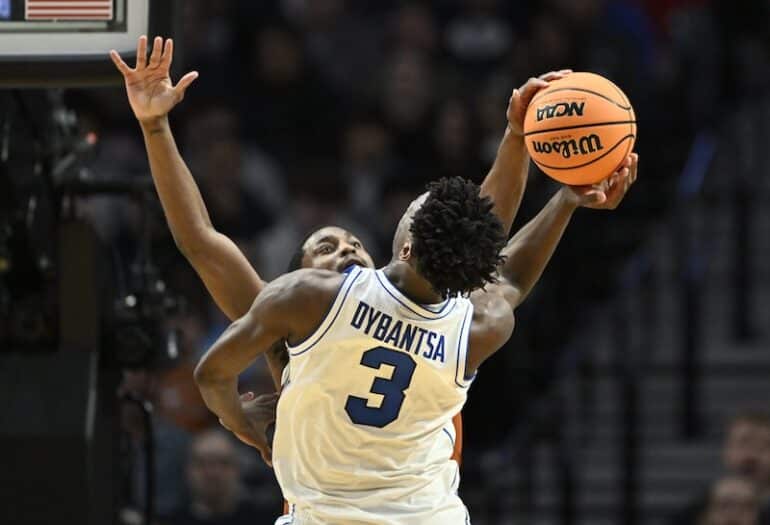
Kentucky’s $22 million roster and BYU’s star AJ Dybantsa, widely considered the highest-paid player in college basketball, both flamed out in the opening weekend. Last year’s champion, Florida, ranked 77th in NIL spending.
The market may also be approaching a correction. Many collectives front-loaded NIL distributions before July 1, 2025 to beat new College Sports Commission oversight requirements, meaning 2025-26 could represent peak spending before the market settles.
For now, Greenberg’s $12 million figure stands as the starkest assessment of what college basketball has become. The sport isn’t just being played on the court anymore. It’s being won and lost in the offseason, in collective meetings, and on spreadsheets — long before a single ball goes up.