
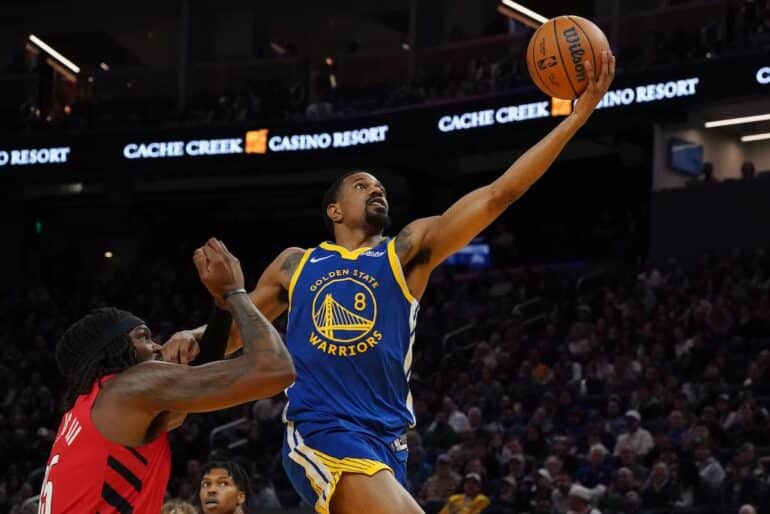
Past the seven-minute mark in the second quarter of the Golden State Warriors’ home-court contest against the New York Knicks last week, the Warriors deployed a lineup of De’Anthony Melton, Will Richard, Moses Moody, Jimmy Butler and Al Horford.
As expected, the nature of their offense drastically changes with Butler as its sole engine — from primarily a motion offense predicated on ball and player movement to that of an isolation/pick-and-roll offense with Butler seeing the majority of the touches. Moreover, head coach Steve Kerr has made it paramount to surround Butler with as many capable shooters who can space the floor and create wide driving lanes for Butler.
Melton, being guarded by Landry Shamet, comes over to set a ball-screen for Butler to coax Shamet into switching onto Butler. Once Butler has Shamet on him, every Warrior on the floor gives Butler room to operate in isolation. Melton moves right next to Horford in the right corner, while Moody stays still in the left corner.
This results in plenty of driving optionality for Butler: either he can drive to his left, lure Josh Hart into helping on the drive and spray a pass to one of Melton or Horford in the right corner; or, he can drive to his right and force Moody’s defender (Jordan Clarkson) to have to make a decision with regard to helping off of the ball-side corner.
Interestingly, the Knicks have one more thing to worry about, given where Richard positions himself:
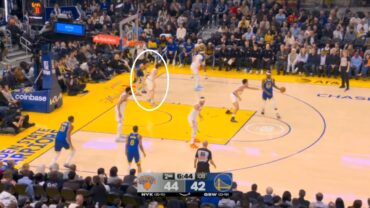
Conventional basketball thinking would assume Richard parking himself on the ball-side dunker spot would clog Butler’s driving lane should he choose to attack to his right. But the rationale behind this is rather smart, seeing as Richard is being defended by 6-foot-3 Tyler Kolek — thus, forcing the smaller guard to be the help defender against a much bigger player in Butler. The weak-side configuration consisting of Horford and Melton also makes it extremely difficult for Karl-Anthony Towns and Hart to commit to helping Shamet.
When Butler finally makes his move to his right, Shamet, Kolek and the other Knicks’ defenders are powerless to stop Butler’s rim attack:

Butler knowing which button to push in a situation like the one above has been helped by Kerr knowing which buttons to push with regard to personnel surrounding Butler, whose talents as a scorer and decision-maker are maximized with multiple floor-spacers surrounding him. That effect is amplified when such personnel also happen to be highly intelligent operators, such as Melton and Horford.
The numbers certainly back it up, with Butler-only units (i.e., without Stephen Curry and Draymond Green on the floor) outscoring opponents by 14 points per 100 possessions in 368 non-low-leverage minutes, with offensive and defensive ratings that would both rank within the top five in their respective categories, per Databallr. With Butler, Melton and Horford all on the floor (79 minutes), the Warriors outscore opponents by a whopping 20.4 points per 100 possessions.
Butler being flanked by Melton and Horford played a significant part in the Warriors’ 10-4 record since dropping to 13-15 on Dec. 20 heading into Saturday’s home game against the Charlotte Hornets. Kerr was most certainly planning to rely on the trio anew during the non-Curry minutes, having proven to be more than just a reliable stopgap solution.
But Kerr found himself having to rethink his plans after Butler was a last-minute scratch due to an undisclosed personal reason — a potential mini-disaster scenario during the minutes Curry and Green had to rest.
Mr. Do Something Did A Lot Of Things
Rarely does a temporary promotion in role produce a good outcome, let alone an excellent one. But Melton — seeing himself having to handle the ball in a primary role with the second unit — was up to the task against the Hornets, proving without a shadow of a doubt his ACL injury is well behind him. He finished with 24 points on 65.9 percent true shooting as the virtual main option without Curry on the floor.
In particular, Melton flashed excellence as a two-way beacon of stability in terms of the guard-guard ball-screen action — both in defending it as well as running it on offense.
When LaMelo Ball and Kon Knueppel attempt to run guard-guard action to involve Curry defensively, Melton isn’t fooled into taking the two-to-the-ball bait. Rather, he immediately finds Knueppel drifting back behind the 3-point line, cuts off his drive and forces the Hornets to reset, ending up in a Grant Williams shot attempt the Warriors would rather live with as opposed to a Ball or Knueppel attempt:

In using the guard-guard screening action, Melton exploited the cracks presented within the Hornets’ defense, which largely wasn’t up to the task in stopping the ball. With Buddy Hield setting the screen for Melton, Miles Bridges finds himself leading with his right foot after switching onto Melton, who exploits the momentary gap created by the switching maneuver with a quick left-right crossover. The Warriors’ five-out spacing (with Horford being closely marked), as well as the lack of bonafide rim protection from the Hornets, provides Melton with zero resistance on his drive:

With Hield once again setting a screen for Melton in a subsequent possession, the Hornets switch Ball onto Melton. Compelled to help on Melton’s middle drive, Collin Sexton stunts at the nail, while Brandin Podziemski drifts from the slot to the wing. Melton sprays the ball to Podziemski, who creates ample closeout distance against Sexton’s attempt to recover and contest the shot:

In tandem with Horford (more on him later), Melton’s underrated handle and off-the-dribble wiggle allowed him to create efficient offense, mostly through his driving exploits and paint touches.

While this tandem excelled without Butler on the floor, it was a pairing that has been a work in extremely advanced progress, with how both of them have naturally slotted into their respective roles as ball-handler and screener. Butler’s absence fostered a semblance of role creativity that expanded the two veterans’ roles to more than just ball-handler and screener.
With the Warriors creating mismatches for Horford in the post, Melton was utilized in an off-ball shooter role to foment further confusion within the already compromised Hornets defense:

A Rejuvenated Big Man
The possession above came not before a possession that had the Warriors attempting to run the offense through the 39-year-old Horford, who was given a favorable matchup in the post against Sion James via a switch induced by a ball-screen for Podziemski:

Despite multiple defenders pinching in with every crab dribble, Horford proves to be too much for James in the paint — a rare avenue of offense for the Warriors, which have mainly used Horford as an advantage finisher rather than as an advantage creator. But the absence of Butler required Horford to scale up in role when it was called for him to step up, although not to the same degree required of Melton.
Rather, Horford has been content with playing a veteran doing the figurative dirty work, mostly as a screener and cleanup man on the boards. His partnership with Melton has created plenty of finishing opportunities for the Dominican big man. His ability to shoot adds a layer of complexity through the simple maneuver of staying put beyond the arc instead of rolling, putting a defense that has opted to play drop coverage (without a veer-back switch) into a precarious spot:

When teams have to take note of marking a trailing Horford, it has allowed him to attack desperate closeouts with drives to the rim — an encouraging sight for someone with extensive mileage on his proverbial treads:

But arguably more encouraging than his valuable offensive skill-set has been his rejuvenation as a defensive anchor. A former All-Defensive Second Team selection, Horford — who has had to sit out games during this season due to Sciatica — is reaping the benefits of a medical staff that has taken a prudent and cautious approach to his minutes and playing time. As a result, he has looked spry as of late, a development most notable defensively.
Whether as a pick-and-roll big capable of playing multiple coverages or as a switch big retaining the switch-big capability that has been a hallmark of his defense, Horford has displayed flashes of his former All-Defensive Team self:

Over his last 10 games, Horford — on an average of 2.3 shots defended at the rim per game — has allowed opponents to shoot a stingy 47.8 percent there, a number which would place him among the top rim protectors in the league (albeit, at a lower shots-defender-per-game mark).

Even the absence of Butler didn’t deter Horford and Melton from being impactful auxiliary options. In 12 minutes of Horford and Melton without Curry on the floor, the Warriors outscored the Hornets by 15 points, buoyed by a humming offense (150 offensive rating) and an absolutely suffocating defense (84 defensive rating).
Granted, while the Hornets don’t necessarily profile as a top-of-the-line defensive unit (21st in points allowed per 100 possessions), their 117.2 points per 100 possessions on offense is enough to consider them a top-10 offensive unit replete with shot-making talent. To keep such talent contained is an achievement worthy of praise.
On the season, the Melton-Horford pairing without Butler has seen a total of 20 minutes, per Databallr, with the Warriors outscoring opponents by 11.5 points per 100 possessions. With Butler expected to return Monday against the Miami Heat, this duo won’t have to shoulder the second-unit load for too long of a period. But if you’re the Warriors, it is reassuring to take into account that if the need arises once again, they can rely on the veteran tandem of Melton and Horford to provide much-needed heavy lifting.