

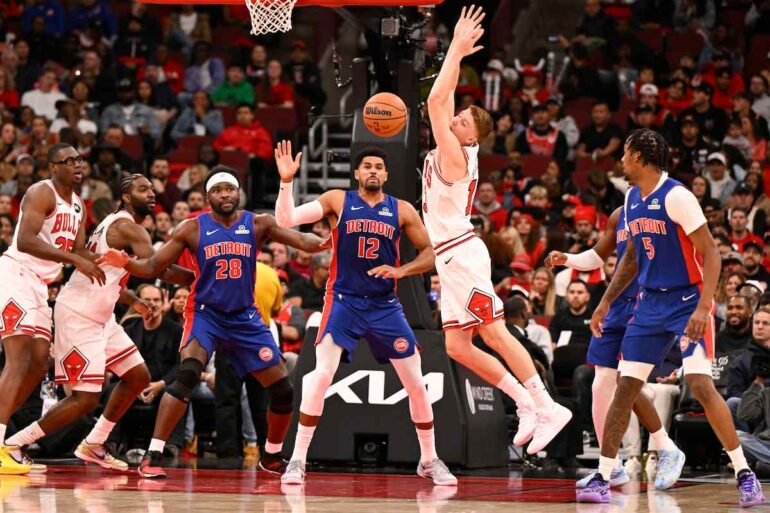
Whistling through the backdrop of the Detroit Pistons’ 9-2, East-leading start — one headlined by Cade Cunningham’s late game gravitas, Jalen Duren’s rowdy rim-running and Ausar Thompson’s awe-striking athleticism — is a constant, unmistakable echo.
Nearly every time Detroit’s opponents organize offense, aiming to crack the Pistons’ imposing labyrinth, head coach J.B. Bickerstaff is reminding his club of its unifying principle: No middle! No middle!
Flip on a Pistons game for a few minutes and Bickerstaff’s voice introduces itself, refusing to be drowned out by the squeaking sneakers, crunching of rival shoulders or metronomic bouncing of the ball. Through 11 games, his words are heard, adhered to and succeeded by vise-grip possessions like these:
As Detroit readies for its fourth full week of action in 2025-26, it finds itself strutting a seven-game winning streak en route to the East’s top seed and a 9-2 record. That’s the longest winning streak among all Eastern Conference teams and second-longest in the league this season, trailing only the Oklahoma City Thunder’s eight-game escapade to kick off the year.
Predominantly fueling the Pistons’ sprint out of the gates is their third-ranked defense. Last season, as they rejoined the playoff picture by winning 44 games and earning the East’s No. 6 seed, they finished 11th in defensive rating. Pesky and feisty were warranted, complimentary monikers for a good, not great, unit paving the way for a playoff berth but nothing much beyond that.
This season, those labels would not suffice, akin to calling Stephen Curry the greatest shooter of all-time — certainly true but underselling the situation at hand. Through three weeks, Detroit has been downright dominant, fine-tuning its 2024-25 formula and vaulting from good to great defensively.
Nothing schematic has been dramatically overhauled. The Pistons’ no-middle mantra remains intact, a carryover from their resurgent 2024-25. Instead, the rotation is even more defensively slanted.
Whether it be a workload bump for bright-eyed defensive dynamos like Thompson (22.5 -> 29.1 minutes per game) and Ron Holland II (15.6 -> 23.3), swapping Tim Hardaway Jr. and Malik Beasley for stouter defensive veterans in Javonte Green and Caris LeVert or rearranging lineups (hello, Duren-Isaiah Stewart minutes!), Detroit is fully committed to this identity.
No-middle schemes are rather common. Plenty of teams around the league employ them, cognizant of how valuable shots at the rim are (the best the game has to offer!), even amid the reign of the long ball.
Differentiating these teams is, of course, the execution. It’s really difficult to rotate one pass away in help and recover to the perimeter without sacrificing a lucrative opportunity, such as rhythmic spot-up threes or unencumbered drives downhill.
The Pistons excel because they’re astonishingly athletic, equipped with perimeter range, physicality and dexterity and interior backstops to blot out any openings their no-middle approach may present. They’re winning a war on two fronts, deterring crisp paint touches and preventing an overabundance of open triples (17th in opponent 3-point rate). Driving through them or passing around them are the horrible, no good, very bad available options that offenses continually must navigate.
Last year, Stewart and Duren shared the floor for just 20 possessions, according to Cleaning the Glass. This year, they’ve already reached 160 possessions (a Tobias Harris injury factors in here), where they’re absolutely pummeling teams.
With their brawny bigs on the court, the Pistons are holding opponents to a 107.5 offensive rating and outscoring them by 15.6 points per 100 possessions. During those minutes, they blanket the paint, cornering foes into a meager 17.4 percent rim frequency (100th percentile) and ghastly 45.8 percent conversion rate (100th percentile).
While their interior defense is optimized with both centers, paint protection is a broader theme of their splendor, too. They concede the league’s sixth-fewest shots at the rim (28.2 percent) and lowest success rate (58.2 percent). Six different Pistons have a block rate above the 60th percentile, with four of them sitting in the 85th percentile or better.
According to NBA.com, Stewart (19 percent), Cunningham (15.8 percent) and Thompson (12.7 percent) are all coaxing opposing players to shoot at least 12.5 percent worse on field goals within 6 feet of the hoop when they’re the primary defender. Among 75 players contesting 4.5 such shots or more per game, Stewart (second) and Cunningham (fourth) are both nestled in the top five alongside 7-foot fly-swatters, Rudy Gobert and Donovan Clingan.
It’s a slice of good fortune to sew high-level defense with one bona fide rim protector like Stewart. It’s another to enjoy similar production from a pair of wings who moonlight as towering, impenetrable low men inside.
The Pistons don’t lurk in help solely to curtail drives or detonate ball-screen actions. They hunt chaos, ranking fifth in opposing turnover rate (16.7 percent) after placing 12th (14.8 percent) a year ago. Three of their players reside among the 85th percentile or better in steal rate: Holland (91st), Thompson (90th) and Green (85th).
These are Detroit’s leapfrogs, a trio of pogo-stick wings who combat gifted creators, plug gaps and collect steals to reroute possessions entirely. They’ll jam off-ball actions, denying or interrupting handoffs to demand opponents back-cut or swim through their ironclad limbs, only to be greeted by timely rotations or frisky hands plucking takeaways.
With all three forwards on the floor, the Pistons’ defensive rating is 95.2, per databallr. With just Thompson and Holland, that mark ticks up slightly to 97.7. Either way, they’re comfortably winning their minutes and relentlessly turning teams over (plus-22.3 net rating for all three, plus-24.2 with Thompson + Holland).
According to databallr, each ranks in the 73rd percentile or higher in STOP rate, a metric measuring steals, offensive fouls drawn and recovered blocks per 100 possessions. Holland (4.4 percent, 99th percentile) and Thompson (4.3, 95th) are particularly elite as hell-in-a-cell defenders routinely ripping apart offensive blueprints.
For all the rightful consternation about Detroit’s dubious ball-handling depth behind Cunningham — exacerbated by the absences of Jaden Ivey and Marcus Sasser — its jackpot start defensively is the byproduct of having someone like him who capably backpacks such enormous offensive usage.
Cunningham leads the NBA in time of possession, ranks fifth in usage rate and touts a 100th percentile on-ball rate. His individual creation (26.8 points per 75 possessions, 92nd percentile) and exquisite facilitating (41.8 percent assist rate, fifth league-wide) constantly simplify life offensively for Detroit’s defensive pillars, all of whom primarily operate as play-finishers and can conserve energy toward their complex, lofty defensive responsibilities.
This composition is not dissimilar from the 2023-24 Dallas Mavericks, which rode a versatile defensive infrastructure (athletic wings, double-big dominance!) and Luka Doncic’s center-of-the-universe offensive brilliance to an NBA Finals berth.
The distinguishing element, however, is Kyrie Irving, an All-NBA talent and platonic secondary star — not to mention, Doncic sitting a couple rungs above Cunningham offensively. He was the final wheel morphing those Mavs from a trike into a car, with the latter far better suited for lengthy travel.
Be it through internal development or, much likelier, an external acquisition, the Pistons need their fourth wheel. Cunningham is tremendous and the defense looks entrenched among the league’s premier. But they’re a low-volume, poor 3-point shooting club (28th in frequency, 20th in efficiency) that struggles scoring in the half-court (21st in half-court offensive rating) and doesn’t totally flourish at the rim, despite living there (sixth in frequency, 24th in efficiency).
Second-chance hoops (35.3 percent offensive rebounding rate, second league-wide) and transition buckets (seventh in frequency, 12th in points per possession) spearhead their viability. It’s reminiscent of the 2024-25 Houston Rockets, which were a good, defensive-minded team ultimately undone in the first round by their topsy-turvy, shaky shooting offense.
When defenses blitz Cunningham, they must have additional counters to Duren’s short-roll finishing and playmaking. For as masterful as Duren’s been this year, even those possessions can be hamstrung by surrounding offensive personnel and stall into a sticky sludge. Shrewd defenses will increasingly eliminate Duren as a release valve and persuade the ball elsewhere. We’ve already seen it crop up at moments in which Detroit lacks solutions.
Can Ivey (or Sasser) help alleviate this issue without diminishing the defensive ceiling? If the front office seeks outside help, can this group land the proper offense-defense tradeoff? Perhaps, these questions are too rash and too quickly aspirational 11 games into a new season.
Yet that is what Detroit’s domineering defense and 9-2 start, propelled by its under-25 core, can elicit. Led by a 24-year-old, All-NBA star, this is a good, youthful team seemingly taking a step forward after last season’s laudable exploits. A prosperous horizon potentially awaits, especially if crucial next steps are aced.
Whatever the future entails, it’ll probably still feature Bickerstaff’s bellowing instructions.
All stats accurate prior to games played on Nov. 11.