

Diana Ross took a penalty kick at the 1994 World Cup opening ceremony, missed by roughly a metre, and watched the goal collapse on cue anyway.
The goalkeeper dived the wrong way. Ross sprinted to the stage and performed her hits, radiant and unbowed. Thirty-two years later, the clip is still circulating – and the question worth asking is not why she missed, but why this particular miss became one of the most beloved moments in football history.
With the 2026 World Cup now underway in the USA, The Athletic revisited the moment in full – unearthing broadcaster reactions from around the world, commissioning biomechanical analysis, and making the affirmative case that the Ross penalty belongs in football’s canon not as a blooper but as something stranger and more durable: a piece of accidental perfection. The full story is worth telling properly.
What Actually Happened – The Full Sequence
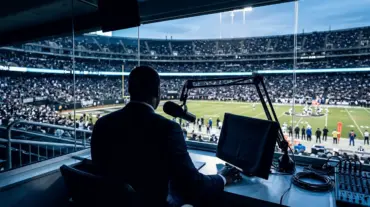
The date was June 17, 1994. Soldier Field in Chicago was sold out – roughly 67,000 people in the stands – for the opening ceremony of the first FIFA World Cup ever held on American soil. Oprah Winfrey was emceeing. Bill Clinton was in attendance. Daryl Hall and Jon Secada had performed. The event was designed by FIFA and organizing committee president Alan Rothenberg as a Hollywood-scale spectacle – a deliberate attempt to sell the game to a U.S. audience that had never been asked to care about it in quite this way before.
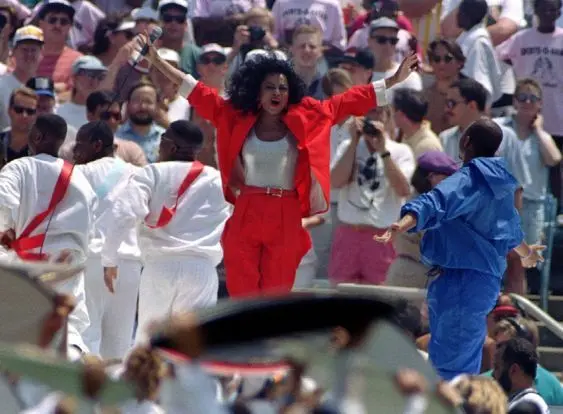
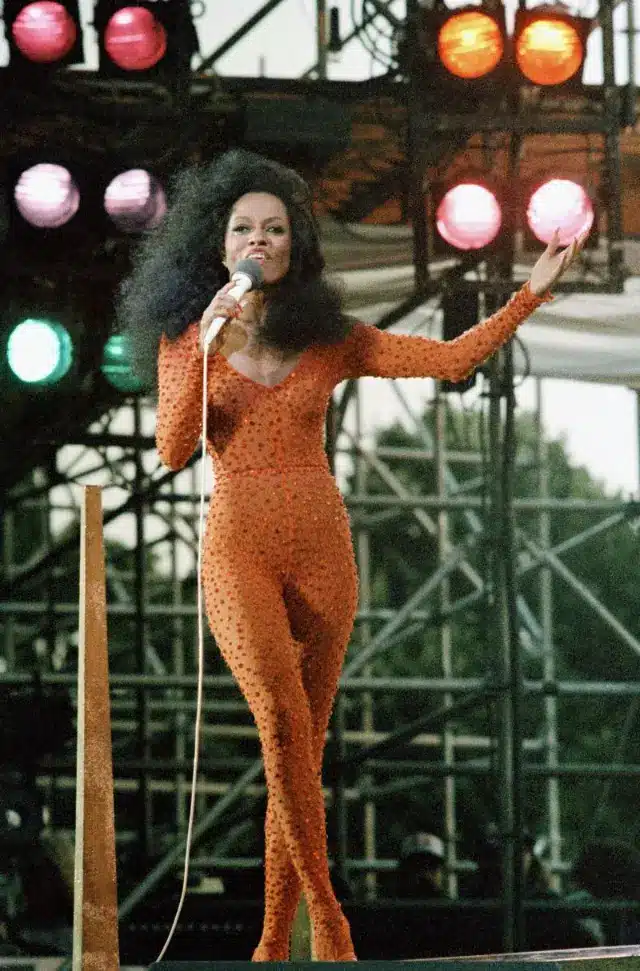
The centerpiece stunt involved Ross jogging the length of the pitch and driving a penalty into a specially rigged goal frame that would collapse dramatically on impact. The goal was engineered to fall regardless of whether the ball went in. The stunt was scripted. Ross performed I’m Coming Out as she ran up. What was not scripted was what her right foot did when it reached the ball.
Her approach was uneven – too large a stride disrupted her plant foot position, her body leaned back, and her foot sliced down the outside of the ball rather than through it. The shot curled wide left of the post by approximately a metre. The rigged goal collapsed on cue anyway. The still-unidentified goalkeeper dived theatrically in the wrong direction. British commentator John Helm, calling the moment live for TSN, captured the global confusion in seven words: “Calamity. I’m not sure that was supposed to happen.”
Diana Ross and the Kick – Why It Became What It Became
The structural reason this clip has lived for 32 years is not the miss itself. Misses happen. What makes this moment irreducible is the collision between 3 distinct layers of absurdity that landed simultaneously: a global icon performing an athletic task she had no training for, a rigged mechanism that was supposed to paper over that gap, and the mechanism firing perfectly despite the gap being fully exposed.
Ross was not a footballer attempting to perform athletically and falling short. She was one of the most celebrated entertainers in the world – a Motown icon, the voice behind Ain’t No Mountain High Enough – placed in an inherently absurd situation by a ceremony that needed American audiences to feel something about a sport they barely knew. The gap between her cultural stature and the specific physical task is the comic engine. The internet did not invent that gap. It just found it and kept finding it.
The rigged goal is the detail that tips the moment from embarrassing to perfectly absurd. Had the goal been real and simply stood there while the ball sailed wide, the clip would be a footnote. Instead, the collapse happened on cue – the mechanism doing exactly what it was designed to do, indifferent to what Ross’s foot had just done – and the result was something no screenwriter would have approved. It looked like the universe was collaborating. That is not a common feeling, and the internet recognizes it immediately.
This is not just a celebrity miss. It is a moment where the scaffolding of a produced spectacle fell in precisely the right way at precisely the wrong time, and the result was more interesting than anything the producers intended. Those moments are genuinely rare. As a window into the history of iconic World Cup moments, the Ross penalty stands alone in its category.
The Biomechanics – What Actually Went Wrong
Bartek Sylwestrzak, a ball-striking coach who analyzed the kick for The Athletic’s retrospective, was direct in his assessment: “I would limit myself to saying that she kicked the ball like someone who has not worked on this skill. This is how children do it.” The diagnosis is not unkind – it is technically precise.
Sylwestrzak identified pronounced hip flexion in Ross’s follow-through – an upright punt with the leg extending high, which is the signature of an untrained or non-dominant-foot kick. The approach stride was too long, which meant the plant foot landed in the wrong position relative to the ball, forcing the body to lean back. When the body leans back on a penalty, the contact point on the ball shifts downward, and the natural result is a shot that climbs and curves rather than drives low and true. Ross’s shot did exactly that.
Geir Jordet, professor of psychology at the Norwegian School of Sport Sciences and author of Pressure: Lessons from the Psychology of the Penalty Shootout, added the psychological layer. The conditions Ross faced – a sold-out Soldier Field, global broadcast, high ceremony stakes – represent genuine performance pressure, even for a performer accustomed to stadium-scale events. Singing in front of 67,000 people uses entirely different neural pathways than striking a stationary ball with precision. The skill transfer simply does not exist. What happened was, biomechanically and psychologically, almost inevitable.
The World Was Watching – Broadcaster Reactions Around the Globe
Helm’s live reaction – “Calamity. I’m not sure that was supposed to happen” – is the most quoted, but the international reactions tell a fuller story about how the moment landed in real time across different football cultures.
Galvao Bueno, calling the ceremony for TV Globo Brazil, did not hide his amusement: “That wasn’t good from her, but at least she managed to break the goal. Absolutely North American, this opening ceremony.” The line is illuminating – Bueno’s framing treats the moment as culturally diagnostic, not just funny. Brazil in 1994 was a football superpower hosting nothing; watching the Americans stage this was a particular kind of viewing experience.
Alan Green on BBC Radio 5 described the scene with detached bemusement, letting the facts do the work in the manner of a man who has decided the facts are sufficient. Chilean television, per The Athletic’s research, simply sustained laughter – no commentary required. That range of reactions, from dry British understatement to Brazilian editorializing to Chilean silence-as-commentary, is itself a minor document of football culture in 1994.
The Internet’s Adoption – How a 1994 Moment Became a Permanent Cultural Fixture
The Ross penalty predates YouTube by eleven years. It survived anyway – first through broadcast clip packages, then through the early days of online video, then through the full social media era – because the clip requires no football knowledge to process. That is not a coincidence. It is the structural reason it circulates.
The mechanics are straightforward: recognizable celebrity, universally legible physical failure, absurdist payoff that requires no context to appreciate. You do not need to know what a penalty kick is. You need to see that a person tried to kick a ball into a goal, missed by a visible distance, and the goal fell over anyway. That sequence is complete and self-explanatory in under ten seconds. The BBC later included it among its most shocking World Cup opening ceremony moments. Vice called it “the greatest moment in the history of World Cup opening ceremonies.” FIFA‘s own museum has packaged it in social posts as affectionate football folklore.
The clip also benefits from a specific asymmetry that the internet rewards: the stakes were ceremonial, not real. Nobody lost a match. Nobody’s career ended. The absence of genuine harm is what makes repeat viewing feel pleasurable rather than cruel. It is the same dynamic that makes a perfectly timed pratfall more shareable than a genuine injury. The Ross clip is safe to enjoy, completely, every time.
The Honest Re-examination – More Endearing Than Embarrassing
Here is the honest accounting: Ross’s shot was genuinely wide. The goal was rigged to fall regardless. She was placed in an awkward situation by a ceremony that needed a spectacle and chose her to provide it. She had no meaningful preparation for a task that requires specific athletic training. None of that is in dispute.
What is also not in dispute: she ran the length of the pitch in front of 67,000 people and global broadcast cameras, attempted the kick without visible hesitation, and when it missed, she paused for exactly one beat and then sprinted to the stage and performed. That is not the behavior of someone who was embarrassed. That is the behavior of a professional who understood the assignment even when the assignment malfunctioned.
The 32-year durability of this clip is not mockery. The data on how the clip circulates – in FIFA museum posts, in affectionate anniversary pieces, in ‘greatest moments’ compilations – does not look like ridicule. It looks like affection. Celebrities who generate genuine accidental absurdist joy in public become permanently beloved for it, because those moments are authentic in a way that produced spectacle almost never is. Ross belongs in that category. The USA 1994 opening ceremony tried to manufacture a moment. It got a different one. The different one was better.
Bottom Line
Thirty-two years on, with the 2026 World Cup back on American soil and the origin story of U.S. soccer back in circulation, the Ross penalty is exactly the kind of moment worth examining rather than simply celebrating. The 1994 World Cup both opened and closed with famous penalty misses – Ross’s at the ceremony, Roberto Baggio‘s in the final against Brazil – and that structural symmetry is not nothing. It is a tournament that told its whole story in spot-kicks.
The 2026 World Cup will produce its own defining images. But the 1994 opening ceremony at Soldier Field is part of the foundation this tournament is built on, and Ross’s miss – rigged goal, wrong direction, one beat of stillness, then full sprint to the stage – is the most honest single image that foundation contains. It captured exactly what it looked like when America tried to host the world’s game for the first time: spectacular, chaotic, a little wide of the mark, and somehow completely unforgettable.
For the latest on the 2026 World Cup, football history, and everything at the intersection of sports and culture, keep it locked to Sportscasting.com.