
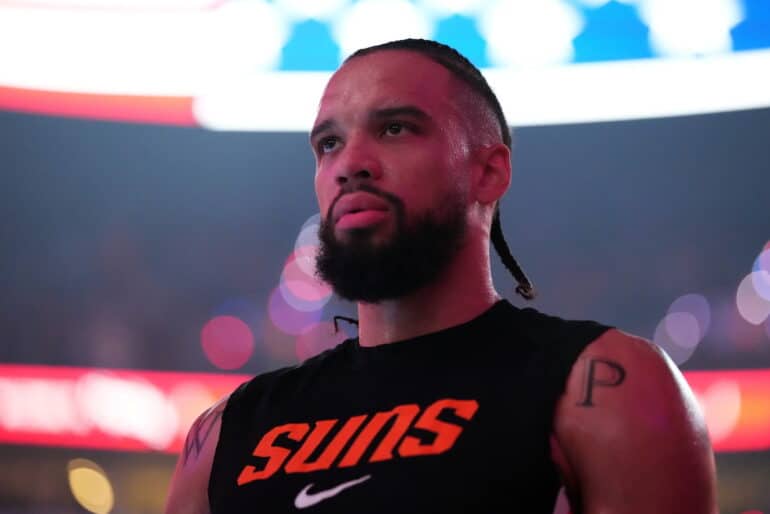
Few NBA role players carry the level of negativity around their name as Dillon Brooks. Casuals know him as the man who tried to poke the bear known as LeBron James, only to get mauled by it. Meanwhile, more invested fans recognize he is the type of player teams trade away when they want to go from good to great.
However, what people often misunderstand about Brooks is, while he may not be a textbook ceiling-raiser, Brooks has a propensity toward winning. Before this year, three of his last four seasons were spent on the team which finished as the No. 2 seed in the Western Conference.
This is trend is no coincidence. Here, correlation does equal causation. Brooks knows how to instill a winning culture in the locker room. Once upon a time, he helped the Memphis Grizzlies become a perennial threat in the West. Then, after being dishonorably discharged, he helped end the Houston Rockets’ rebuild.
Now, he’s doing the same thing with a Phoenix Suns team no one (except me!) had any expectations for heading into the 2025-26 season.
Toughness Goes A Long Way
Looking at Brooks’ first two organizations, what did those Grizzlies and Rockets teams have in common? They were both very good defensively.
Brooks doesn’t deserve all the credit for this (gentleman like Amen Thompson and Jaren Jackson Jr. play on those teams, you know) but he was certainly a primary driver of their successes. It’s not just he’s a very good defender. It’s the type of defense he plays.
Brooks isn’t some new-age low man savant. He’s an old-school isolation-stopper who specializes in shadowing front-court players and making life absolutely miserable for them. Just look at how he hounds Jalen Johnson:
I have enjoyed watching Dillon Brooks defend this season
He has an infectious defensive disposition that grows more impactful when his scoring is on
He's *in* Jalen Johnson's airspace this whole possession pic.twitter.com/rAAFvs570c
— Stephen PridGeon-Garner 🏁 (@StephenPG3) November 17, 2025
Analytically speaking, man-to-man defense isn’t as impactful as what you do off the ball (and Brooks can get a little leaky in this regard) because offenses can negate a great point-of-attack defender by steering clear of their direction or getting them switched off the ball. That’s why Brooks has never had an elite on-off footprint defensively.
But sometimes, data doesn’t tell the full story. Like the tweet above says, there is an infectious quality to how Brooks plays defense. No matter what level you are at, when teammates see a guy willing to lay it all on the line, it’s inspiring. And what do you know, Phoenix has gone from one of the worst defenses in the league (28th in defensive rating) to a respectable one (15th).
"Everywhere he's went, he's helped a team develop an identity. … Every night, there might be some type of scuffles, some type of altercation but that brings a team together or it can separate a team."
Devin Booker on Dillon Brooks.
(via @NBAonNBC)pic.twitter.com/2uGNySuarz
— ClutchPoints (@ClutchPoints) November 19, 2025
By the way, while Brooks isn’t an elite off-ball defender, he has had a great start to the year as a defensive playmaker, averaging a career-high steal rate of 3.4 percent (95th percentile, per Dunks & Threes).
The Beauty Of Floor-Raising
Like I said in the introduction, Brooks lacks the ceiling-raising skills (namely, floor-spacing, connective passing and defensive role versatility) you want from a championship-level starting forward. But he’s a heck of a floor-raiser, which is what teams like the Suns need to help them build a strong foundation.
By letting go of Kevin Durant and Bradley Beal, the Suns became a much more balanced team. They have more minutes to play good shooters, defenders and paint protectors (like Grayson Allen, Ryan Dunn, Royce O’Neale and Mark Williams). But losing those two bonafide bucket-getters left them with a need for secondary scoring behind star swingman Devin Booker.
Again, Brooks isn’t a second option on an elite offense. But on a team trying to rack up regular season wins, he is fit to take the mantle. Brooks is an audacious gunner, cut from the same cloth as guys like Julius Randle and Jaylen Brown. On the season, he’s in the 92nd percentile in points per 75 possessions (25.3) and the 58th percentile in true shooting (59.5 percent).
Those numbers will surely go down. Brooks likely won’t continue to convert on midrange jumpers at a 53 percent clip like he’s Michael Jordan. But his scoring won’t regress by much if his 3-point numbers start to creep back up (he’s currently three percentage points below his career average).
Along with being a confident shooter, Brooks also knows how to leverage his pro wrestler build to execute takedown moves on mismatches in the post.
Although Brooks has never been an efficient finisher (he’s been below 60 percent at the rim since his rookie year), he can muscle his way into looks in the paint, which makes him a better foul-drawer than most members of his player archetype (75th percentile in free-throw rate).
If the Suns are able to restructure this roster to build a real contender around Booker, Brooks will probably be used as a sacrificial lamb once more. But for the third time in his career, he’s showing a team with no clear direction how to win through toughness and intensity.
So many times, we as analysts poo-poo on guys who aren’t perfect fits on high-end teams. But we also forget a team needs to learn how to be great before they can actually do so. In that sense, Brooks is a master educator and we need to celebrate him for it.