
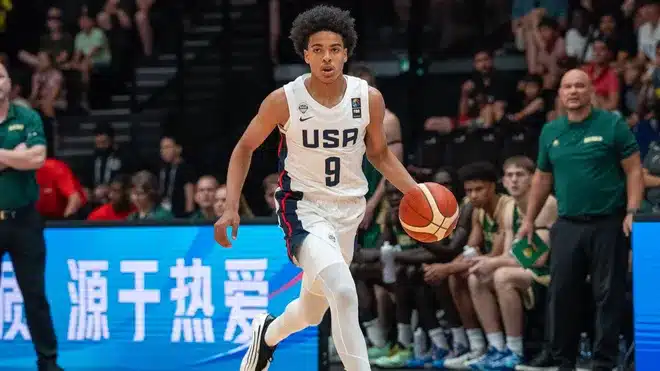
The USA under-19 World Cup squad dominated en route to winning the tournament. This wasn’t surprising, as the American squad generally features the best high-school and college talent available, leading to youth competition domination.
Massive athletic advantages and incredible depth make the USA squads tough to beat and a challenging evaluation context for the American players. Though we shouldn’t make any sweeping conclusions from the FIBA U19 World Cup, we can evaluate how these top American players performed.
Mikel Brown Jr., G, Louisville
Many felt Brown Jr. was snubbed for the tournament MVP award after leading his USA team in points, assists and minutes per game. In his 23 minutes per game, Brown Jr. averaged 14.9 points and 6.1 rebounds on a sparkling 63.4% true shooting. Brown Jr. melted the nets from deep, converting 47.6% of his six 3-point attempts per game.
Though he scored efficiently throughout the competition, Brown Jr.’s table setting made him the most impactful player in the field. He’s a pristine decision maker (2.9 assist-to-turnover ratio), always finding high-value layups and threes while taking some risks. He fuels his team’s potent transition attack, pushing the ball or launching it down court after rebounds and turnovers.
mikel brown jr led the USA in points, assists and minutes per game, thriving all tournament as an otd shooter and passer. probably should have won tournament MVP
his passing was surgical, so many high risk, high value passes while taking care of the ball (2.9 a:to) pic.twitter.com/SuoYJndejT
— ben pfeifer (@bjpf_) July 7, 2025
Brown Jr. competed on the defensive end, guarding the ball with length and speed. It’s Brown Jr.’s offensive performance, though, that garnered most excitement. His FIBA performance reinforced his status as a projected lottery pick in 2025, creating even more buzz heading into his freshman season at Louisville
AJ Dybantsa, F, BYU
Dybantsa took home the tournament’s MVP award after a strong performance (though Brown Jr. would have been my pick). He averaged 14.3 points, 2.3 assists and 4.1 rebounds on 64.3% true shooting. Those are pedestrian numbers by his lofty standards, but it’s important to remember that Dybantsa played a hair over 20 minutes a night.
He caused most of his damage in transition and advantage situations, relentlessly punishing inferior athletes and defenders at the basket. Without much half-court creation necessary, Dybantsa converted a scorching 68.4% of his 2-pointers, only trailing his former teammate Tyran Stokes in 2-point efficiency.
Though Dybantsa made just 2 of his 18 3-point attempts, his dominant interior scoring and foul drawing (0.89 free-throw rate) made up for it. He performed as expected heading into a highly anticipated season at BYU, where that interior scoring and athleticism could carry him to the top of the 2026 NBA Draft.
Koa Peat, F, Arizona
Most FIBA defenders couldn’t handle Peat’s size, strength and touch on the offensive end. He was one of three USA players to eclipse 10 points per game, averaging a solid 12.6 points, 6.9 rebounds and a steal per game on 51.8% true shooting. Like Dybantsa, Peat is a challenge to stop in the open court, winning with his excellent physical tools.
The 6’8 forward didn’t attempt a 3-pointer across the tournament, making 48.6% of his 10 2-pointers per game. Peat’s great burst, coordination and mid-range touch for his size let him easily crack the paint in early offense and in the half-court.
Peat’s size, ground coverage and activity contributed his team’s defensive dominance as well. Heading into his freshman season at Arizona, Peat must continue to prove himself as an outside shooter and playmaker (0.69 assist-to-turnover ratio), but his scoring is the foundation of his case as a lottery prospect in 2026.
Caleb Holt, G, Uncommitted
Despite playing up multiple age groups, Holt more than held his own against older FIBA competition. The 6’5, 17-year-old guard was extremely productive in his 16.5 minutes per game, averaging 10 points, 3.4 rebounds, 2.1 assists and 3.7 stocks (steals plus blocks) per game on an excellent 70.5% true shooting.
Holt, who impacts the game most on the defensive end at this stage, averaged an absurd 6.5 steals per 40 minutes, leading the tournament by over an entire steal. His length, instincts and aggression let Holt thrive as a digging defender and disruptive off-ball playmaker.
caleb holt more than held his own as a 17 year old playing in the fiba u19 WC, leading the tournament in steals/40 (6.5)
though he thrived on defense as usual, he looked quite comfortable on offense as well which was encouraging to see pic.twitter.com/teofmi6Gu9
— ben pfeifer (@bjpf_) July 7, 2025
Most of Holt’s improvement must come on the offensive end, but he held his own as a complementary player throughout the summer. Much of the production came in blowouts, but Holt’s off-ball movement, intermediate scoring and outside shooting (52% on 3.6 3-point attempts per game) are all encouraging signs moving forward.
Morez Johnson, C, Michigan
Johnson dominated the 2024 FIBA U18 Americup tournament and continued that excellent play in Switzerland this summer. He often moonlights as America’s Shaquille O’Neal in these international tournaments, overwhelming opponents with his incredible explosiveness, strength and size.
morez johnson’s incredible power athleticism, motor and length make him a monster at the FIBA level. excited to see how he carries it over to michigan this season pic.twitter.com/umorYY3H8U
— ben pfeifer (@bjpf_) July 7, 2025
He averaged a solid 9.4 points, 6.4 rebounds and 2.7 stocks in his 18.7 minutes per game, scoring his points on excellent efficiency (64.8% true shooting). Johnson doesn’t have a complicated offensive role, but he eviscerates opponents on the glass and whenever he catches the ball down low.
Johnson’s defense anchors an already impenetrable USA unit, ranking fourth in the tournament in blocks per game (1.7). Heading into his sophomore season at Michigan, Johnson will hope to carry over his dominance on both ends, especially as a versatile, game-wrecking inside-out defender.