
The Golden State Warriors’ heartbreaking 98-99 loss to the Philadelphia 76ers Thursday night is symbolic of many things concerning the Warriors’ season. They almost snatched victory from the jaws of defeat before willingly jumping back into the maw they have sunk into several times this season, for reasons both of their own making and out of their control.
For one, this almost-win didn’t happen due to three of their mainstays in Stephen Curry, Jimmy Butler and Draymond Green. Curry and Butler had already been ruled out of the game beforehand while Green had to sit out early due to a right ankle injury suffered when the Sixers’ Dominick Barlow unintentionally landed on Green’s foot.
Head coach Steve Kerr was therefore forced to count on a ragtag bunch of unproven youth, players on non-guaranteed roster spots and journeyman veterans (most of which, funnily enough, were former Sixers players themselves).
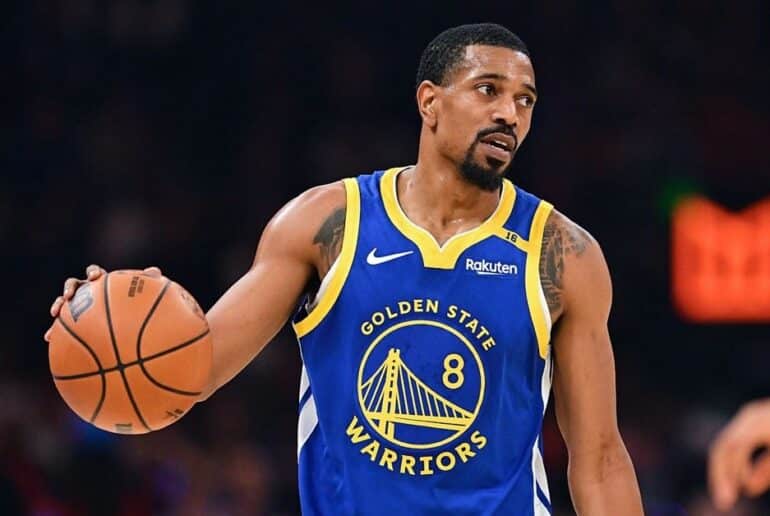
As such, when the Warriors get into an after-timeout (ATO) set in the fourth quarter with the players on the floor being two-way-contract player Pat Spencer, a returning De’Anthony Melton (fresh off of ACL injury rehabilitation), second-round rookie Will Richard, the undrafted Gui Santos and sophomore center Quinten Post, Kerr is forced to be entirely creative. That creativity stems from the consideration he is all out of bonafide advantage creation — i.e., players who can effortlessly draw extra defenders unto them in order to tilt defenses and create good looks for their teammates.
Kerr’s ability to craft set plays is often unheralded, hidden among the many other things he does well (and also, among other things perceived to be his shortcomings). The one he draws up in this instance — with the Warriors down eight points after having been down by as many as 24 points — was quite the doozy:

You can point to the ingenuity of the set through several of its aspects: the use of second-side action to divide the defense’s general attention, the use of Richard in motion to preoccupy two defenders and Spencer — a guard — setting a down screen for a lifting floor-stretching center in Post, who promptly buries the three that cuts the deficit to five.
Spencer’s performance, in particular, spoke volumes through the ways with which he implicitly impacted the game (his screen above being an example) and through the ways with which he explicitly made his presence known, both to the Warriors’ decision-makers in the coaching staff and the front office.
Spencer’s Impact
Amid furious debate about the Warriors’ draft picks and their inability to provide consistent winning impact, Spencer — a former lacrosse standout at Loyola University Maryland — has inserted himself as a viable alternative, let alone a candidate for a guaranteed roster spot. While he doesn’t profile as the most athletic guard (in the traditional sense of the word when it comes to basketball), nor is considered elite at any skill-set, Spencer does several things at an NBA-worthy level, belying his status as a two-way-contract player.
For one, he’s unafraid of challenging rim protectors and help defenders through his paint-touch exploits. He possesses enough of a handle and sufficient wiggle to not only get himself to the paint, but to cause defenses to have to collapse toward his drives. While Spencer may not finish due to a lack of athleticism — often having to compensate using guile, craft and off-beat finishes — he displays enough willingness and bravado to be an event creator, so to speak.
On a team whcih has struggled to create much of anything on offense without Curry and Butler, Spencer’s willingness to take on that role is something to be admired:

Not to mention — with the understanding the Warriors’ motion offense places a huge emphasis on making oneself a danger even without the ball, Spencer is cognizant enough to take the “motion” aspect to heart. When defenses opt to ignore him on the perimeter, he isn’t content to be a stationary witness; he uses the space given him to make himself available as a cutter, creating another instance of him breaking the paint and playing a part in generating efficient offense:

But perhaps the most important part of his game is his immunity to the bright lights and embracing the moment with pure ice in his veins. When two defenders botch a high ball-screen coverage involving Spencer and Post — with two defenders opting to stick to Post on his roll — Spencer calmly drills an open three:

And when he gets a favorable matchup on a switch, courtesy of another high ball-screen, the Warriors flow into an automatic low-post split action, where Spencer drills another three off of the same matchup he was able to create from the initial ball-screen:

Not everything was rainbows and butterflies for Spencer. He played a part in the botched inbound (along with Buddy Hield) that gave the Sixers a chance to win the game — and win they did, courtesy of a VJ Edgecombe putback made possible by a missed box-out by Spencer. Nevertheless, I would be remiss not to largely credit Spencer for his performance against the Sixers. The comeback was made possible in huge part from his contributions.
Melton’s Return Is A Silver Lining
Not enough words can capture how impactful De’Anthony Melton can be to this team, on a roster that has a significant deficit in two-guard depth and overall quality. However, Green — after the Warriors’ loss to the Oklahoma City Thunder a couple of nights ago — made sure the burden of expectations shouldn’t be placed upon Melton’s shoulders alone.
With that said, Melton, on most nights, won’t be counted on as a primary option but rather as a secondary ball-handler capable of creating in a pinch, such as during pick-and-roll situations born out of the lack of juice from initial actions. It just so happened on a night without any primary option present, Melton had to shoulder some of the primary creation responsibilities.
Counting on Melton to be a primary creator can have diminishing returns, especially from someone who hasn’t played competitive basketball in nearly a year. But in a pinch, he’s not a bad choice as someone to shoulder some of that burden:

Not to mention, being able to act as an auxiliary piece of the offense through mostly being at the right place, at the right time — namely, as a screener:

But the defensive value he adds is arguably needed most for these Warriors, a group which — despite profiling as the league’s sixth-best defensive team in points allowed per 100 possessions — has a point-of-attack containment problem. Melton provides that much-needed resistance at the point of attack, as exemplified by his end-of-game defense against Tyrese Maxey that ultimately went for naught:

Additionally, his off-ball instincts remain as valuable as ever. Whether it’s as a nail defender stunting at driving gaps or as a screen navigator who possesses the requisite anticipatory instincts to get to the ball before his man does — resulting in deflections or outright steals — he is quite impactful.

Melton represents a modicum of stability to a team plagued with plenty of instability and uncertainty. That tumult is fueled by an old roster, the inability of the youth to counteract the disadvantages of an aging roster (e.g., constant injuries from wear and tear) and the mercurial rotations as a result of those aforementioned aspects.
He’s not the be-all-end-all solution to their woes. But if Thursday provided Kerr with any clarity concerning the players he should be counting on, Melton and Spencer should be a part of his realization.