

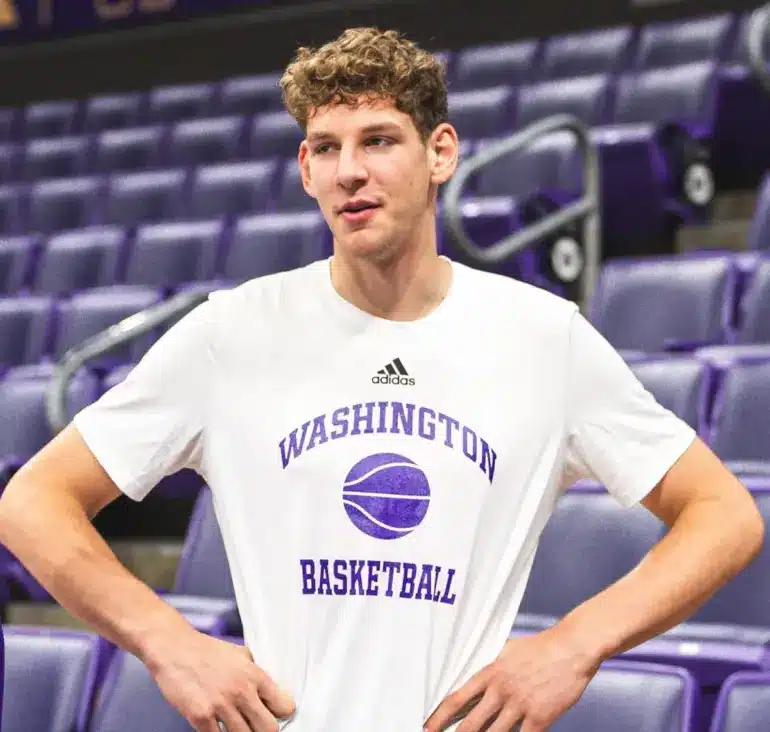
Imagine a college freshman who posted these numbers (per 40 minutes) over the final 11 games of their season, including Conference/NCAA Tournament contests:
22 points, 15.1 rebounds, 2.6 assists (0.9 assist-to-turnover) and 3.3 stocks (steals + blocks) on 66.9% true shooting with a 59% free throw rate. Even without further context from stats, game tape or measurables, those are dominant per-minute numbers for any player, let alone a college freshman.
Those numbers belong to Washington freshman big man Hannes Steinbach, except those aren’t from a college season at all. I pulled those numbers from his 11 playoff games in the German League from May and June 2025, widely considered a top domestic league with tons of talent.
Hannes Steinbach dominated his peers
The 6’9, 220-pound big man with a reported 7’1 wingspan was a driving force behind professional playoff wins, playing in his first German League playoff game days after turning 19. Expanding our sample to Steinbach’s 41 regular-season and playoff games, most of which he played as an 18-year-old, presents similarly impressive per-40-minute numbers:
17.6 points, 13.4 rebounds, 2.0 assists (1.0 assist-to-turnover) and 2.9 stocks on 64.8% true shooting and a 50% free-throw rate. Steinbach will take a slight step down in competition level, transitioning to the Big 10, and we should expect him to continue his dominant play, especially on the offensive end, to top-10 pick status in the 2026 NBA Draft.
Before his full-time graduation to the big club, Steinbach played 12 games last season for his team’s third-division squad and was comically dominant in those games, averaging 32.8 points 16.3 rebounds, 4.2 assists (1.3 assists-to-turnover) and 5.3 stocks per 40 minutes on 63.6% true shooting.
Steinbach carried a monster 30.4% usage rate in the third division and shot 5.8 threes per 40 minutes in those 12 games, compared to an 18% usage rate and 0.9 threes per 40 minutes. He splashed pull-up triples, ran pick-and-rolls and dunked in the half-court once per game, more frequently than college Zion Williamson, Ben Simmons and Joel Embiid had.
His tape from those games is just as ludicrous as those numbers suggest:
there are plenty of nonsensical hannes steinbach stats from his 12 german 3rd division games last season (25-13-3-4 stk on 63% TS),
here’s my favorite — he averaged a half court dunk per game, more than college zion (0.7), simmons (0.8) and embiid (0.9)! hilarious dominance pic.twitter.com/X8RKpVzpTa
— ben pfeifer (@bjpf_) October 15, 2025
Elite NBA prospects should dominate low levels of competition, but Steinbach’s first division games are the primary sample for his evaluation. At Washington, though, his role might more closely mirror his youth role, trading cutting, screening and rebounding for more on-ball initiation.
What are his special traits?
Regardless of his role, Steinbach will rely on his truly special hands, functional strength, coordination and touch to thrive in college. He has the strongest, stickiest hands of any prospect I can remember. That isn’t hyperbole — Steinbach routinely makes full extension catches in traffic, Mossing defenders before making a decision with the basketball:

He’s a people-moving machine who routinely erases boxouts by driving players out of position with tree trunk legs and a strong core. Watch Steinbach drive #35 (28-year-old Karim Jallow) so far into the restricted area that he’s completely out of the picture by the time the shot hits the rim:

Every aspect of Steinbach’s on-court impact sprawls out from his hands and strength, whether through rebounding, screening, blocking shots and deflecting passes. Most critically for his ultimate ceiling, those elite physical tools fuel high slashing and paint scoring upside on post-ups and drives.
Steinbach shot an elite 65% at the rim in the half-court last season in the German first division. He bashed and bludgeoned his way to the basket against professional defenders and, as a result, his team generated efficient offense on Steinbach’s rolls to the rim (1.165 points per possession, 71st percentile) and post-ups (1.256 PPP, 95th percentile).
He’s more than a strong, lumbering big, though. Steinbach indeed lacks high-end speed, big-space change of direction or explosiveness. He compensates for those limitations with special coordination, dribbling in traffic and movement skills for his size, especially as a decelerator.
Without great speed or acceleration, Steinbach creates advantages by stopping on a dime and scoring on exaggerated plants and slow steps. Legendary balance and core strength let him park on a single leg as defenders fly by him while he scores with a silken touch at the basket:

To reach his ceiling as a top-10 pick or better in a strong 2026 class, Steinbach must progress somewhat as a shooter and playmaker to maximize his interior gravity. Aside from the tiny third division sample, Steinbach has never been a volume 3-point or mid-range shooter and shot 65.8% at the line last season.
Steinbach’s best passes come on the short roll, where his devastating downhill scoring creates easier passing windows. While he lacks high-end vision and passing talent, his processing speed and decision-making should be solid enough to capitalize on his scoring at the college level. For his NBA ceiling, he must progress as a passer on the move.
How will Steinbach fare in college?
I don’t expect Steinbach to struggle mightily on defense in college as he leans on strength, elite hands and solid positioning. At the NBA level, especially in an eventual playoff series, Steinbach’s lack of height and reach, explosive twitch and long ground coverage could limit his utility in certain matchups.
That’s a high bar to clear for any draft prospect, but for a top-10-plus prospect, it’s important to conceptualize how teams will game-plan for his weaknesses (though identifying strengths matters more to me). Imperfect tools and spotty off-ball awareness cause some gaffes defending the paint, which is where he’ll spend much of his time on defense.
After a dominant showing at the FIBA U19 World Cup this summer, Steinbach has firmly cemented himself on NBA Draft radars. Recent mock drafts from Bleacher Report (19th) and ESPN (26th) view him as a first-round player, but that significantly undersells him.
The NBA often fades big men without traditional center size or athleticism and weak outside shooting. That makes surface-level sense, but we’ve seen plenty of non-traditional frontcourt players with unorthodox elite traits dominate international leagues at a young age and translate to the NBA (Alperen Sengun, Goga Bitadze) after falling in the draft.
NBA teams won’t have to fully project Steinbach’s impact to high-leverage basketball. He’s already proven himself a playoff contributor who fits next to other on-ball stars because of his rebounding, play finishing and defensive chops. Those traits suggest a solid floor for impact, but we shouldn’t discount his ceiling.
Regardless of his eventual NBA career, Steinbach should be one of the 10-15 best players in college basketball from the second he steps on the floor in Seattle. At the tail end of Steinbach’s outcome range, he could return All-Star value through dominant interior scoring and complementary play. If that happens, his exceptional youth dominance and bankable elite traits (strength, coordination, touch) were all signals.
Stats courtesy of RealGM, Bart Torvik and Synergy Sports