

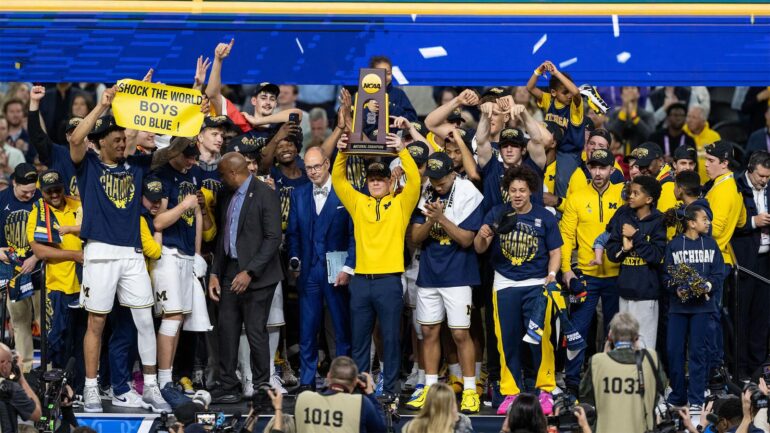
Michigan spent around $10 million on NIL to build its 2026 national championship roster, and it paid off. Here’s how they built their roster.
Winning a national championship costs money. Michigan just proved exactly how much.
The Wolverines claimed their first NCAA title since 1989 on Monday night, beating UConn to end a 37-year drought. According to Front Office Sports, Michigan’s roster carried an estimated $10 million in NIL spending, placing it among the biggest spenders in college basketball this season.
That investment paid off in a big way.
Where Michigan Spent Its Money
Michigan head coach Dusty May had money to work with, and he built a winner. The centerpiece of Michigan’s roster-building effort was the transfer portal. The Wolverines put together the No. 2 transfer class in the country, according to 247Sports, and it showed all season long.
Yaxel Lendeborg headlined the group. The transfer big man earned Big Ten Player of the Year honors after averaging 15.1 points and 6.9 rebounds per game. He was Michigan’s most consistent performer from opening night through the championship.
Elliot Cadeau was just as important. The former North Carolina guard was named the tournament’s Most Outstanding Player after taking over game after game during Michigan’s run. His ability to create off the dribble and run the offense under pressure made him one of the most valuable players in the entire field.
Aday Mara, who transferred from UCLA, and Morez Johnson Jr., who came over from Illinois, rounded out the portal additions. All four transfers finished as Michigan’s four leading scorers on the season. That is not a coincidence. That is a high-level roster construction plan.
Michigan also invested in high school recruiting. The Wolverines landed the No. 11 class in the country in 2025, headlined by 4-star prospect Trey McKenney.
What Michigan Spent Compared to Other Big Spenders
Michigan was not the only program writing big NIL checks this season. According to On3’s Pete Nakos, several other programs also reached the $10 million threshold, including Arkansas, Duke, Houston, St. John’s, and Texas.
Kentucky sat at the top of the list with a reported $22 million roster budget. That number is staggering, and the results were equally stunning in the wrong direction. The Wildcats finished 22-14 and exited in the second round of the tournament. It was one of the most disappointing seasons in recent Kentucky history, given the resources available.
The other big spenders had mixed results. Duke came in as the No. 1 overall seed and reached the Elite Eight before falling to UConn. Arkansas made the Sweet 16 but lost to Arizona. Texas snuck into the field with a First Four win and reached the Sweet 16. Houston and St. John’s both fell in the Sweet 16 as well.
NIL Spending Alone Does Not Win Titles
Michigan’s story is compelling precisely because it was not just about money. The Wolverines spent wisely, targeting the right pieces at the right positions rather than simply collecting talent.
Coach Dusty May built a team with a clear identity. Michigan defended at an elite level all season. The transfers fit the system. The roster had a balance between experienced portal additions and younger homegrown pieces.
Plenty of programs have spent $10 million or more and gone home early. Michigan is the latest proof that how you build a roster matters just as much as what you spend to build it. The Wolverines now have a banner to show for it.