
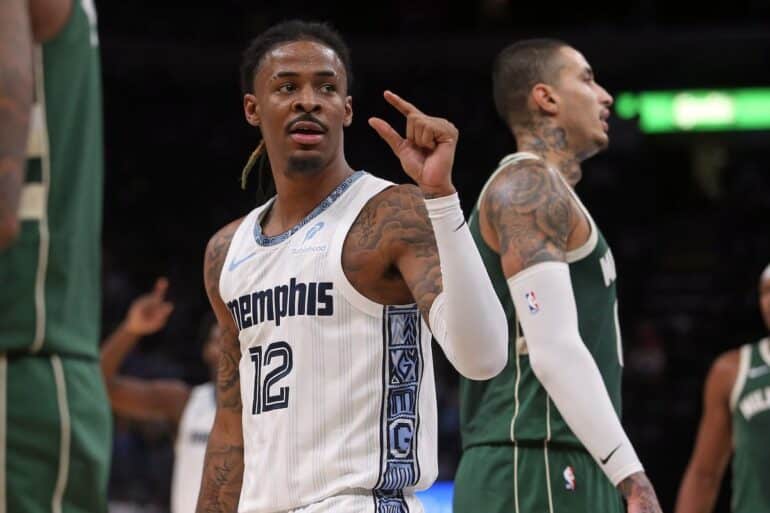
On Nov. 4, 2024, Ja Morant – during the Memphis Grizzlies’ yearly visit to Brooklyn to face the Nets – pulled off arguably one of his most memorable highlight finishes of his career. A 360 reverse layup accomplished once in a game would be enough to headline one’s career. Two 360 reverse layups in a single game is downright uncanny, a monstrous display of supreme athleticism and body control.
If there was one player in NBA history who fit that profile, it was certainly Morant:
It should be noted such potent displays of aerial ability were a mere year ago, a couple of seasons removed from what would be considered Morant’s peak season. During the 2021-22 season, in which Morant led the Grizzlies as far as the Western Conference Semifinals, he tallied averages of 27.4 points (a career high), 5.7 rebounds and 6.7 assists, on a shooting split of 53.4 percent from two, 34.4 percent on threes and 76.1 percent at the free-throw line.
Along with his 2022-23 campaign, it marked Morant’s peak as the Grizzlies’ main creation fulcrum, averaging 19.7 creation true shot attempts per 100 possessions (that is, shot attempts out of isolation, pick-and-roll, and post-up play types), per Databallr. That mark is second only to Morant’s 2023 mark of 20.6 creation true shot attempts per 100.
The aforementioned seasons also produced the highest frequency of Morant being on the ball. In 2022, 44.8 percent of the Grizzlies’ offensive possessions saw Morant with the ball in his hands, while 2023 was an even higher 47.3 percent.
Coincidentally, Morant’s 2022 season allowed the Grizzlies to become one of the most efficient offensive teams in the league. Their 115.8 points per 100 possessions in 2022 ranked fourth in non-garbage time, per Cleaning the Glass. At the center of it was Morant and his dynamite displays of rim attacking, often precipitated with a quick first step and burst at the point of attack. But it was his ability to hang in the air an extra split-second and contort his body in an awkward manner providing him the extra dimension needed for him to become one of the league’s most dynamic finishers.

At the time, no one had any inkling it was the absolute peak Morant would reach, a season which saw him win the NBA’s Most Improved Player Award and an All-NBA Second Team selection. While 2023 was a near-equal to his 2022 campaign, the following years would prove to be the start of his fall from grace.
A Square Peg In A Round Hole
In 2024-25, the Grizzlies hired Noah LaRoche as an assistant to head coach Taylor Jenkins. Belying his status as an assistant, LaRoche had an influential input behind the nature of their offense. Doing away with the pick-and-roll-based schemes Morant highly favored, LaRoche’s approach instead centered around a continuous stream of dribble-drive attacks supplemented by modern spacing principles and a varied diet of off-ball movement.
In theory, having Morant be the centerpiece of an offense that favored straight-line drives – and him making reads off of those attacks with a spaced floor – was a match made in heaven. In practice, it ran anathema to Morant’s preferred approach of attacking off of ball-screens.
That season, the Grizzlies became the league’s least-frequent pick-and-roll team. Only 10.2 percent of their offensive possessions were finished by the ball-handler in the pick-and-roll, while only 3.9 percent were finished by the roll man. The former was dead last in the league, while the latter was 29th, with only the Golden State Warriors notching a lower mark.
Moreover, with LaRoche’s offense being indiscriminate in terms of who was handling the ball, Morant’s time with the rock in his hands saw a precipitous drop: 36.3 percent, a far cry from 2022-23. In his view, Morant felt his talents as a pick-and-roll specialist weren’t being maximized as they once were before LaRoche was hired to sculpt the offense.
As a result, LaRoche’s employment with the Grizzlies was terminated, but not before Jenkins himself was also fired by the team, despite Morant reportedly being on good terms with his longtime head coach. In Jenkins’ place was Tuomas Iisalo, whose time with Paris Basketball in Europe produced a high-powered offense more in line with Morant’s proclivity for the pick-and-roll.
Along those lines, one would think Morant would experience a renaissance under Iisalo and his philosophy. But due to several factors mostly of Morant’s own making, a reversion in philosophy apparently won’t be enough to salvage his tenure in Memphis, with the Grizzlies reportedly open to trading away the former All-Star.
The Problem Of Availability
It is said the best ability an NBA player can have is availability. And in several ways, there is truth to that notion. Morant’s talent is undeniably but it cannot be maximized if it is utilized sparingly.
Over the previous three seasons, Morant has played a mere 77 games – fewer than Anthony Davis (147), Kawhi Leonard (134), Zion Williamson (123), and LaMelo Ball (97). An infamous blend of suspensions and injury has contributed to that low number. But it has been his injuries that have contributed to the dip in on-court effectiveness.
Morant’s style of play is highly pleasing to the general public. But it is highly dependent on near-perfect health. At 26 years old, Morant shouldn’t be on the wrong end of the age spectrum but injuries to his shoulders, hips, thighs and knees have somewhat accelerated his aging process. Much of those injuries are a byproduct of his constant change-of-direction exploits and the wear-and-tear that naturally accompanies rim-pressure exploits.
Morant’s Areas Of Decline
One statistical consequence apparent has been the sharp decline in Morant’s rim frequency – from as high as 49 percent in his rookie season to as low as 30 percent this season. Even more than a decline in rim-attack rate has been a noticeably sharp drop-off in rim efficiency. In 2022, Morant had a finishing relative true shooting percentage of plus-4.2 percent – in other words, Morant’s finishing at the rim was 4.2 percentage points higher than league-average efficiency at the rim. This serves as a stark contrast to Morant’s efficiency at the rim this season: a finishing relative true shooting percentage of minus-8.5 percent.


A decline in rim frequency must naturally be accompanied by compensation in other shot-profile areas, notably the midrange. The numbers support that notion, as Morant is taking 46 percent of his shots in the midrange, the highest rate of his career.
However, he’s making only 40 percent of his midrange attempts, 34th percentile among point guards. Breaking it down between “short” midrange (floater range) and “long” midrange (shots taken outside of 14 feet but below the 3-point line), Morant is shooting 41 percent on the former (44th percentile) and 34 percent on the latter (34th percentile).
His highly inconsistent jumper (0.63 points per jumper, least efficient among 150 most active jump-shooters this season) has been the main culprit behind his lack of effectivity in the middle ground:

Likewise, the 3-point line serves as zero recourse for Morant, a career 31 percent shooter beyond the arc who is shooting a career-low 20.8 percent on threes this season.
Perhaps, no statistic has been more damning of Morant’s impact this season than on-off metrics. With low-leverage minutes taken away, the Grizzlies have been significantly better without Morant (minus-0.3 point differential) than they have been with Morant (minus-9.0 point differential). This drop-off has been primarily due to the drop-off in defensive efficiency (from a 114.7 defensive rating with Morant off to a 118.8 defensive rating with Morant on) during his minutes.
Recent history has been most unkind to the profile Morant is a member of, that of diminutive guards whose decline has shined a light upon the lack of compensatory skills and impactful traits that have seen their value rapidly decline. The recently traded Trae Young – whose perceived value throughout the league was so low he was acquired by the Washington Wizards without them having to surrender a single draft pick – serves as a sobering reminder to the Grizzlies and Morant.
Which brings us to the recent news the Grizzlies are entertaining offers for their franchise point guard.
Potential Trade Destinations
Amid talks of Morant being possibly dealt to the Miami Heat, there is reason to doubt Morant would want to ply his trade in South Beach – chief among them being LaRoche is serving as a consultant to head coach Erik Spoelstra. In turn, Spoelstra has installed the very same offensive scheme Morant balked at last season.
After a torn ACL ended Fred VanVleet’s season before he could suit up, the Houston Rockets have been in need of a bonafide table-setting point guard, a role Morant could certainly play, given his rather underrated passing and playmaking ability. Being one of the league’s better rebounding guards also subscribes to the team which leads the league in rebound rate. The fit with Kevin Durant would be theoretically seamless. However, the fit with everyone else – in particular, Amen Thompson – would have to be a work in progress, given how both profile as non-shooting threats.
Like the Rockets, the Minnesota Timberwolves would welcome the point-guard services of Morant, seeing as ball-handling responsibilities are currently shared among Anthony Edwards, Julius Randle and Donte DiVincenzo. Funneling most of the on-ball reps toward Morant would unburden Edwards from having to act as the defacto point guard, freeing him to be more of an off-ball threat.
The conundrum the Wolves face in a potential trade scenario, however, is the prospect of having to give up one of Rudy Gobert, Randle and Naz Reid in exchange for Morant. Out of the three, Reid is the one most likely to be packaged – but the Wolves would be exchanging a player with the rare combination of size and outside shooting for a much smaller guard with virtually zero shooting value. The Wolves will have to decide how much they value ball-handling and rim pressure over the traits Reid gives them.
Whatever the case, Morant is in a tough spot. Scoring below league-average efficiency (minus-7.4 relative true shooting) and notching a ghastly effective field goal percentage of 42.9 percent (226th out of 227 players with a minimum 15 games played and averaging at least 20 minutes per game), teams will find it strenuous to center their offense around a small guard with mileage on his worn treads and baggage that places doubt on his ability to be the face of their organization.