
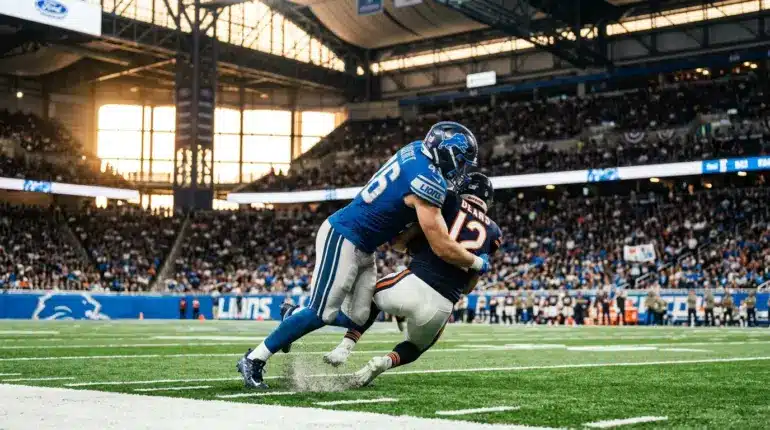
The Detroit Lions locked up linebacker Jack Campbell on a four-year extension through 2030 worth up to $81 million – $51 million guaranteed – making him the second-highest paid off-ball linebacker in the NFL at $20.25 million per year. Only San Francisco’s Fred Warner, at $21 million AAV, earns more at the position. This is not a routine contract. This is a declaration.
General manager Brad Holmes did not write an $81 million check because he had cap room to burn. He did it because the Lions’ championship architecture depends on it – and because the financial engineering beneath this Lions contract extension is smarter than the headline number suggests.
What the Extension Actually Signals: Holmes Is Building a Dynasty, Not Managing a Roster
Holmes has operated on a single organizing principle since taking over in Detroit: draft the right players, develop them, then pay them before the market forces your hand. That is not roster management. That is franchise construction with a deliberate timeline.
The Lions had already extended Amon-Ra St. Brown, Penei Sewell, Alim McNeill, Aidan Hutchinson, Jameson Williams, and Kerby Joseph before Campbell’s name was added to that list. Each deal followed the same logic – lock in your core at or near the top of the market, structure the contract to protect near-term cap flexibility, and keep the Super Bowl window from closing prematurely. As championship contenders have demonstrated with creative extension structures, the headline AAV is rarely the full story.
Detroit declined Campbell’s fifth-year option – which would have made him the highest-paid off-ball linebacker in the league on a single-year number – and replaced it with a long-term deal that almost certainly carries a manageable early cap hit through signing bonus amortization. The Lions used the same playbook on Sewell, whose 2024 cap charge came in well under $15 million despite a $28 million APY deal. Expect Campbell’s 2026 number to follow a similar pattern.
Campbell’s Value to the Defense Makes This a No-Brainer Investment
Campbell’s breakout 2025 campaign – more than 150 total tackles, multiple splash plays, a Pro Bowl selection, and second-team All-Pro recognition – gave Holmes all the evidence he needed. This was not a team paying for potential. This was a team paying for a proven product.
He entered 2023 playing 43 percent of defensive snaps as a rotational piece. By late 2024, he was Detroit’s every-down linebacker and the green-dot communication hub of the entire defense. With Alex Anzalone now in Tampa Bay, Campbell steps into the full defensive captain role – the player calling protections, identifying formations, and keeping the Lions’ front aligned against the NFL’s most complex offenses.
Losing that player to free agency in 2027 – the original expiration of his rookie deal – would have cost the Lions more in defensive continuity than the $20.25 million per year costs them on the cap. That is not a soft claim. That is the core reason elite off-ball linebackers command top-of-market money: they are irreplaceable infrastructure, not interchangeable parts.
The Honest Pushback – Positional Value and Competing Demands Are Real Concerns
Here’s the honest pushback: linebacker is not quarterback, and spending elite money on an off-ball linebacker while Jahmyr Gibbs, Sam LaPorta, and Brian Branch all need new contracts is a genuine financial tightrope. LaPorta and Branch, as second-round picks, have no fifth-year options – their rookie deals expire after this season, creating hard deadlines that can’t be pushed.
The NFL salary cap concern is legitimate on its face. According to OverTheCap, Detroit currently carries approximately $53 million in cap space not counting Campbell’s extension, and the official year-by-year breakdown of his deal has not been filed publicly yet. That breakdown will determine exactly how much room Holmes has to pursue the next wave of extensions.
But the counterargument holds up under scrutiny. The NFL cap has jumped from $224.8 million in 2023 to $255.4 million in 2025, with projections pointing well past $300 million by 2028. Campbell’s peak cash years will arrive as a shrinking percentage of total cap – and if Holmes structures the deal with back-loaded cash and front-loaded signing bonuses, Detroit’s near-term flexibility remains workable. The Lions have demonstrated repeatedly that they know how to move financial weight around the calendar without breaking compliance. Compare that to front offices that have let their cores fracture under cap mismanagement – the contrast is stark.
What This Means for the Lions’ Super Bowl Window – It’s Still Wide Open
Campbell’s extension does something beyond securing one player. It confirms that both of Detroit’s 2023 first-round picks – Campbell and Gibbs, whose fifth-year option at $14.293 million was already picked up – are under contract through at least 2027. That is the spine of the Lions’ offense and defense, locked in simultaneously.
Holmes will now pivot to Gibbs, LaPorta, and Branch. Multiple reports indicate Gibbs is the priority, with a new deal that could reset the running back market before the 2026 season. The Athletic’s Colton Pouncy framed the Campbell move as “the logical next step in Holmes’ plan to keep the 2023 core intact,” noting that locking Campbell early gives Detroit negotiating leverage – not desperation – in those coming talks.
The Lions are not hoping their window stays open. They are engineering it to stay open. Every Holmes extension – unlike the short-term patchwork strategies some franchises lean on – is a deliberate brick in a structure designed to sustain contention for multiple seasons, not just one run.
Bottom Line
Jack Campbell is worth $20.25 million per year to the Detroit Lions – not because the linebacker market demands it, but because what Campbell specifically does for this specific defense is irreplaceable.
Brad Holmes structured this deal to protect cap flexibility while securing the player. The signing bonus engineering, the back-loaded cash flow, and the rising cap projections all point in the same direction: Detroit can pay Campbell and still pay Gibbs, LaPorta, and Branch.
NFL Rumors will continue to swirl about which team can sustain a championship window through this cycle of extension demands. The Lions are providing the clearest answer in the NFC.
The Super Bowl window in Detroit is not cracking under the weight of these contracts. It is being bolted shut – from the inside.