

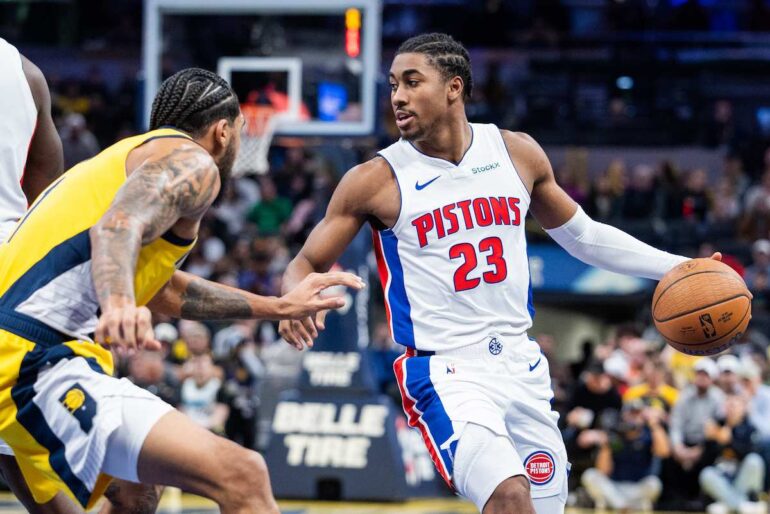
This is part of a series breaking down players poised to possibly take a leap this upcoming NBA season and influence the playoff race. Our first installment featured Indiana Pacers guard Andrew Nembhard.
The Detroit Pistons aren’t going anywhere. Led by their intrepid All-NBA guard, Cade Cunningham, the Pistons returned to the playoffs for the first time since 2019 last season and pushed the New York Knicks to six games in round one, offering a glimpse of what’s possible moving forward.
The team is still wildly young. Cunningham, Jalen Duren, Ausar Thompson, Isaiah Stewart and Ron Holland are all under the age of 25. While they lost Dennis Schroder (and Malik Beasley’s status is TBD), they’ve filled out the roster nicely with veterans who can provide some offensive punch, namely Tobias Harris, Duncan Robinson and Caris LeVert.
They missed a key piece for the majority of last season, though. Perhaps their most intriguing young prospect, Jaden Ivey only played 30 games in 2o24-25 after suffering a broken left fibula, which sidelined him for the remainder of the season. For his part, Ivey was amid something of a breakout campaign before getting hurt, putting up career-highs in points and scoring efficiency.
Like the Pistons themselves, we only got a glimpse of what Ivey’s ceiling can be. But year four will be crucial as he adapts to his role on a playoff-caliber team, especially ahead of next summer’s restricted free agency.
A Key Offensive Role
Cunningham was about as ball-dominant as they come last season. He finished top 10 in usage percentage and was the do-it-all engine for the Pistons’ offense, almost to a fault. Ultimately, that will still be Detroit’s main recipe for success moving forward, which leaves Ivey to make the most of his situation off the ball.
Of course, with Ivey around, the Pistons can scale back Cunningham’s ball dominance. It’ll help them diversify the offense to ideally improve their 14th-place finish in offensive rating. Keeping defenses guessing could do them some good. Ivey’s on-ball prowess will play a big part in that.
But the bulk of his usage will be spent working off the ball, finding space and operating as a release valve next to Cunningham.
Ivey’s most prevalent skill is his speed. He’s a bullet train in transition, barreling to the basket. In half-court settings, he can burst through the seams of a defense as an off-ball weapon. It’s an overwhelming gift. Weaponizing that next to Cunningham is a tantalizing thought.
During Ivey’s 30 appearances last year, we saw him thrive in head coach JB Bickerstaff’s offensive system. He ranked in the 91st percentile as a spot-up player, largely due to the quality looks Cunningham generated for him beyond the arc. He shot a career-best 41 percent from three, including 45 percent on catch-and-shoot looks and 50 percent on uncontested chances. Even beyond the improved shooting, he was more decisive off the catch and generated 9.8 drives per game — the second-highest mark on the team behind Cunningham.
Ivey’s speed also makes him formidable in handoff scenarios, where he can leverage his burst to catch defenders off guard. The Pistons should lean more on this skill as another source of offense in 2025-26, regardless of whether Cunningham is on the floor.
Synergy between Ivey and Cunningham is crucial for the Pistons’ long-term outlook. Last season, they frequently staggered their backcourt duo. Ivey only played 500 of his 1,000 minutes alongside Cunningham. Despite being a top-six seed with a plus-1.6 net rating overall, they struggled during the minutes those two shared and posted a minus-4.2 net rating.
That must change and the impetus is on Ivey to do so. Without him, the Pistons found a winning formula. He must enhance that formula, not detract from it.
Finding Himself Defensively
Last season, the Pistons hung their hat on this end of the floor and finished 10th in defensive rating. They found a way to get under the skin of every opponent, grinding the pace down to a halt, closing out possessions with rebounding and prioritizing protecting the paint above all else.
It worked marvelously in the playoffs against the Knicks. They switched and blitzed Jalen Brunson and Karl-Anthony Towns into tough shots. Each game felt like a rock fight because of Detroit’s bruising style.
Ivey must figure out how to fit into that equation. Without him on the floor, the Pistons were 4.6 points better defensively per 100 possessions, the worst mark of any Detroit rotation player. He particularly struggles with screen navigation and ranked in the 12th percentile when defending pick-and-roll ball-handlers, per Synergy.
It’ll be difficult for him to overcome his slender 195-pound frame and become a truly positive on-ball defender. That said, the same burst and mobility he wields offensively can be useful defensively. If harnessed properly, he can round out as a solid team defender who buys into the Pistons’ scheme and helps them force turnovers (12th in opponent turnover rate last year) with his speed and 6-foot-9 wingspan.
That requires buy-in. Ivey will need to be, at the very least, not destructive on that end, so his offensive impact isn’t wiped away by porous defense and inhibit the Pistons’ defensive-minded identity. It creates a delicate balancing act for Ivey to pull off: developing as a young player while still helping a playoff-caliber team win games.
It’d be naive to suggest the Pistons are dead set stylistically on the type of team they want to be. But with Ivey specifically, 2025-26 is an all-important season to determine whether he fits with the franchise’s long-term vision.
On paper, it’s easy to see how a quick-twitch guard with an improved jumper can work in tandem with Cunningham’s methodical, bruiting nature. But so far, the numbers suggest the appealing fit is based more in hypotheticals than reality.
Cunningham has broken out. Now, it’s on Ivey to hold up his end of the bargain.
Whether the speedy guard can may be the difference between the Pistons remaining as merely a fun playoff team and one that could make some serious noise out East.