
Leon Rose spent four years hoarding assets, making one franchise-altering free agent signing, and then going all-in at exactly the right moment – and the New York Knicks are in the 2026 NBA Finals because of it.
New York is back on the Finals stage for the first time since 1999, and in a twist that feels scripted, they’re facing the same opponent: the San Antonio Spurs. The roster that got them here wasn’t built in a single offseason or through a lucky lottery pick. It was assembled piece by piece over four years through trades, mid-level signings, and a level of front-office patience that this franchise hadn’t demonstrated in a generation.
The Knicks Were a Cautionary Tale Before They Were a Contender
Before Jalen Brunson arrived, the New York Knicks were the league’s most reliable example of how not to rebuild. The Kristaps Porzingis trade, the failed 2019 cap-space gamble for Kevin Durant and Kyrie Irving, and the short-lived Julius Randle playoff core all left the organization spinning without a true franchise cornerstone. Their preseason NBA title odds entering the 2022-23 season sat north of +5000 – a market reflection of genuine irrelevance.
Leon Rose took over as team president in 2020 and preached patience when patience was deeply unpopular in New York. He stockpiled draft picks, avoided panic trades, and resisted the urge to blow the asset bank on Donovan Mitchell when Cleveland and other teams drove that price to the stratosphere in the summer of 2022. That discipline is the origin story of everything that followed.
The picks Rose preserved became the currency for Mikal Bridges, Karl-Anthony Towns, and OG Anunoby. He didn’t chase. He built.
Jalen Brunson Was the Move That Made Every Other Move Possible
Dallas let Brunson walk into unrestricted free agency in the summer of 2022. New York signed him to a four-year, $104 million deal – a number that was immediately mocked as an overpay for a guard who had never made an All-Star team. ESPN later described the contract as one of the best value contracts in the league. That reappraisal didn’t take long.
Brunson averaged 24.0 points in his first season as a Knick, quickly becoming the primary engine the offense had been missing for years. His gravity as a pick-and-roll operator opened the floor for everyone around him and gave Tom Thibodeau a genuine star to build a rotation around. The betting market moved accordingly – New York’s title odds shortened considerably after his first full season, a quiet signal that the league was recalibrating its read on the franchise.
Brunson’s consistency also validated Rose’s broader philosophy. Once the front office knew they had a legitimate No. 1 option, every subsequent move had a clearer purpose: add two-way wings, protect the rim, and surround him with players who had proven they could win meaningful games together.
Draft Capital Was the Foundation Rose Refused to Waste
The Knicks’ Knicks roster construction story is unusual by any modern standard. NBA.com noted that none of New York’s top rotation players were first-round picks by the Knicks themselves – a fact that underscores just how thoroughly Rose converted accumulated draft capital into finished players rather than development projects.
Deuce McBride, drafted in 2021, is the clearest homegrown success story – a second-rounder who developed into one of the team’s most reliable bench contributors. The Knicks also added Pacôme Dadiet in the 2024 draft and executed a series of draft-night trades that brought in Ariel Hukporti, Tyler Kolek, and later Mohamed Diawara. None of these moves generated headlines. Collectively, they gave the roster functional depth without eating into the payroll flexibility Rose needed for bigger swings.
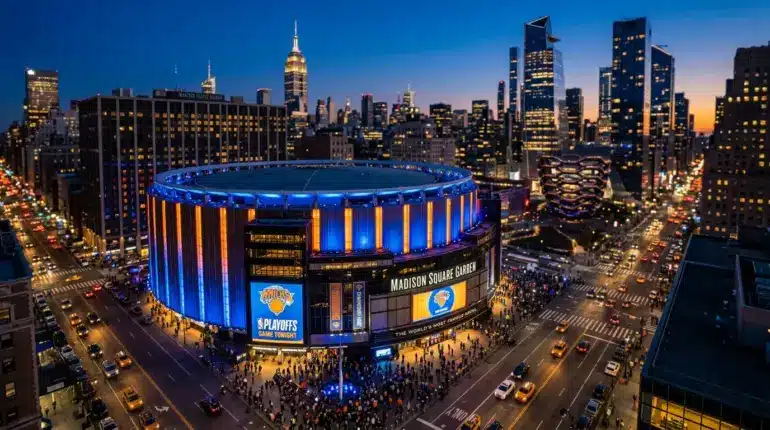
The Josh Hart acquisition in February 2023 is where the asset strategy started paying visible dividends. A four-team trade that sent Cam Reddish and a first-round pick out of New York brought Hart to Madison Square Garden and ignited what became known as the “Nova Knicks” – a Villanova-forged core of Brunson, Hart, and eventually Bridges built on shared instincts, toughness, and offensive connectivity.
The OG Anunoby Trade Turned New York Into a Defensive Identity Team
In late December 2023, the Knicks traded RJ Barrett and Immanuel Quickley to Toronto for OG Anunoby. No first-round picks changed hands – a remarkable outcome for a prime-age, elite defensive wing. The Knicks were immediately criticized for giving up two young players the fan base had invested in, but the basketball logic was hard to argue.
Anunoby’s arrival pushed New York’s defensive rating into top-five territory almost immediately. His combination of length, lateral quickness, and positional versatility gave Thibodeau a genuine stopper he could deploy on opposing stars without sacrificing offensive flow. Anunoby re-signed on July 6, 2024, eliminating any rental risk and signaling his own buy-in to the project. The betting market recognized the shift – New York’s Finals odds moved into the top-six conversation for the first time in the Rose era following the trade and the re-signing.
The OG Anunoby acquisition was the defensive turning point. Everything before it was infrastructure. Everything after it was a genuine threat.
The Mikal Bridges Trade Closed the Roster
Early in the 2024 offseason, Rose made the move that completed the core. The Mikal Bridges trade from Brooklyn cost the Knicks multiple unprotected first-round picks – including a 2025 Bucks first and an unprotected 2028 first-round pick swap – a haul commentators compared to the Rudy Gobert and Kevin Durant packages. It was an aggressive price. Rose paid it anyway.
Bridges gave New York the third star-level wing the roster needed to match up with the East’s best lineups. His Villanova connection with Brunson and Hart was a secondary benefit; his switchable defense and off-ball shooting were the primary ones. Bridges later signed a multi-year extension on August 1, 2025, locking his prime into Brunson’s championship window.
After the Bridges trade, New York’s title odds shifted into the top-three conversation across major sportsbooks. The market had finally caught up to what the roster was becoming. Before the 2024-25 season even tipped off, Rose added Karl-Anthony Towns via a trade that sent Julius Randle and Donte DiVincenzo to Utah – a clean exchange of a Randle-era asset for an All-Star-caliber big who fit the spacing and pick-and-roll identity Brunson had established.
How the NBA Betting Odds Tracked Four Years of Roster Building
The Knicks’ title odds arc is one of the cleanest illustrations of how betting markets respond to genuine roster construction progress rather than noise. Entering the 2022-23 season – Brunson’s first – New York sat at roughly +4000 to win the title. Manageable optimism, but still a significant longshot. By the end of that season, after Brunson’s 24-point average and a playoff appearance, the number had compressed into the +1800 range.
The Anunoby trade in December 2023 was the next major market inflection. Sportsbooks moved New York inside +1200 within weeks of the deal closing. The Bridges acquisition in the summer of 2024 pushed the Knicks into the top-three favorites entering the 2024-25 season for the first time since the Carmelo Anthony era. Each move wasn’t just a basketball decision – it was a market signal, and the market responded in real time.
- Pre-Brunson (2022 offseason): ~+5000
- Post-Brunson Year 1 (2023): ~+1800
- Post-Anunoby trade (early 2024): ~+1200
- Post-Bridges trade (summer 2024): top-three favorites
- 2026 NBA Finals: title series participants
*Odds are for entertainment purposes only
The depth moves reinforced the line. Landry Shamet, signed before the 2024-25 season, leads the NBA in eFG% entering the Finals at 77.7%. Jordan Clarkson, waived by the Jazz and signed as a free agent, played 72 regular-season games averaging 17.8 minutes – reliable, cheap, and exactly the type of low-cost contributor a team with a depleted pick reserve needs. Jose Alvarado was acquired before this season’s trade deadline from New Orleans for two second-rounders, stepping into a backup-guard role created by Deuce McBride’s injury and logging 13 postseason appearances entering the Finals. Mitchell Robinson, drafted in 2018, has played 397 regular-season games in a Knicks uniform and remains a functional rim anchor even as his role has shifted since Towns’ arrival.
Jeremy Sochan, signed early in 2026, rounded out a roster that now carries elite top-end talent, proven secondary contributors, and an identity that holds up in seven-game series.
What Leon Rose Actually Built
ESPN’s playoff team-building analysis used the Knicks as the lead example of patient asset accumulation followed by a decisive all-in push – a franchise that deliberately avoided the Mitchell bidding war and waited until the roster was ready before going heavy. That framing is accurate, but it undersells the execution. Rose had to hold the line in a market that demands urgency, resist moves that would have felt satisfying in the short term, and trust that Brunson was the right foundation before the league agreed.
The result is a Finals roster that NBA.com called “highly unusual for a modern contender” – a team where none of the top rotation players were lottery picks by New York, assembled almost entirely through trades, second-rounders, and mid-level free agency. The Knicks roster construction model is already being studied by front offices around the league, and the Spurs matchup – the same opponent from 1999 – adds a narrative layer that no one could have scripted.
Rose didn’t chase stars. He built a roster. The Knicks are in the 2026 NBA Finals because he knew the difference.