
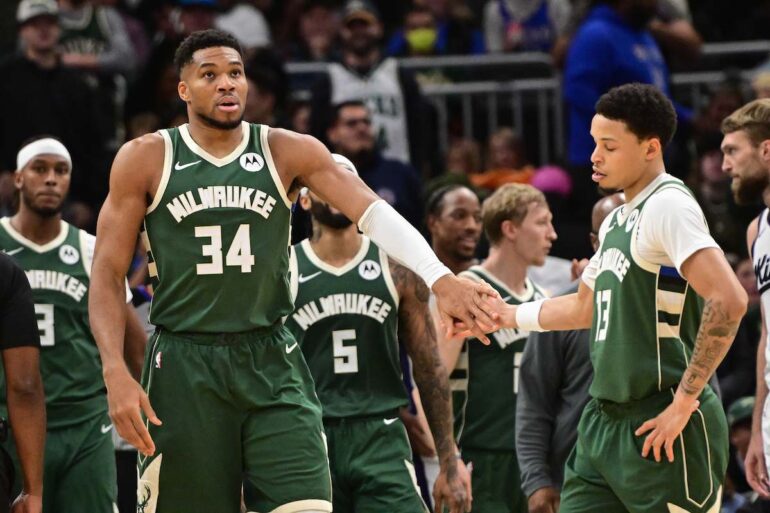
For the first time since 2019, Giannis Antetokounmpo began a Bucks season without an All-Star beside him. Milwaukee’s 2021 NBA title and consistent postseason appearances all came with Antetokounmpo surrounded by some mix of Jrue Holiday, Khris Middleton and Damian Lillard.
That hasn’t hindered Milwaukee through six games — it’s 4-2 with a top-seven net rating and the league’s best half-court offense. Even with Antetokounmpo missing their win over the Golden State Warriors on Thursday, the Bucks are humming.
Producing elite offensive results, especially in the regular season, is a reasonable ask for an Antetokounmpo-led unit, regardless of the surrounding talent. During the past seven seasons, the Bucks still managed an elite plus-8.8 net rating and a 117 offensive rating with Antetokounmpo on the floor without any of Middleton, Holiday or Lillard across more than 4,200 minutes of play.
Milwaukee’s hot offensive start revolves around the unsolvable Antetokounmpo, who’s developed into a historic offensive engine as he enters his 30s. The two-time MVP currently ranks second in the NBA in points per 75 possessions (38.8) on plus-13.7 percent relative true shooting, ranks fifth in assist rate (42.2 percent) and touts the league’s second-highest usage rate (36.9 percent).
The Bucks have previously fielded productive half-court offenses, finishing among the top-seven units in all but one season since 2018 (12th in 2023). They’ve never finished first, though, maxing out at second place in 2020. There’s plenty of season left to play but Doc Rivers’s squad is executing offense with pristine spacing and simple, effective actions to complement its MVP-caliber engine.
Skeptics of Milwaukee’s hot start might point to its third-ranked 3-point shooting (41.2 percent). While Antetokounmpo, Taurean Prince and AJ Green won’t finish the season at a 50 percent clip from deep, the Bucks led the league in 3-point percentage last season and have reached 37 percent as a team for five straight seasons.
Considering transition and put-back plays, the Bucks drop to a still-laudable sixth in offensive rating — they don’t crash the glass hard and aren’t forcing tons of turnovers. Milwaukee plays slow, ranking 24th in average time to shot (12.3 seconds), trusting its half-court offense over transition run-outs.
Tweaking The Formula
Without on-ball star power (aside from one unlikely exception…), the Bucks loaded up on floor spacing around Antetokounmpo. All nine of their regular rotation players are capable shooters at minimum, ranging from spot-up options like Amir Coffey to elite off-ball movers like Green and Gary Trent Jr.
They swapped Brook Lopez for Myles Turner this offseason, which looks like a straight upgrade so far. He facilitates their bread-and-butter five-out offense with a bit more mobility on defense, acting as a seamless front-court partner for Antetokounmpo.
In the past, Antetokounmpo-centric offenses relied on perimeter drive and kicks to generate open threes and drives. To begin this season, Rivers and his staff iterated on that formula, tinkering with a still-heliocentric Antetokounmpo offense. He’s isolating less frequently than any season since his rookie year, logging three possessions per game (compared to 4.9 last season).
Despite a reduction in isolation frequency and effectively no change in pick-and-roll scoring frequency, Antetokounmpo has the ball in his hands during 34.4 percent of his minutes, which is the highest rate of his career. He’s posting up a career-high, league-leading five times per game. What’s with the shift to back-to-basket initiation?
One dominant post scorer surrounded by shooters isn’t a new formula. Teams almost universally throw two or three bodies at his drives, so swapping some of those for post-up initiation might be a bit less taxing on him. His 50 total post-up scoring chances haven’t been remarkably efficient (44th percentile) but the spacing benefits of Antetokounmpo’s post touches are clear.
Time has shaped him into a sage-level facilitator, comfortable throwing high-level passes to cutters and shooters from the post. Most of these assists, though, stem from his sheer gravity paired with excellent outside shooting and thoughtful off-ball movement.
Giannis post passing pic.twitter.com/VilsUp4MRv
— bjpfclips (@bjpfclips) October 31, 2025
Beyond Antetokounmpo’s usual enormous on-ball gravity and shot creation, Milwaukee’s deployment of him as an off-ball player is fueling his best playmaking start. He’s logged 2.3 roll man possessions per game so far, another career-high mark. Similar to boosting post touches, these rolls feed him paint catches more easily than isolation drives.
The Bucks are locating Antetokounmpo on short and deeper rolls that force defenses into no-win situations. Like many modern defenses, the Cleveland Cavaliers shows their screen defenders near the level, which leaves Evan Mobley between helping on Antetokounmpo at the rim or leaving Turner open in the corner.
The reigning Defensive Player of the Year chose the former, of course:

Teams have had little answer for his playmaking from the middle of the floor, with excellent shooters shifting and screening around the arc. Below, notice Turner and Green swapping places before Antetokounmpo’s pass. The weak side of the New York Knicks’ defense on the pick-and-roll morphs into a zone, with Mikal Bridges hugging the nail and Karl-Anthony Towns defending between two shooters.

It might seem inconsequential but that Green-Turner swap counters New York’s defense, knowing Bridges won’t follow Green to the corner. Antetokoumpo reads this all instantly on the catch and Towns has no chance closing out to the flame-throwing Dairy Bird.
A Breakout Star
Beating a full-strength Warriors team littered with stalwart defenders without Antetokounmpo speaks to the health of Milwaukee’s offensive ecosystem. The Bucks don’t win that game without Ryan Rollins’s heroics, stepping up as a makeshift star creator and primary defender on Stephen Curry.
Rollins made plenty of plays independent of his offensive system, nailing tough off-dribble jumpers and knifing to the basket with his elite movement skills and speed. But even with a new creator at the helm, Milwaukee still buoyed him with great spacing and simple yet effective actions.
The Bucks’ three-man actions gave the Warriors’ switch-heavy approach issues all night, spamming double-drag variations like this play, where Green slips to the opposite wing instead of setting a second screen. The ensuing star-caliber drive by Rollins isn’t possible without the confusion that action created:

On the next half-court possession, Milwaukee runs the same action flipped the other way, with Kyle Kuzma as the first screener and Green sneaking out to the wing. The action freezes Jonathan Kuminga and Moses Moody, opening an easy lane for Rollins to drive and create an open three:

Milwaukee shows a nearly identical look on the following possession, this time with Turner as the first screener in Kuzma’s stead. But this time, Green sets a hard screen and rolls to the rim with Turner popping. The Warriors weren’t ready for it and Turner finds airspace for an open shot:

If Rollins’s offensive breakout persists, playoff defenses will have a much tougher time loading up on Antetokounmpo. The Bucks must prove these offensive changes are the new norm and not a quick shock to the status quo. They’ve made the most of an ostensibly thin rotation so far and the results, at least for now, are auspicious.
None of this offensive goodness matters if the Bucks can’t correct their playoff woes, failing to escape the first round for three straight years. Blame injuries, poor coaching or shortsighted roster building but they’ve underperformed in the postseason relative to their talent since their 2021 title.
Defense has bitten the Bucks in recent years because of their offensively slanted rosters and, despite a strong start on that end, this roster still faces some of the same potential limitations. If this Bucks team is the one to break through once again for another Antetokounmpo-led deep run, they’ll go as far as their offense takes them.