
San Antonio Spurs assistant coach Mitch Johnson says Victor Wembanyama has already moved past prospect status and is actively reshaping how every team in the NBA approaches the game.
This is not a developmental story anymore. What Wembanyama is doing to opposing rosters, defensive schemes, and offensive game plans is structural – and it is happening right now.
Spurs assistant coach Mitch Johnson has been emphatic on the point: Wembanyama is not just excelling within the existing framework of NBA basketball. He is forcing the framework to change. Johnson has described the 7-foot-4 Defensive Player of the Year as already “revolutionizing” the game, a claim that carries more weight coming from a coach who watches him reshape practice film every single day.
What Makes Wembanyama Different: The Physical and Technical Profile
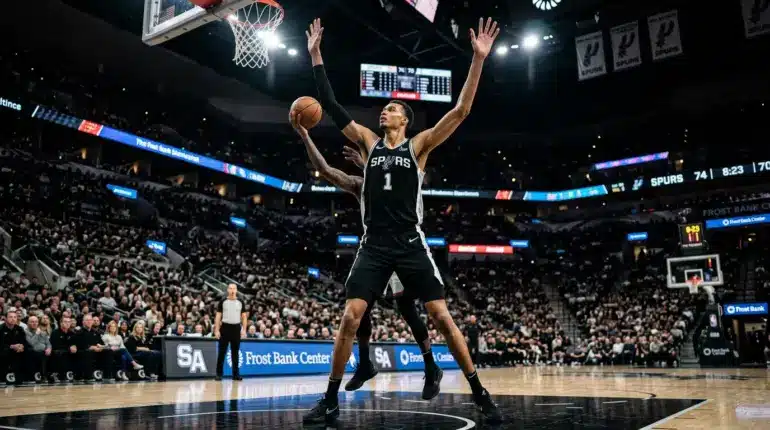
The comparison points break down fast when you try to apply them to Wembanyama. Elite rim-protecting bigs have existed before. So have seven-footers who can step out and shoot. But the combination – elite paint deterrence paired with genuine guard-level perimeter creation – has not existed in a player this size. Ever.
Johnson’s NBA analysis centers on exactly that combination. Wembanyama is being deployed as a five-out hub, capable of initiating pick-and-rolls, handling the ball in transition, and drawing opposing centers away from the rim on the perimeter. That last detail matters enormously – when the defense has to follow him to the three-point line, the paint opens up for everyone else on the floor.
His defensive imprint is equally unmeasurable by traditional stats alone. Opponents have dramatically shifted their shot profiles when facing San Antonio, moving toward low-efficiency mid-range attempts and floaters rather than challenging him at the rim. That is not accidental shot selection. That is a defense being redesigned around one player’s presence before the ball is even inbounded.
How Wembanyama Is Forcing Defensive Scheme Changes Across the League
Johnson has made clear that opposing coaches are not simply adjusting their game plans – they are rethinking their starting lineups. Teams have repeatedly gone smaller specifically to try to pull Wembanyama away from the paint, hoping his length becomes a liability in space. It has not worked. Instead, it has handed San Antonio rebounding advantages and forced opposing bigs into uncomfortable defensive assignments on the perimeter.
The drop coverage that big men have relied on for years becomes nearly indefensible against a player who can legitimately hurt you from 27 feet. Switching is equally risky – Wembanyama punishes mismatches in both directions. He can post up the guard switched onto him, and he can step over the top of any hedge a big tries to execute. There is no clean answer in the current defensive playbook.
This is the NBA Revolution Johnson is describing – not a gradual shift, but a forced adaptation. The other 29 teams are not catching up to Wembanyama. They are scrambling to contain him. That is a meaningful distinction, and Johnson knows it.
The Offensive Side: Guard Skills in a 7-Foot-4 Body
Traditional NBA defensive principles are built around forcing the ball away from primary creators and protecting the rim with size. Wembanyama breaks both rules simultaneously. He is the primary creator and the rim protector on the same possession, depending on which end of the floor San Antonio is operating.
Johnson has been direct about what that means for his team’s offensive ceiling: Wembanyama needs the ball more. He publicly stated that the Spurs have been more successful when Wembanyama’s shot volume is higher, going as far as saying, “He’s got to take more than 15 shots.” The numbers back that up – San Antonio won the playoff games in which he attempted at least 22 shots and lost the games in which he took 16 or fewer. That is not a coincidence. That is a usage-rate argument settled by outcomes.
His Game 7 performance against the Thunder – 22 points, three-of-five from three, seven rebounds, and a dominant defensive presence in a 111-103 win – showed what maximized Wembanyama looks like at the highest stakes. A 7-foot-4 player hitting pull-up threes in elimination games is not something defenses have a prebuilt answer for. It simply does not exist in the scouting manual yet.
What This Means for the Spurs’ Future
The strategic evolution happening in San Antonio mirrors what happens across sports when a player genuinely breaks the mold – every surrounding decision gets recalibrated around them. For the Spurs, that means roster construction designed to maximize spacing around Wembanyama’s five-out role, and coaching philosophy that treats his shot volume as a performance variable, not an afterthought.
Johnson has also flagged a legitimate concern that has nothing to do with scheme: the physicality opponents are using against Wembanyama. He has said directly that teams have made physicality part of their game plan against Wembanyama since his first day in the league, and that the NBA’s officiating has not fully protected him. That is a conversation the league will have to have – because if Wembanyama is reshaping basketball strategy at 20 years old, protecting that asset becomes a league-wide interest, not just a Spurs problem.
San Antonio is still learning how to fully unlock what they have. The coaching staff is shifting from managing his NBA adjustment to systematically building around his basketball-breaking traits. That process has already produced a playoff series win and a Defensive Player of the Year award. The ceiling from here is not yet visible.
The rest of the NBA spent last season trying to figure out how to slow Victor Wembanyama down. They didn’t. The next question isn’t whether he can be stopped – it’s how much further he can go before the league catches up. Based on what Mitch Johnson is describing, that gap is only getting wider.