
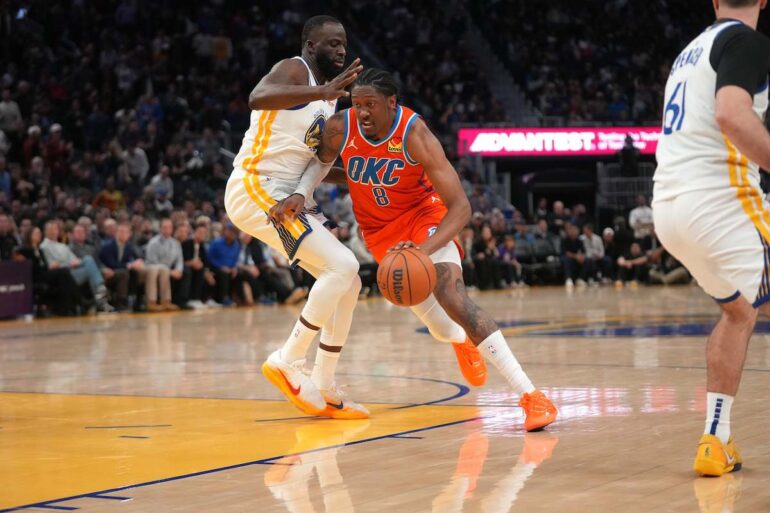
During the first quarter of the Golden State Warriors’ Dec. 2 contest against the Oklahoma City Thunder, Shai Gilgeous-Alexander – having coaxed Brandin Podziemski to switch onto him via a ball-screen – drove toward the paint and immediately kicked to Ajay Mitchell in the weak-side corner after seeing the low man, Moses Moody, saunter into the paint to show help. That left Draymond Green as the weak-side defender splitting the difference between two Thunder players: Mitchell in the corner and Chet Holmgren on the right wing.
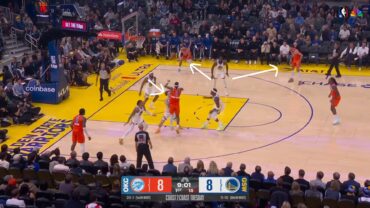
This puts the Warriors’ defense in a precarious position, given the pass to the corner should trigger one or multiple rotations. An elite offensive team such as the Thunder punishes “blender” situations like these with scalpel-like precision. However, the subsequent rotation that follows from Moody and Green – called an “X-out” due to them forming an “X” during Moody’s closeout toward Holmgren and Green’s closeout toward Mitchell – is textbook:

However, Moody’s closeout toward Holmgren – a capable 3-point shooter – empowers the lanky Thunder big to attack off the catch, putting both Green and Moody in a tough position. In Green’s case, he has a decision to make: Should I help off my man, off the strong-side corner, and take Holmgren on his drive? Or, should I trust the weak-side help and stay put? Should I stunt, at the very least?
The answer Green chooses ends up being the first option:

You may have heard of an adage considered a basic defensive rule in basketball circles: Never help off the strong-side corner (the “strong side” being the side of the court where the ball is located – therefore, making the “weak side” the side of the court opposite of where the ball is located).
It’s often considered a hard and fast rule. But as with all hard and fast rules, there are exceptions when it involves an exceptional circumstance, which in this case, is Green, whose pedigree as a defensive savant allows him to get away with its otherwise definitive nature.
However, the consequence of helping off the strong-side corner in this instance is something he can’t avoid – and it indeed hits him and the Warriors’ defense hard and fast:

Jamal Crawford, in his capacity as an analyst in this particular broadcast, made sure to point out Green’s “mistake,” which also informs the league-wide mindset when it comes to strong-side corner help (at least, the mindset ingrained within Crawford most certainly instilled during his 20-year playing career):
— 'Murica Film Room (@muricafilmroom) December 19, 2025
The Concept Of Peel Switching
While Crawford’s assessment is technically correct when considering how teams have historically guarded the strong-side corner, a small peek into a conversation between Warriors head coach Steve Kerr and Moody after a called timeout may have something to do with what Moody didn’t do:

One can only assume what Kerr was telling Moody above. Kerr pointing to the corner may have had something to do with Moody not “peeling” off of Holmgren and switching toward Mitchell in the corner, a maneuver that would’ve looked something like this possession from the Boston Celtics:

When Jaden Ivey drives against Anfernee Simons in the sequence above, Neemias Queta helps off of the strong-side corner. Instead of sticking to Ivey, Simons “peels off” toward the corner and therefore switches onto the man Queta left open by helping.
This maneuver – called a “peel switch” – is a relatively novel way of shutting off a momentary gap often considered a deadly defensive mistake. More and more teams in the NBA are adopting the peel switch, which is a concept that didn’t exist during Crawford’s heyday and certainly did not exist prior to the expansion of the amount of space teams have had to cover as a result of the 3-point revolution.
During an appearance on The Old Man and the Three podcast (then helmed by current Los Angeles Lakers head coach JJ Redick), Trey Murphy III explained in detail how the New Orleans Pelicans covered “stampede” cuts (also known as “boom” drives):
Nick Van Exel, a player I loved growing up, criticized the Pelicans/Dyson Daniels for helping off the SS corner
And he has the credentials over me
But here's Trey Murphy, a current Pelican, saying their scheme is to SS corner peel switch against a stampede cut (aka boom drive) https://t.co/IyfztQYfda pic.twitter.com/xRMidqWCOH
— Bowser2Bowser (@bowser2bowser) May 16, 2024
Like with most defensive concepts, a peel switch is an exceptionally high-level maneuver that requires discipline, awareness and connectedness. Most of all, it must be part of the team’s defensive fabric – i.e., it should be part and parcel of a team’s defensive scheme. A reason why Moody may have failed to peel toward the corner was the rarity with which the Warriors employ the peel switch, translating into his own personal unfamiliarity with its execution.
(In my years of covering the Warriors, I have rarely seen them peel switch on strong-side-corner help-offs. What they have done, however, is employ peel switching on other kinds of help that can be considered one pass away, such as the defensive sequence below from the 2022 Western Conference Finals between the Warriors and Dallas Mavericks.)

Teams such as the Celtics, under head coach Joe Mazzulla’s regime, have been consistently employing peel switches to cover for strong-side help:

The correlation between the concept and the Celtics’ corner three defense – they allow the league’s fourth-lowest opponent corner three rate (8.7 percent) – is undeniable, even with what is widely considered a roster undergoing a transitional period. But they blend their base tendency to peel switch with a combination of floor awareness and knowing where each and every one of their teammates are on the floor at all times, to the point where the need to peel switch is eliminated.

The drive from Norman Powell draws Derrick White over to help — and off of his defender in the strong-side corner. But in the Miami Heat’s process of creating a “two-side” (i.e., two offensive players spaced outside the line on the wing and corner), Jaylen Brown is there to act as the defender splitting the difference between the wing and the corner. Powell’s drive is stifled with aid from White’s strong-side help — without the need for peeling off.
The Heat, which have consistently been a top-level defense under head coach Erik Spoelstra, are also known to employ the peel switch:

Of course, the best defensive unit in the league is also familiar with the peel switch, which helps the Thunder close gaps quickly and shuts off all possible options, keeping them even-keeled amid the frantic nature of “blender” rotations:

The Veer-Back Switch: A Close Cousin Of The Peel Switch
During Game 4 of the first-round clash between the Indiana Pacers and Milwaukee Bucks last season, a slot ball-screen featuring Tyrese Haliburton and Myles Turner was defended with drop coverage by Brook Lopez. Instead of rolling to the rim, Turner stood pat behind the line, with no one rotating toward him. Lopez was too deep back in his attempt to contain Haliburton’s drive, with Pat Connaughton opting to stick to Haliburton (who had just thrown Connaughton around for a loop with a hesitation left-to-right cross while rejecting the screen in the process).
Naturally, Haliburton finds the open Turner. Connaughton realizes his mistake and tries to close out toward Turner. But having been drawn in by Haliburton’s drive, the close-out distance is greatly increased. Instead of the late switch and closeout being a precautionary measure, it turns into a desperate one:

With Turner being given a wide-open three, what should the Bucks have done in order to take it away? The possibility of having a third defender rotate onto Turner would be countered by a swing pass to the man left open by the third defender, which is also not a scenario the Bucks would’ve wanted.
There’s also the option of Connaughton – instead of following Haliburton all the way inside in his attempt to funnel the ball toward Lopez – “veering back” much earlier toward Turner and closing out. This type of switch is often called a “veer-back” switch, a counter teams employ mostly against bigs who pop out beyond the arc.
For example:

Julius Randle, after setting the screen for Anthony Edwards, pops out beyond the arc, with Kevon Looney stepping up to the level of the screen. Lindy Waters III attempts to recover toward Edwards before realizing Randle has parked himself outside the arc and immediately veers back to take Randle. Seeing a smaller defender switching onto him, Randle attempts to take Waters to the rim but his drive is stifled.
Veer-back switching is, for all intents and purposes, a peel switch in the sense the screener’s defender is helping on a drive by the ball-handler while the initial on-ball defender “peels off” in order to take the screener, who either may have popped or rolled.
Whenever the screener opts to roll, veer-back switches are still an effective way of taking away the option of dumping the ball to the roll. Of course, the caveat of veer-back switching a roll is the possibility of the roll man exploiting a mismatch underneath the rim.
Which is why, in the possession below, Rob Dillingham seeks out a “scram” switch – bumping him off of the bigger roller and solving the problem veer-back switching creates:

These defensive maneuvers are hard to pick up in real time for most casual observers, let alone analysts and film buffs such as myself. However, it is most certainly proof of the high-level defensive play the modern NBA requires, mostly as a response to the high-level offensive play that has widened the floor and increased the difficulty level for defenders.
As risky as these maneuvers can be – especially whenever they are botched – it can be incredibly rewarding to execute peel-offs with near-perfect precision, just as it is both rewarding and entertaining to watch and appreciate the little nuances that make the NBA the pinnacle of professional hoops.